



Modern-day treasure hunters

Advertisement
Hey there, time traveller!
This article was published 30/06/2014 (4283 days ago), so information in it may no longer be current.
In times of yore, you needed a wrinkled, stained treasure map and a strong shovel to uncover buried treasure.
Now all you need is a smartphone or tablet loaded with an app, and a pencil to record your find in a geocache’s logbook. After that, you can report your discovery online at www.geocaching.com to keep track of the number of caches you’ve uncovered.
Headingley geocacher Robert Burch — or markzsalmon, his geocaching alias — said this activity, which began about 14 years ago, has over six million participants who scour the planet to search for the more than two million hidden caches hidden across the globe.
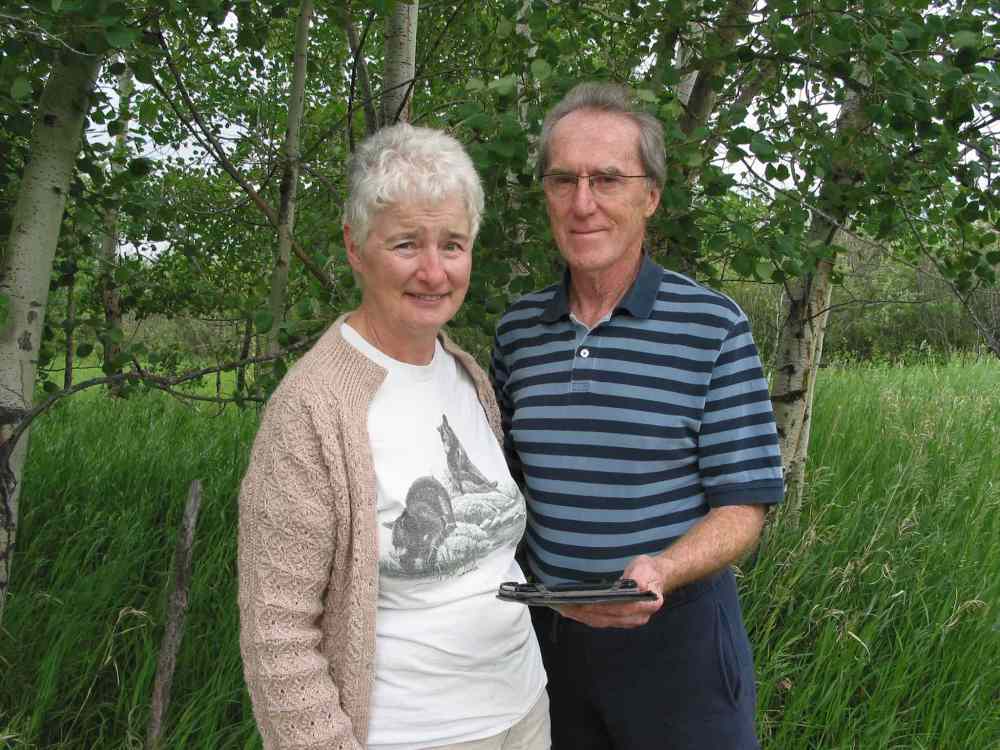
GPS devices were originally used to locate caches, but now many devotees like Burch and his wife, Evelyn, simply download an app that allows them to quickly see the co-ordinates of caches reported to be located within a specific area. Once they decide which cache to search for, their device’s screen shows a compass with the arrow pointing toward the cache and the number of metres between the device and the cache itself.
Burch typically loads information on up to 200 caches at a time on his tablet before he sets off.
“That doesn’t take me any time at all,” he said.
Burch displayed an online map showing the number of geocaches recorded within the RM of Headingley. The dots were aligned along most of the main roadways.
“Headingley is pretty good for geocaching,” he said, adding that there are more than 200 in the area, with about 30 along the Grand Trunk Trail that runs along the southern edge of the municipality from the Perimeter Highway to Beaudry Park in the RM of Macdonald.
“Every cache is different. Some are easy to find and some are hard,” Burch said.
He should know about the level of difficulty, as he and his brother Peter (Stormcrow50) have created and hidden some of the local caches.
While you can buy premade containers for caches, Burch prefers to create his own from Ziploc bags and plastic containers made waterproof with electrical or duct tape. He showed off a small cache made from a lip balm pot and an even smaller one made of folded plastic that’s just big enough to hold a piece of paper used as a log book.
It seems that many geocachers enjoy the challenge of creating and hiding caches as much as they do discovering them.

“New ideas come out all the time,” he said, recalling that he found one inventive cache that was designed to look like a pedestrian crossing push button.
Burch has passed on his love of geocaching to Evelyn’s family in Ireland, as the couple visit there regularly. He said he and a nephew spent a memorable day climbing up the sides of mountains to locate a few caches.
Geocaching can be done individually or in groups, and there are variations such as nighttime geocaching, using a canoe, snowmobile or bike to arrive at a cache, placing small items that can be traded in a cache or larger items, called travel bugs, that are tagged and tracked online as they make their way from cache to cache. Some caches are placed in wheelchair-accessible locations and can be accessed by car.
Burch said he most enjoys the logistical challenge and exercise that geocaching brings for him personally. He gets out daily to check on the caches he has hidden or to discover new ones.
“The more I go out, the more I see young people getting involved,” he said.
Facebook.com/TheHeadlinerWPG
Twitter: @CanstarHeadline
Andrea Geary
St. Vital community correspondent
Andrea Geary was a community correspondent for St. Vital and was once the community journalist for The Headliner.
Our newsroom depends on a growing audience of readers to power our journalism. If you are not a paid reader, please consider becoming a subscriber.
Our newsroom depends on its audience of readers to power our journalism. Thank you for your support.
Andrea Geary
St. Vital community correspondent
Andrea Geary was a community correspondent for St. Vital and was once the community journalist for The Headliner.
Our newsroom depends on a growing audience of readers to power our journalism. If you are not a paid reader, please consider becoming a subscriber.
Our newsroom depends on its audience of readers to power our journalism. Thank you for your support.
Advertisement Advertise With Us
Advertisement Advertise With Us