



A look behind the scenes at ASD

Advertisement
Hey there, time traveller!
This article was published 05/08/2014 (4269 days ago), so information in it may no longer be current.
There’s nothing like having the chance to go backstage and get the real goods from the horse’s mouth.
That’s what Assiniboia Downs (ASD) offers during its monthly backstretch lunch tour held the last Sunday of June, July and August.
It’s an early start – 9:15 a.m. – on a Sunday, but worth the lost pillow time.
On July 27, I was one of a group of 15 people who signed up for the two-hour walking tour that starts at the guest services desk in the clubhouse’s concourse. Our group’s ages ran from about 10 to 85, including a grandmother with two young grandchildren visiting from Calgary, a father and two teen daughters who are members of a rural 4-H equestrian club, and a grandfather and grandson, both regular horse racing fans at the Downs.
ASD receptionist Samantha Goulet, a Westwood resident who formerly lived in Sanford, and paddock host Rob MacLennan, who also lives in Westwood, led our tour.
Photo finish still used to determine winners
We start with a stair climb to the grandstand’s upper deck to get an inside view of the press box and race announcer’s booth. MacLennan describes how the announcer stands holding a mic and pair of binoculars to watch the track and report on the race.
He says media coverage of live ASD racing has dwindled over the 56 years since the track opened at its current location on the western edge of Winnipeg.
“We have a really long stretch,” MacLennan says, while looking out over the 6.5 furlong — or 13/16th of a mile — track, explaining the stretch is the straight section of track where horses can really pick up speed.
He points out the wooden posts situated next to the track on which cameras are mounted to verify horses’ speeds. Photos are still taken at the finish line since they are more reliable than an electronic finish measurement.
Dining room offers prime rib, tableside betting
Goulet then leads us back into the clubhouse and takes the adults in our group on a tour through the VLT lounge, with its 140 machines. There are also 40 private carrel desks with TVs for betting on simulcast thoroughbred and harness races at tracks across North America. Like the adjacent dining room, this area is open every day of the year except Christmas.
All diners in the Terrace Dining Room get a good view of the entire track, and those in the formal dining area are able to enjoy tableside betting along with their food and drink.
“We have a Red Seal executive chef,” Goulet says.
The dining room’s specialty is prime rib.

“We sell the most prime rib in North America,” she says.
Jockey Nolan shares tricks of the trade
From there, MacLennan takes us into the jockeys’ quarters, an area normally off limits to the public. Veteran jockey and a two-time leading rider at ASD, Paul Nolan, meets us and describes how jockeys’ weights are checked before and after a race.
The jockeys are weighed when dressed in their riding gear and holding a lightweight saddle that has pockets for extra weights. Nolan says his own weight varies between 112 and 114 pounds.
Showing off his special racing saddles, Nolan says one weighs just six ounces and the other 1.5 pounds.
“It looks small but you get used to it,” Nolan says.
The Englishman has been riding for 50 years, beginning when his father, who was also a jockey, first put him on a horse.
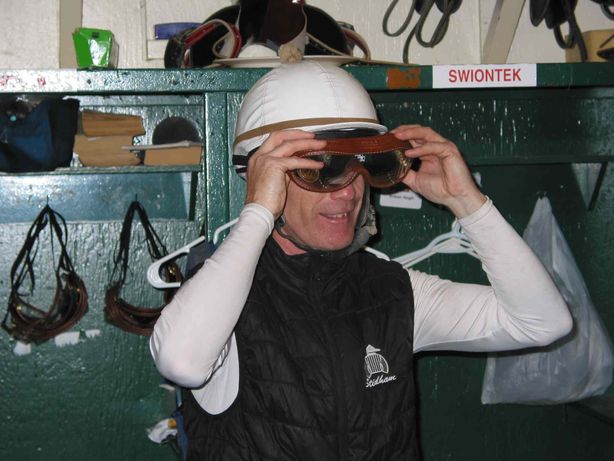
He demonstrates how the flexible goggles used to keep dirt out of a rider’s eyes are layered over each other and carefully placed with the elastic at the back of the helmet, allowing him to quickly use one hand to flip down the top pair as the race progresses and they get dirty.
“I always have an extra set,” he says, and he can go through up to five pairs in one race if the track is muddy.
Without these goggles, Nolan says it would be impossible for a jockey to see where his horse was heading.
“You can’t see anything. Your eyes are watering; you’re blind.”

He described how important it is for a jockey to be able to see what the horse and rider ahead are doing, as subtle signals — such as another jockey’s hand position or the set of a horse’s ears — will provide a clue as to their next moves.
A lightweight flak jacket, first introduced in the 1990s, is now standard equipment for jockeys since it offers them some protection if they are thrown off a horse and trampled.
“Once you get run over a few times, you like (the jacket),” he jokes.
All jockeys use a light leather whip that doesn’t hurt the horse, but instead it’s used to shock them into a faster pace.
Each of the 17 jockeys now racing at ASD have their own equipment space. This year, there is only one female jockey and she has her own private dressing room. In previous years, there have been as many as three women racing at ASD.
“When you put the silks on, you’re the same as everyone else,” Nolan says.
Like many athletes, Nolan is superstitious, especially on race day.
“I’ve got a set routine I do every day,” he says. This includes spending some time in the steam room located next to the dressing area.
It doesn’t take much prompting to get Nolan to tell about one of his many experiences on the track. He describes how he figured out how to get a balky horse to pick up speed at just the right time by being careful to remain motionless until he wanted the horse to take off. He was able to use this trick to win a few races.

“If you know something, you keep it quiet,” he says.
Starting gates pose a hazard
He’s had his share of accidents, with the worse being one in which he cracked two vertebra and smashed a third.
“You can only make it (horse racing) so safe,” he says. “The most dangerous part of this game is the gates.”
We were able to see the starting gates and watch how suddenly the doors open, releasing the horses and their riders from the narrow chutes.
“It’s like sitting on a stick of dynamite,” Nolan says, adding that an agitated horse can crush a rider’s leg against the side of the chute. He once had a leg broken and needed the gate handlers’ help to prevent his other one from being broken as well.
We then walk to the backstretch, the part of the grounds where the barns, training rings and staff quarters are located. MacLennan says many of the seasonal workers who clean the barns, groom, feed and water horses come from Caribbean countries. They live in small motel-style rooms for the race season which begins in May and runs until the end of September.
Although the 11 barns can hold over 1,000 horses, MacLennan says there are only about 500 horses on site now.
Dedicated trainers log long hours
In one barn we meet trainer Blair Miller, originally from Russell, Man., who is hired by horses’ owners to work with their animals.
“It’s seven days a week year-round,” he says. “You have to love horses.”

The horses he’s now training all look beautiful, and were happy to eat carrots fed to them by tour participants. But Miller says they vary widely in purchase price. He pointed out a two-year-old that was recently bought for $5,000, while another horse in the same barn cost its owner $68,000.
Miller says he usually winters at tracks in warmer U.S. states, but for racing action, his favourite track is Woodbine in Toronto.
He would like Manitobans to realize that even though horse racing isn’t as popular or common here as it is in other areas, it is still an important part of the provincial economy.
The tour concludes with a lunch at Charley’s Diner in the backstretch.
Information on the backstretch tour is available at http://www.assiniboiadowns.com/contests-promotions.cfm or call 204-885-3330.
Facebook.com/TheHeadlinerWPG
Twitter: @CanstarHeadline
Andrea Geary
St. Vital community correspondent
Andrea Geary was a community correspondent for St. Vital and was once the community journalist for The Headliner.
Our newsroom depends on a growing audience of readers to power our journalism. If you are not a paid reader, please consider becoming a subscriber.
Our newsroom depends on its audience of readers to power our journalism. Thank you for your support.
Andrea Geary
St. Vital community correspondent
Andrea Geary was a community correspondent for St. Vital and was once the community journalist for The Headliner.
Our newsroom depends on a growing audience of readers to power our journalism. If you are not a paid reader, please consider becoming a subscriber.
Our newsroom depends on its audience of readers to power our journalism. Thank you for your support.
Advertisement Advertise With Us
Advertisement Advertise With Us