


Canola pioneer reflects on crop’s history
Canadian scientists were able to develop ‘double-low’ canola varieties

Advertisement
Hey there, time traveller!
This article was published 28/03/2017 (3485 days ago), so information in it may no longer be current.
Recent visitors to a travelling exhibition highlighting the history of Canada’s canola industry were honoured to also meet one of the industry’s pioneers, Dr. Keith Downey.
The exhibition was shown at the Canola Council of Canada’s conference in Winnipeg from March 7 to 9, which Downey attended.
It includes a photo of Downey taken as a young researcher at the University of Saskatchewan taken about 50 years ago. He and University of Manitoba scientist Baldur Stefansson are acknowledged as the men who were able to transform rapeseed into canola — Canada’s largest cash crop.
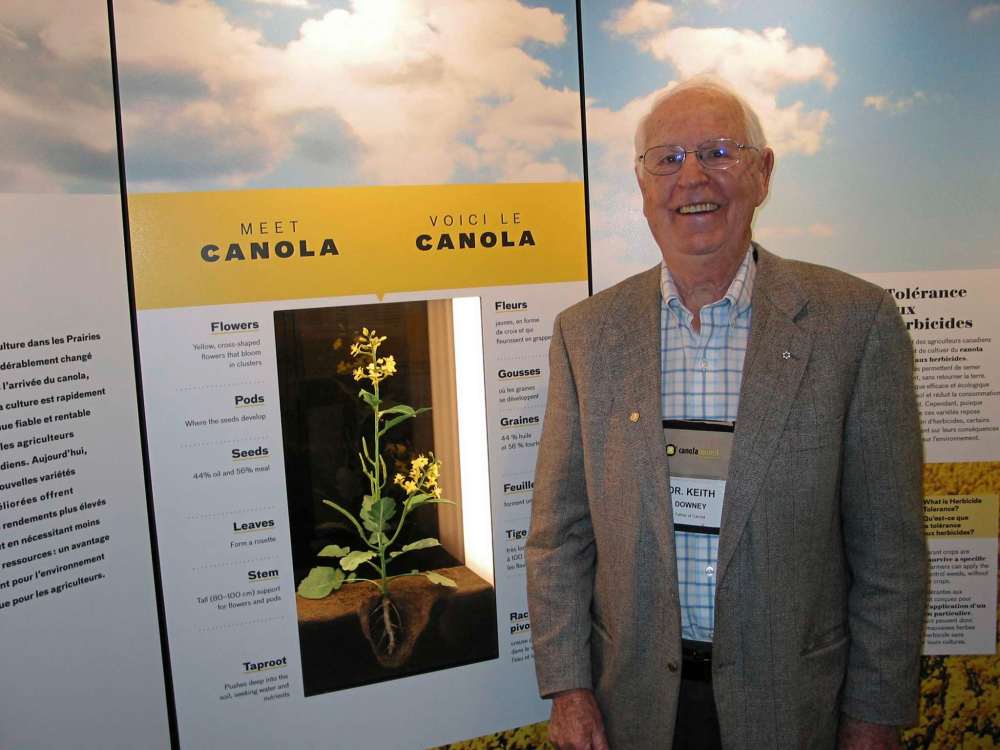
“It was nice to see and to get that kind of recognition, Downey said. “I wanted to make a lasting contribution to Canadian agriculture.”
Downey was named as an officer of the Order of Canada in 1976, received honorary doctorates in science and law and many national and international agriculture industry awards.
Stefansson, who died in 2002 at age 84, was named an officer of the Order of Canada and was also given the title of professor emeritus by the University of Manitoba in 1985. He also received many industry awards.
He and Downey were inducted into the Canadian Agricultural Hall of Fame in 2002.
“We were friendly competitors”, Downey said, adding that the two shared rapeseed germplasm for use in their research, as well as their knowledge about rapeseed genetics.
Early research begins
The first rapeseed research and breeding program dates back to the 1940s, with Dr. William J. White’s work at the Dominion Forage Laboratory in Saskatoon.
The end of the Second World War brought a huge drop in rapeseed acres in Canada from 80,000 in 1948 to 400 in 1949 as demand fell for rapeseed oil for industrial use.
Researchers decided to create a rapeseed variety that contained low erucic acid and glucosinolates (termed ‘double-low’) so that it could be a domestic source of edible oil for human consumption and meal for animal feed.
Concerns over possible links between cardiac problems and erucic acid content and the pungent smell and taste created by glucosinolates, prompted the move to reduce the levels of each.
Downey’s involvement with the crop began at just 14, when he was hired on a part-time basis to help tend the plots at the Dominion Forage Laboratory.
“I can remember hoeing there,” he said. He worked at the research facility throughout his high school and university years, learning about White’s research work.
After earning a master’s degree in 1952, Downey began work as an alfalfa breeder in Lethbridge, Alta. He was called back to Saskatoon in 1957.
“When I walked in the door, they said, ‘Here, you can take this little rapeseed program too,’” he said.
The push for ‘double-low’
Downey and Stefansson’s research focused primarily on Argentinian and Polish rapeseed varieties. Stefansson discovered a low erucic acid German variety and Downey transferred the gene to an Argentinian variety that was released as the low-erucic acid variety ORO in 1968.
The race for a double-low variety heated up soon after. Downey recalls an international rapeseed congress in Quebec in 1970 at which Canadian researchers learned that international buyers wanted lower erucic acid. Health Canada was also urging a switch to low-erucic varieties.
“There was considerable fear that we would lose our markets,” Downey said.
He and Stefansson had low-erucic varieties multiplied in plots in California before introducing the seed to Canadian farmers.
The push was then on to develop low-glucosinolate varieties.
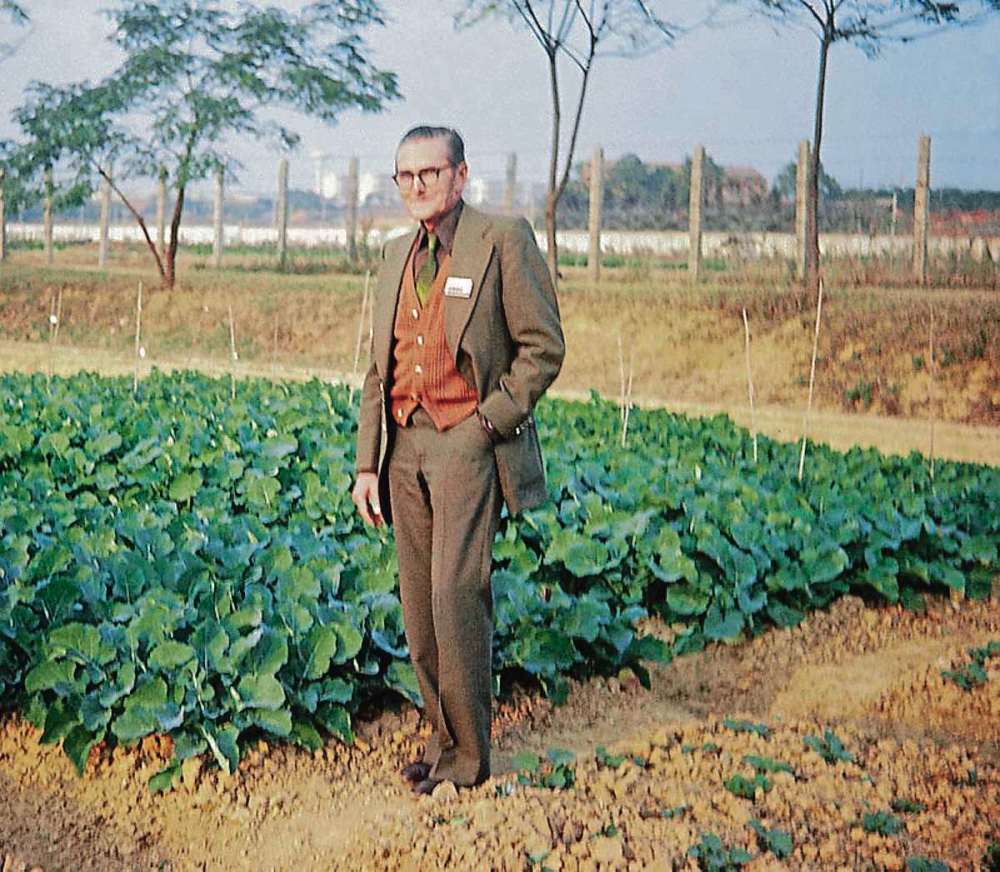
Stefansson developed ‘Tower’ from an Argentinian variety and it was registered in 1974. The new strain was well-suited to growing in southern Manitoba and southeastern Saskatchewan. Downey’s team bred the faster-maturing ‘Candle’ from a Polish variety. It was registered in 1977 and was well-suited for northern growing areas.
Canola’s popularity grows
Downey said the new rapeseed varieties proved popular.
“Rapeseed became attractive because it was a cash crop.”
At this point, the rapeseed industry was looking for a way to distinguish the new crop with a name.
Downey said it could have been called canbra (for Canada and the plant’s genus Brassica) but that name was taken. It was named canola (Canadian oil, low acid) in 1978. The Rapeseed Association of Canada changed its name to the Canola Council of Canada in 1980.
Downey said the introduction of herbicide-tolerant and hybrid varieties helped increase yields, and believes future varieties will further push yield.
“I don’t think we’ve exhausted the possibility of increasing seed yield,” he said.
Information on the Canola Council’s website states a goal of increasing average yield to 52 bushels per acre by 2025. The average yield for 2016 was 42.3 bushels/acre.
Canadian farmers have learned that proper crop rotation is necessary to help reduce pests and invasive weed species.
Downey said clubroot protection and blackleg resistance are now research issues. Clubroot is a disease of the Brassica family that has seriously damaged canola crops in Alberta. Blackleg is a fungal disease that can also reduce yield and kill plants.
Research into changing canola’s fatty acid composition to heighten the Omega-3 content is also underway.
“It’s still a very exciting crop,” Downey said.
The Canola Council’s history timeline can be found at http://canolahistory.ca
Andrea Geary
St. Vital community correspondent
Andrea Geary was a community correspondent for St. Vital and was once the community journalist for The Headliner.
Our newsroom depends on a growing audience of readers to power our journalism. If you are not a paid reader, please consider becoming a subscriber.
Our newsroom depends on its audience of readers to power our journalism. Thank you for your support.
Andrea Geary
St. Vital community correspondent
Andrea Geary was a community correspondent for St. Vital and was once the community journalist for The Headliner.
Our newsroom depends on a growing audience of readers to power our journalism. If you are not a paid reader, please consider becoming a subscriber.
Our newsroom depends on its audience of readers to power our journalism. Thank you for your support.
Advertisement Advertise With Us
Advertisement Advertise With Us