


RCMP police dogs have big impact
Head of provincial service stationed in East St. Paul

Advertisement
Hey there, time traveller!
This article was published 03/07/2018 (2890 days ago), so information in it may no longer be current.
For dogs in the Royal Canadian Mounted Police, public service isn’t a job, it’s their life.

“Work is his fun,” Sgt. Kent MacInnis, the non-commissioned officer in charge of the RCMP’s police dog service in Manitoba, said of his partner, Eddie. “Eddie is a highly driven dog that wants to work. He needs tasks every day. That’s his fun.”
Stationed at the Royal Canadian Mounted Police detachment in East St. Paul, MacInnis and Eddie — a German shepherd bred and trained for police work at the RCMP’s dog service training centre in Innisfail, Alta. — are among seven dog service teams in Manitoba, and approximately 130 nationwide.
“It’s a labour of love,” MacInnis, who has been with the RCMP for 18 years, said. “I don’t even like calling this a job, it’s a lifestyle more than an occupation.”
Breeding and training
German shepherds in the RCMP’s service are bred and trained exclusively as working dogs.
“Our dogs are trained to track, first and foremost,” explained MacInnis. “That’s our bread and butter. They’re also trained to search for crime scene evidence, missing persons, narcotics or explosives.”
Bred for attributes like health, performance, aptitude, drive and work ethic, training for the RCMP’s police dogs begins shortly after they are born in “the Kennels” in Innisfail. Up until 1999, the RCMP had purchased service dogs for training from Europe or the United States.
“It became clear that initiating our own breeding program would be most cost effective,” Staff-Sgt. Grant Hignell, program manager of the Kennels in Innisfail, explained. As a result of their breeding program — the second-largest for working German shepherds in the world — the RCMP hasn’t had to buy a dog for training purposes since 2009.
“Our goal is 100 to 110 live births per year,” said Hignell, who was an RCMP dog handler for 28 years before moving to the Kennels full-time two years ago. “That gives us a pool for meeting our needs.”
At six weeks, the dogs are assessed for their ability to work in the field. Those who pass the first test are then sent out to apprentice dog handlers (known as quarry apprentices) across the country.
“The puppies come to them under the tutelage of the local dog handler and are raised with the hopes and dreams that someday that dog will become a police service dog,” MacInnis said. “Our quarry apprentices will start working on the basics of tracking right away. For a puppy that can be as much as chasing and biting a rag. The tasks we ask them to perform become more and more difficult as the dog ages and matures and grows.”
It’s such a special relationship. My partner is like my best buddy.
The dogs are re-assessed at four, eight and 12 months. Those who don’t make the grade are sold as a cost recovery measure for the program. Depending on when the dogs are cut from training and why, they can be sold as common pets, or as specialty dogs to other law enforcement or private agencies.
“Other agencies might only have dogs do one thing, so they could use those dogs,” MacInnis said. “Maybe the dog wasn’t great at tracking, but could search well. You’d be surprised to know the different things dogs can be trained to do.”
Those dogs who pass muster are sent back to the Kennels between a year and a year-and-a-half to begin their formal training in earnest. Between two and five months later, dog and handler are ready for assignment.
“We feel we have a very successful program, borne out by the fact we have other agencies coming here to see our program,” Hignell said, adding that the program has a 95 per cent success rate for the dogs who return to the Kennels for training at the year mark.
Putting in the work
In Manitoba, the RCMP’s seven dog service units take part in approximately 600 to 900 cases a year. Between those cases, both dogs and handlers are constantly training.
“We train every week,” MacInnis said. “We send the prospective handlers away for training too. If you ever stop learning doing something like this, you’re either a fool, or you shouldn’t be doing this.”
While police service units are stationed locally, they are integrated into both the provincial and national RCMP network.
“We can be deployed anywhere as needed,” MacInnis explained. “We are required sometimes to travel great distances to assist with whatever kind of operation is going on.”

MacInnis and Eddie, who is trained to search out explosives, recently returned from working for three weeks in Quebec during the G7 meetings in early June.
“A lot of the time, we live out of the truck for weeks at a time and it’s just he and I doing our thing, responding to calls as needed.”
Manitoba is home to three RCMP districts, with seven police service teams spread evenly around the province. MacInnis said that East St. Paul is ideally situated for housing two of the East District’s three police service teams.
“It’s right on the Perimeter Highway. We can get anywhere in the East District using Highway 59 or the Trans-Canada, the Perimeter Highway or Highway 75. It’s all about quick access.”
Being close to Birds Hill Provincial Park also has its benefits.
“On my worst day in the office, maybe a paper heavy day, unlike people who work in an office full-time, I have the ability to just go take my police dog for a long walk in the country, just the two of us,” MacInnis said. “It’s good for your mental well-being and that of the dog.”
On the hunt
The RCMP’s police dog service is most often used to help find missing persons or track criminals.
If you ever stop learning doing something like this, you’re either a fool or you shouldn’t be doing this.
“We are a time sensitive unit,” MacInnis explained. “We’re always fighting time to get a good track. We’re always trying to get to a scene as fast as safely possible.”Being time sensitive, weather can play a huge role in whether or not a tracking mission is successful. In extreme weather, smells decay quickly.
“Your ideal weather situation would be a light mist at about plus 3 or 4, in the bush, which holds scent more, and an overcast sky,” MacInnis said. “But it’s possible that by the time we get there, there’s a decay factor, which makes it so much more difficult to locate that person.”
When tracking is no longer an option, the police dog service begins searching.
“We cut our dogs into the wind and work into it, with hopes that dog winds the missing person,” MacInnis explained. “We all have an individual scent that’s unique to ourselves. When searching, we hope that the wind will blow the scent into the dog’s scent cone and then the dog will follow that until he finds the person.”
Dogs trained to find narcotics, explosives, or human remains locate their targets in the same way.
“The dog locates it with their nose, the dog sits, and we reward them with a ball,” MacInnis said, adding that RCMP dogs use passive indication (i.e. sitting) rather than aggressive indication. “We don’t want them ingesting or chewing or biting those things.”
A full-time member of the pack
For police service dogs and their handlers, there is no “punching out,” at the end of a shift.
“When other people leave their job and go home, it’s over,” MacInnis said. “I’ve always got that living, breathing thing I have to look after. He’s always with me, he’s always a consideration.”
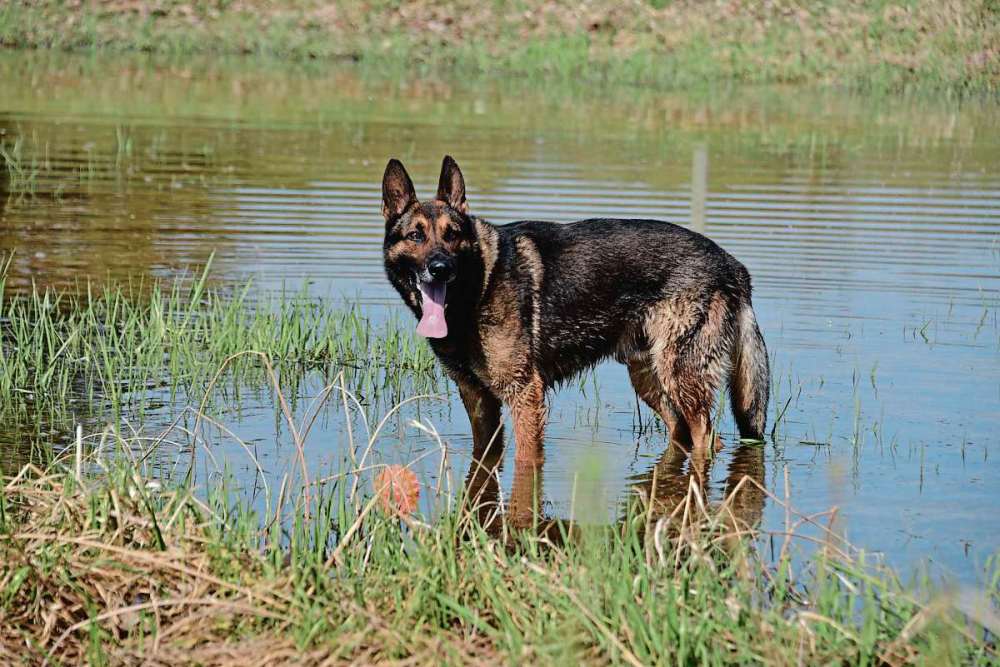
And while Eddie is a working dog, first and foremost, he has also become a member of the MacInnis family.
“It’s a completely different relationship than what you’ve have with a normal house pet,” MacInnis explained. “When he’s at home, that’s his downtime. I do bring him into the yard, especially this time of year. It’s good for his mental health, to get his balance. Dogs are pack animals, right? They need to belong.”
Eddie is the second partner MacInnis has had since he became a dog handler for the RCMP in 2006.
“My first dog’s name was Rev,” an emotional MacInnis recalled. Rev died in 2013 at the age of eight. “That relationship is truly special. Arguably, I spend more time with my dog than my wife and children.”
And while the police dog service is demanding, MacInnis wouldn’t have it any other way.
“It’s just such a special relationship,” admitted MacInnis. “On my worst day, my dog is always happy to see me. My partner is like my best buddy. We’re out there doing nuts and bolts police work, with an immediate impact on society at large.”
Sheldon Birnie
Community Journalist
Sheldon Birnie is a reporter/photographer for the Free Press Community Review. Email him at sheldon.birnie@freepress.mb.ca or call him at 204-697-7112
Our newsroom depends on a growing audience of readers to power our journalism. If you are not a paid reader, please consider becoming a subscriber.
Our newsroom depends on its audience of readers to power our journalism. Thank you for your support.
RCMP service dogs in Manitoba
There are currently seven RCMP service dog teams assigned to Manitoba’s three districts. Each dog specializes in tracking, and in searching for something in particular.
East District
• Eddie (East St. Paul) — explosives;
• Enzo (Steinbach) — narcotics.
North District
• Ennox (The Pas) — narcotics.
West District
• Genie (Brandon) — one of a small number of human remains trained dogs in Canada;
• Portage la Prairie — handler is currently training a new dog, graduation expected in August.
At press time, a competition was being held to fill positions in East St. Paul and Thompson. The successful candidate for East St. Paul will be working under MacInnis, and the new police service dog will also be trained to search out explosives.
— Staff
Sheldon Birnie
Community Journalist
Sheldon Birnie is a reporter/photographer for the Free Press Community Review. Email him at sheldon.birnie@freepress.mb.ca or call him at 204-697-7112
Our newsroom depends on a growing audience of readers to power our journalism. If you are not a paid reader, please consider becoming a subscriber.
Our newsroom depends on its audience of readers to power our journalism. Thank you for your support.
Advertisement Advertise With Us
Advertisement Advertise With Us