


Transcona’s buried past
Cemetery a key to community’s history

Advertisement
Hey there, time traveller!
This article was published 29/06/2017 (3381 days ago), so information in it may no longer be current.
With the City planning to improve drainage issues in the Transcona Cemetery (5014 Dugald Rd.) and fix up the crumbling “chapel,” local residents and historians are hoping the rich history of the quarter section, which is found just over the city line in the RM of Springfield, will get some time in the spotlight.
Suthwyn, Manitoba
“That land was originally farm land,” Jennifer Maxwell, assistant curator at Transcona Historical Museum (141 Regent Ave. W), told The Herald. “It was owned by a Peter K. Dickson around late 1890s. It was the site of the original post office for about 10 years.”
Suthwyn was a farming community made up mainly of English and Scottish immigrants.
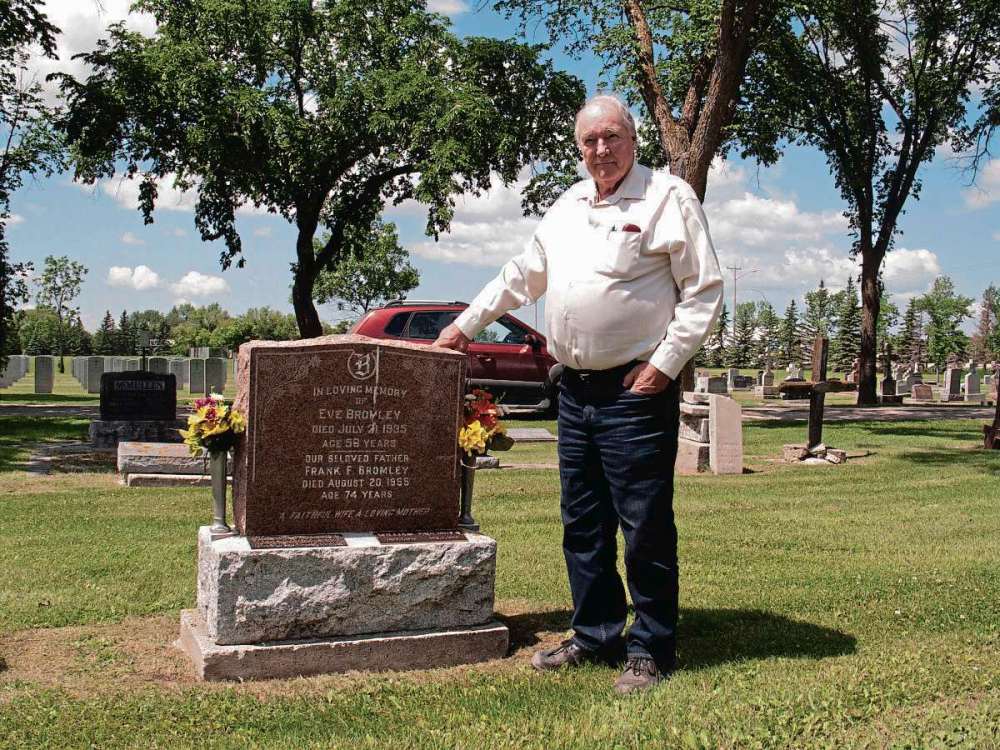
“Suthwyn was more to the southeast of Transcona, though some of Transcona does fall within its boundaries,” Maxwell said. “It had a school, and it had a church, the Presbyterian Church that later became the mortuary in the cemetery. There was a post office, maybe two to three different dairies operating out of Suthwyn.”
“The school was dead centre of the floodway down there,” said Bill Paulishyn, a former high school teacher who was born in Transcona in 1941. His family originally settled in the Suthwyn area. “There’s a lot of old history here.”
According to Springfield: 1st Rural Municipality in Manitoba 1873-1973, a local history published by the Dugald Women’s Institute in 1974, the Suthwyn Church was built in 1900 on property donated by Dickson. The “stately building of solid brick with a sixty-foot tower over the front entrance” officially opened on “the second sabbath of December.”
“The original church was over there,” Paulishyn explained on a sunny day at the cemetery, pointing towards the intersection of Dugald Road and the Perimeter Highway. “It was right where the curve is there to go onto the Perimeter. My uncle lived half a mile down, so I ran by many a time when that (church) basement was still there.”
Transcona incorporated
Dickson sold his land to a developer in 1908. And he wasn’t the only one selling off land at the time. According to Springfield: 1st Rural Municipality, “many families sold their land and moved away” at that time, whether to Transcona or elsewhere. Between 1912 and 1914, attendance at the Suthwyn Church began to diminish, thanks to the establishment of the CN yards in the nearby town of Transcona, which incorporated in 1912.
“When the CN came through,” Paulishyn said. “This was just a swamp back here behind us, so they came through where the land was cheaper.”
In March 1914, Transcona bought Dickson’s former land to build their cemetery. According to a Transcona Times article from April 10, 1914, the town paid $655 an acre for the 38.9-acre site.
On July 18, 1914, the body of Soren Sorenson was the first interred in the new cemetery. Twenty-one others were buried that year.
In 1916, the Suthwyn Church discontinued its services. The town of Transcona bought the “beautiful brick building” for $600, though it stood empty and unused for years.
“The church was only really used a few years before it closed down,” Paulishyn said. “Knox, Suthwyn, north Springfield United all became one big church. That’s why it’s called Transcona Memorial, as a memorial to all those other churches.”
Transcona mortuary and chapel completed
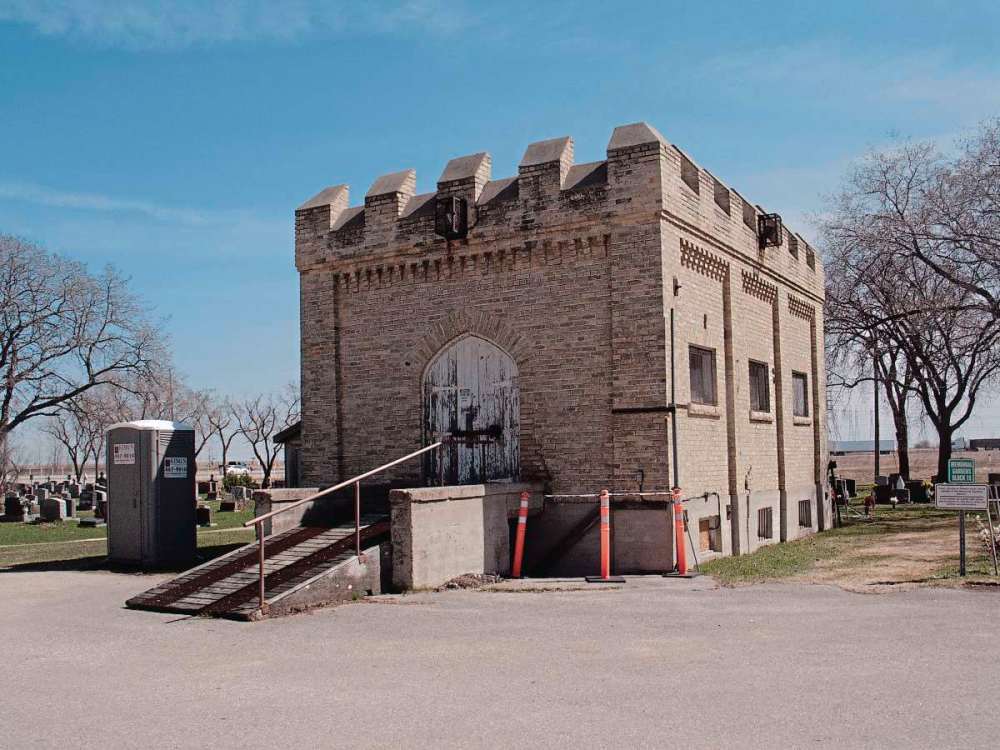
In 1932, Transcona’s cemetery committee had the old Suthwyn Church demolished. The bricks were salvaged, and used by W.A. Girling to build a new mortuary “for winter burial.”
“They took it apart brick by brick and built this morgue,” Paulishyn noted.
“The chapel portion … is very tastefully decorated on the interior in shades of brown,” the Transcona Times reported on Aug. 11, 1932 after work on the building was complete. “The basement is divided into two parts by a solid wall across. The rear section comprises the vault where accommodation for 40 caskets is provided … Double doors at the rear open out to a grade entrance for use in the spring when outdoor interment can be made.”
As Transcona grew, the community of Suthwyn slowly disappeared. The construction of the Perimeter Highway and the Red River Floodway in the 1950s and 60s were the final nails in the community’s coffin.
“A lot of the properties were expropriated by the government for those projects,” Maxwell said. “Suthwyn dissolved, but there are still some old farm buildings in the area.”
The old school house, which Paulishyn said used to sit right in the middle of where Duff’s Ditch now runs, was moved up to Lake Winnipeg as a summer cottage, Maxwell said.
Future of the cemetery and chapel
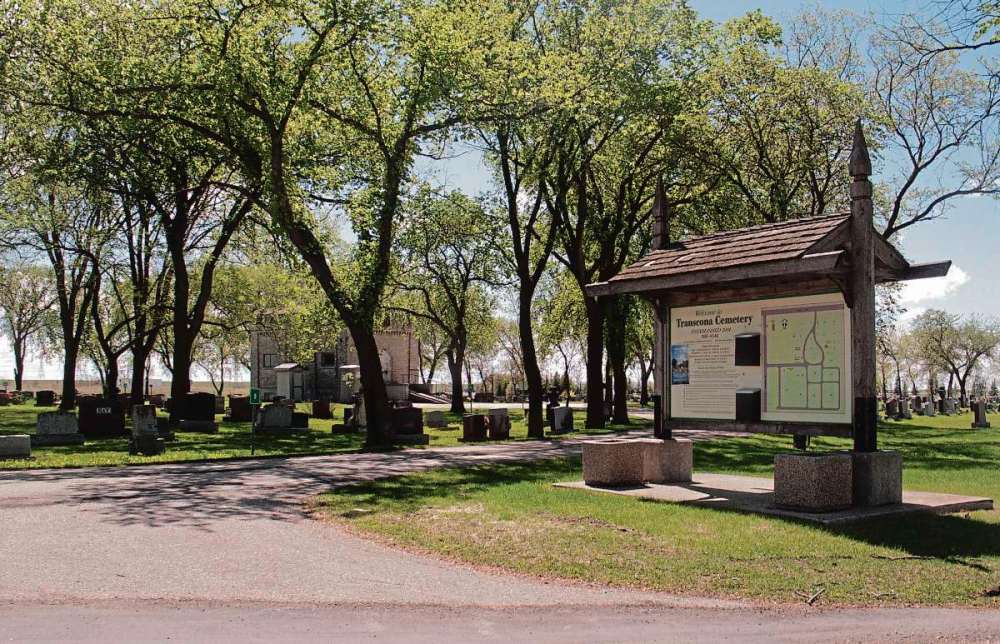
Today, over 100 years after it first opened its gates, the Transcona Cemetery is still the primary cemetery for the area. Approximately 5,000 bodies are interred there. A separate Field of Honour holds the bodies of veterans from the Transcona area.
“I think it’s important,” said Paulishyn, whose parents, grandparents, aunts, uncles, and cousins are all buried in Transcona Cemetery, along with many of his former students. “I can go through here and I bet you I could fill a class book of students of mine who are buried here.”
In the fall of 2016, the City of Winnipeg announced that it would undertake a series of improvements to the Transcona Cemetery, including a renovation of the former mortuary and chapel, which has over the years fallen into disrepair. While a first round of public consultations closed on April 30, 2017, and a report expected May 31, a representative from the City said that a summary of the City’s findings would be released “this summer.”
“It’s a quiet place,” Paulishyn said, adding he is glad the city is working to improve the space. “My wife and I are at the point, we’re talking about what we’ll do. I mean, we could just throw our ashes out some place, scatter them to the wind. But then your offspring have nowhere to go to say, ‘This is a place that was close to my dad,’ you know?”
Paulishyn said he hopes the former chapel and mortuary could be made into something that the public can use.

“It would be nice to see it put it back into something with a small altar at the front, somewhere people can go,” he said. “They already lock the gates at dark. They could lock this door, lock that door.”
For more information on the city’s Transcona Cemetery improvement plan, visit http://winnipeg.ca/PPD/cemeteries/Transcona/ISTCC/default.stm
Facebook.com/TheHeraldWPG
Twitter: @heraldWPG
Sheldon Birnie is the managing editor of the Free Press Community Review. Email him at sheldon.birnie@freepress.mb.ca or call him at 204-697-7112
Our newsroom depends on a growing audience of readers to power our journalism. If you are not a paid reader, please consider becoming a subscriber.
Our newsroom depends on its audience of readers to power our journalism. Thank you for your support.
Sheldon Birnie is the managing editor of the Free Press Community Review. Email him at sheldon.birnie@freepress.mb.ca or call him at 204-697-7112
Our newsroom depends on a growing audience of readers to power our journalism. If you are not a paid reader, please consider becoming a subscriber.
Our newsroom depends on its audience of readers to power our journalism. Thank you for your support.
Advertisement Advertise With Us
Advertisement Advertise With Us