


CNIB celebrates guide dog graduation
Advertisement
Hey there, time traveller!
This article was published 26/11/2019 (2369 days ago), so information in it may no longer be current.
The Canadian National Institute for the Blind Foundation (CNIB) Manitoba hosted its first ever guide dog graduation ceremony.
The ceremony was held on Nov. 22 at the CNIB Manitoba offices at 1080 Portage Ave. The event celebrated the canine graduates of the National CNIB Guide Dog program, highlighting the local organization’s first successful pairing: Tracy Garbutt, program lead at CNIB Manitoba, and Marion, a two-year-old black Labrador retriever.
Marion is the first successful guide dog graduate for the Manitoba chapter of CNIB.
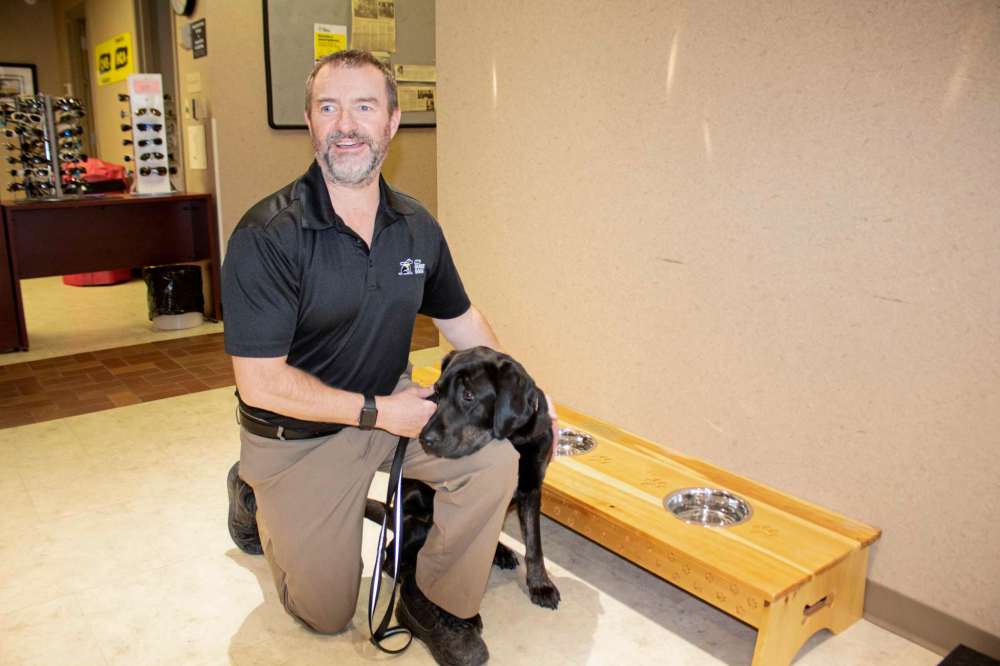
Garbutt, who is legally blind, said Marion has helped him get out of the house more.
“I took a break from dogs for two years … When I got Marion, it showed me how I was starting to regress, staying at home more,” Garbutt said. “Now, (I) just feel good. My confidence is back again, I’m just doing things. I don’t hesitate to go (out) now, I just go.”
Garbutt added that while the guide dog training is important, Marion’s personality is taken into consideration before they were paired up. Garbutt uses a harness and a leash to hold onto Marion, which allows him to feel where her head is.
This allows them to work more closely as a team. If Garbutt wants to sit down, he will say something like “find the chair,” and Marion will rest her head upon the seat, letting him know where he can sit down. Teaching the dog how to do this is called “target training” and it’s used for finding crosswalk buttons, elevator doors and anything else Garbutt might need to get around the city.
Leonard Furber, the executive director for CNIB Manitoba, said he feels proud of the progress the organization has made.
“When we were talking about developing the CNIB guide dog program, it feels like a lifetime ago, in reality it was only a couple of years,” Furber said. “Fast forward to seeing (Garbutt) and Marion sitting with us here today, it’s a huge accomplishment. To have such success, in that short period of time, it’s a huge feather in the cap of our organization.”
The CNIB Guide Dog program started in 2017, when the organization identified gaps in services that provided guide dogs. Furber stressed that the program is not aiming to replace other guide dog programs, but to pair guide dogs with blind or partially sighted people sooner.
The process of training a guide dog starts off with the CNIB Puppy Raising program, where a family in Winnipeg will take in a puppy-in-training until it is about 12 to 15 weeks old. After some basic training, it is sent to a specialized trainer in Ottawa, to begin formal training as a guide dog.
After that, the dog is matched with a blind or partially sighted person, who then begins working with the trainer at home to get the dog used to its partner.