


Creating ‘prairie’ in the city

Advertisement
Hey there, time traveller!
This article was published 28/09/2021 (1824 days ago), so information in it may no longer be current.
This summer, I had a visit from two of Winnipeg’s friendly bylaw officers. They had received a complaint about my yard. It’s not a traditional yard. It’s a nature-scape. In the mid-1990s, I killed the sod and planted native grasses and wildflowers. As a pioneer in ‘naturescaping,’ I soon learned that it is encouraged by naturalist services – but not by bylaw enforcement.
Native prairie grasses grow taller than the six-inch maximum allowed for lawns. This is problematic for bylaw officers. They could see that my yard is not an unmown lawn. It is a carefully-tended wildflower garden. It is a haven for pollinators, birds, and other wildlife. It just looks a bit . . . unkempt. So, every few years, someone complains.
While Winnipeg struggles to integrate non-traditional yards into the urban landscape, it is successfully bringing prairie to public greenspaces. One of the newest examples is near John Bruce Road East. Head north on Louis Riel Senior Trail to visit the site. Part of the new prairie is nestled beside the Seine River forest west of the trail. The rest overlooks a retention pond to the east.
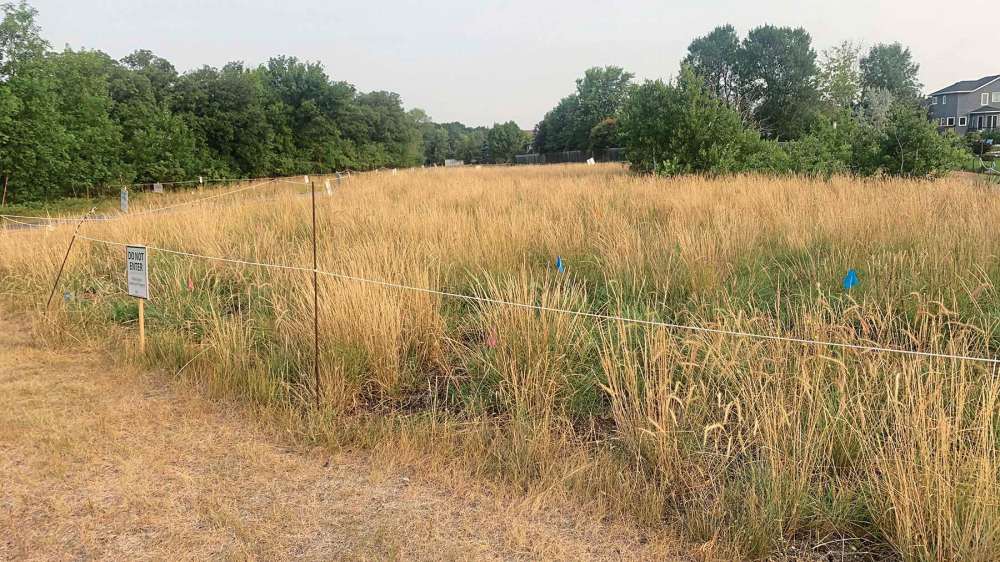
Save Our Seine initiated this prairie restoration as a part of its greenspace enhancement project. A grant from the Conservation Trust attracted matching money – including a generous grant from Coun. Brian Mayes for prairie restoration. Native Plant Solutions, a leader in this field, was chosen for the project.
I had the pleasure of meeting Ashley Rawluk during a recent site visit. It was the first project she has led from start-to-finish. The NPS team carefully prepared the site in 2020. They seeded it with 14 species of native grass. Extra wildflowers (nine species) were planted in 2021 to add biodiversity.
The team had to deal with some unique challenges. Record drought meant water had to be hauled in three times a week to keep transplants alive. Female snapping turtles also move between the pond and the river every spring to lay eggs. Who knew? Adjustments to the fencing allowed them to pass safely through the site.
I asked Ashley what attracted her to NPS.
“As a child, I dreamed of saving the world,” she said.
“With Native Plant Solutions, I am able to provide nature-based solutions to support environmental sustainability and healthy communities in, and around Winnipeg.”
Ashley will remove the fencing soon and her prairie will be officially “open” for wildlife and people. Enjoy!
Michele Kading
St. Vital community correspondent
Michele Kading is a community correspondent for St. Vital. She is also the executive director of the Association of Manitoba Museums.
Our newsroom depends on a growing audience of readers to power our journalism. If you are not a paid reader, please consider becoming a subscriber.
Our newsroom depends on its audience of readers to power our journalism. Thank you for your support.
Michele Kading
St. Vital community correspondent
Michele Kading is a community correspondent for St. Vital. She is also the executive director of the Association of Manitoba Museums.
Our newsroom depends on a growing audience of readers to power our journalism. If you are not a paid reader, please consider becoming a subscriber.
Our newsroom depends on its audience of readers to power our journalism. Thank you for your support.
Advertisement Advertise With Us