Hey there, time traveller!
This article was published 08/03/2019 (2761 days ago), so information in it may no longer be current.
In this case, R2-D2 was the droid the judges were looking for.
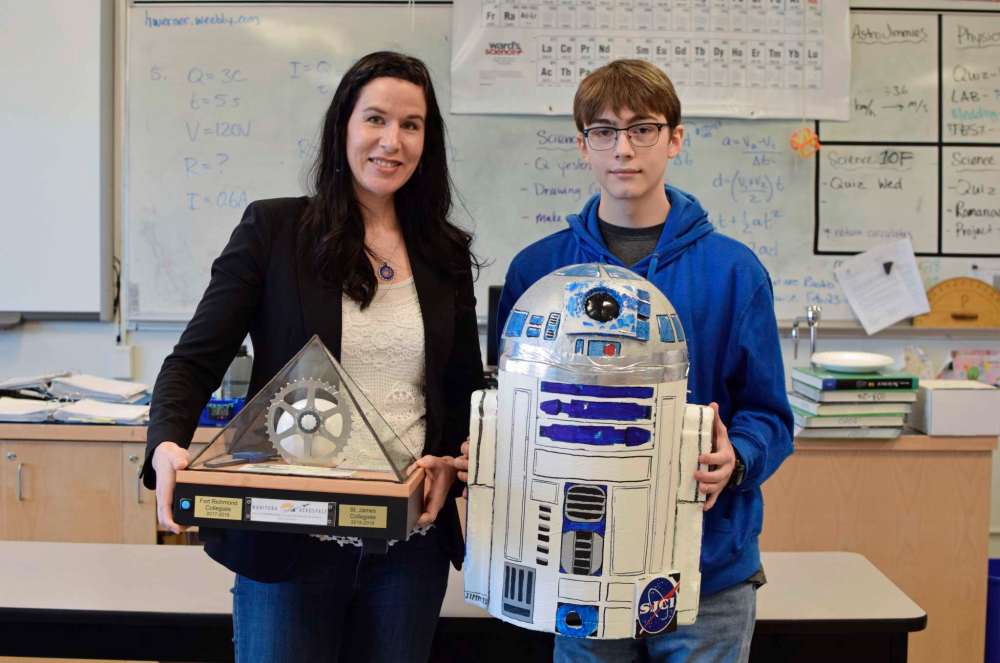
Students from the Astro Jimmies — St. James Collegiate’s extracurricular physics club — recently won an engineering award for their Star Wars-themed payload design at the Manitoba Association of Physics Teachers’ High Altitude Balloon (HAB) Symposium.
The little styrofoam droid was launched into the edge of the Earth’s atmosphere last April, during the group’s 2018 HAB project.
“To know that I actually worked on something that won an award was pretty cool,” Astro Jimmies members Tyler Pooley said.
Pooley is in Grade 10 and was part of the crew that came up with the R2-D2 design for the payload, which contained multiple HD cameras and an electronic tracking system to measure the balloon’s altitude, speed and location when it returned to Earth.
The Astro Jimmies program is now in its fifth year and the payload designs have gotten progressively more complex since the styrofoam cube they sent up in 2014.
“The real science of it is the stuff that goes inside and the data that you can analyze when you get it back, but I think the creative elements of this project has a lot of appeal as well,” said St. James Collegiate physics teacher Heidi Werner. “R2 was a bit of a showstopper and I think he has inspired a lot of schools for this year.”
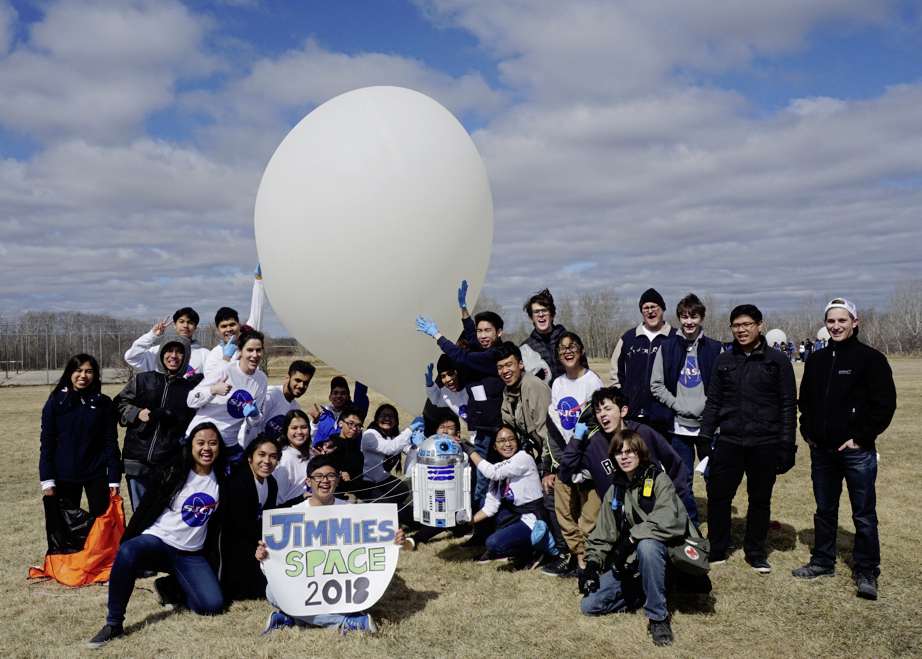
The Astro Jimmies and students from 13 other schools launched their HABs from Alonsa, Man. last April.
The days leading up to the launch, however, required some late nights at school spent problem-solving design issues.
“It was massively overweight,” Pooley said.
The students had to shave off some of the styrofoam and hollow out the half-globe that was used to make R2-D2’s head to get it down to the 2,500-gram weight limit. Any heavier and the payload would have affected the inflation rate of the helium balloon used to carry it into space.
“You have to start making some difficult choices like you would on a real crew,” Werner said, adding that if they couldn’t get the weight down the team would’ve had to sacrifice a camera or tracking instrument.
The weather was another big consideration on the day of the launch and a south travelling jet stream actually took a few of the projects over the border into the United States.
If they are inflated correctly, the HABs are designed to burst at a certain altitude and make their way back to the ground in a predictable area. The Astro Jimmies’ balloon travelled about 30,000 metres above sea level and landed near Portage la Prairie two hours after it was launched.
“We did a really good job of getting our inflation rate correct so it burst when it was supposed to and it came down when it was supposed to,” Werner said.
For Pooley, the most exciting part of the project was watching the footage captured from the balloon.
“It was really cool seeing the thing we spent almost two months working on go up to pretty much the edge of space and then falling down,” he said. “It was well above most of the clouds.”
Pooley is already brainstorming ideas for this year’s HAB payload.
“I’m hoping to do something more complicated in design, but since there’s a helium shortage right now it has to be lighter, so that’s going to be more difficult,” he said.
In this case, R2-D2 was the droid the judges were looking for.
Eva Wasney
St. James Collegiate physics teacher Heidi Werner and Astro Jimmies member Tyler Pooley with the award the group won for its R2-D2 inspired high altitude balloon payload.
Students from the Astro Jimmies — St. James Collegiate’s extracurricular physics club — recently won an engineering award for their Star Wars-themed payload design at the Manitoba Association of Physics Teachers’ High Altitude Balloon (HAB) Symposium.
The little styrofoam droid was launched into the edge of the Earth’s atmosphere last April, during the group’s 2018 HAB project.
“To know that I actually worked on something that won an award was pretty cool,” Astro Jimmies member Tyler Poolie said.
Poolie is in Grade 10 and was part of the crew that came up with the R2-D2 design for the payload, which contained multiple HD cameras and an electronic tracking system to measure the balloon’s altitude, speed and location when it returned to Earth.
The Astro Jimmies program is now in its fifth year and the payload designs have gotten progressively more complex since the styrofoam cube they sent up in 2014.
“The real science of it is the stuff that goes inside and the data that you can analyze when you get it back, but I think the creative elements of this project has a lot of appeal as well,” said St. James Collegiate physics teacher Heidi Werner. “R2 was a bit of a showstopper and I think he has inspired a lot of schools for this year.”
The Astro Jimmies and students from 13 other schools launched their HABs from Alonsa, Man., last April.
Supplied photo
Members of the Astro Jimmies team during the April 2018 launch of their high altitude balloon and R2-D2 inspired payload.
The days leading up to the launch, however, required some late nights at school spent problem-solving design issues.
“It was massively overweight,” Poolie said.
The students had to shave off some of the styrofoam and hollow out the half-globe that was used to make R2-D2’s head to get it down to the 2,500-gram weight limit. Any heavier and the payload would have affected the inflation rate of the helium balloon used to carry it into space.
“You have to start making some difficult choices like you would on a real crew,” Werner said, adding that if they couldn’t get the weight down the team would’ve had to sacrifice a camera or tracking instrument.
The weather was another big consideration on the day of the launch and a south travelling jet stream actually took a few of the projects over the border into the United States.
If they are inflated correctly, the HABs are designed to burst at a certain altitude and make their way back to the ground in a predictable area. The Astro Jimmies’ balloon travelled about 30,000 metres above sea level and landed near Portage la Prairie two hours after it was launched.
“We did a really good job of getting our inflation rate correct so it burst when it was supposed to and it came down when it was supposed to,” Werner said.
Eva Wasney
The progression of the Astro Jimmies' high altitude balloon payload designs over the last four years from oldest, at right, to newest.
For Poolie, the most exciting part of the project was watching the footage captured from the balloon.
“It was really cool seeing the thing we spent almost two months working on go up to pretty much the edge of space and then falling down,” he said. “It was well above most of the clouds.”
Poolie is already brainstorming ideas for this year’s HAB payload.
“I’m hoping to do something more complicated in design, but since there’s a helium shortage right now it has to be lighter, so that’s going to be more difficult,” he said.


.jpg?w=1000)