


Inside Winnipeg’s level 4 laboratory

Advertisement
Hey there, time traveller!
This article was published 28/05/2018 (3019 days ago), so information in it may no longer be current.
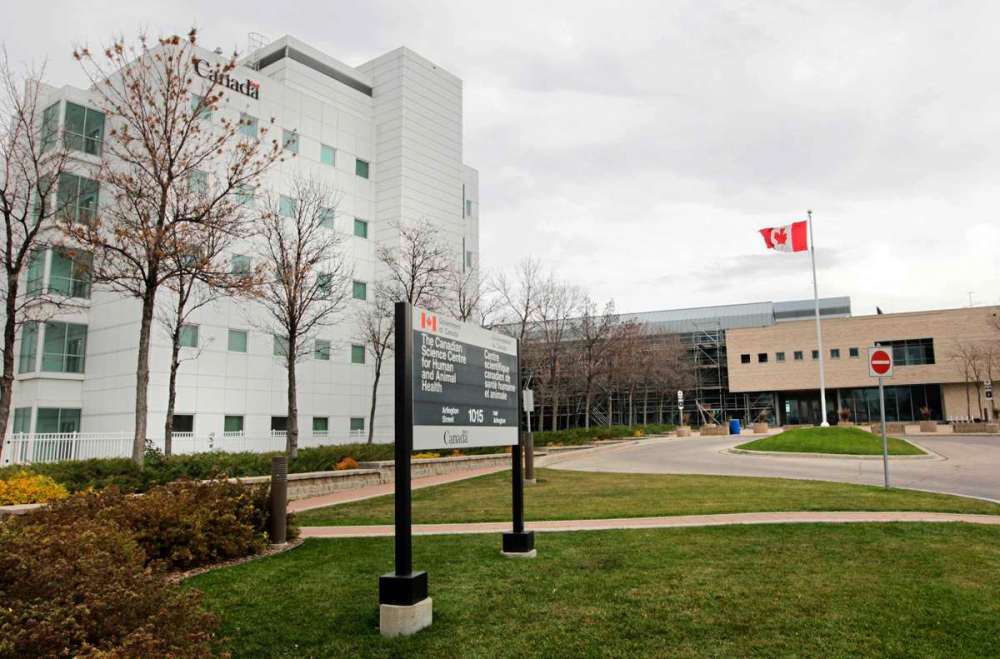
Living so close, I’d wondered about the imposing building set slightly apart on its own block. The Canadian Science Centre for Human and Animal Health (CSCHAH) is a government building and the long driveway with prominent security barriers lends it some intrigue.
I didn’t realize that it is world renowned as the first facility to combine laboratories for human and animal disease research and that it’s the only containment level 4 laboratory in Canada until Ligia Braidotti wrote about a public information session.
I really didn’t know what to expect when I showed up for the session.
After showing ID, I wandered around the lobby looking at info displays then dug through a bowl of temporary tattoos with virus designs searching for one of each for my nephews. Influenza, E-coli, anthrax… I didn’t see the Ebola one although I knew Ebola is housed in the centre at the highest level of bio-containment.
The amphitheatre-style auditorium was packed for the presentation so a second overflow room was opened.
We were treated to a series of informative, fascinating and at times funny presentations by speakers from the CSCHAH and its community liaison committee addressing all aspects of the centre’s operations. These, together with the realization that the centre employs 500 people, many of whom live, work and shop in the community, greatly allayed my vague apprehensions.
There have been impressive advances made at the Centre. The experimental Ebola vaccine being administered in the Democratic Republic of Congo’s Ebola outbreak was developed here. So was ZMapp, which is given to Ebola patients who have already been infected. The centre also pioneered the lab-in-a-suitcase, invented by biologist Allen Grolla, which means that instead of having to set up a lab in a capital city during a crisis, they can set up in remote areas close to the outbreak, thus saving precious diagnostic time.
One of the labs was recently deployed to a remote community in Nunavut during an outbreak of tuberculosis. During a seven-week period it was able to test over 90 per cent of the eligible population.
Community liaison officer Joy Stadnichuk gives presentations at five area high schools and numerous post-secondary career fairs throughout the year. She gives an overview of interesting jobs in the sciences and takes pains to stress that the centre doesn’t just hire biologists and scientists but, like all lab, its also needs administrative personnel, building technicians, bio-containment safety officers and more.
Anne Hawe is a community correspondent for the West End. She can be reached at annie_hawe@hotmail.com
Anne Hawe
West End community correspondent
Anne Hawe is a community correspondent for the West End. She can be reached at anniehawe1@protonmail.com
Our newsroom depends on a growing audience of readers to power our journalism. If you are not a paid reader, please consider becoming a subscriber.
Our newsroom depends on its audience of readers to power our journalism. Thank you for your support.
Anne Hawe
West End community correspondent
Anne Hawe is a community correspondent for the West End. She can be reached at anniehawe1@protonmail.com
Our newsroom depends on a growing audience of readers to power our journalism. If you are not a paid reader, please consider becoming a subscriber.
Our newsroom depends on its audience of readers to power our journalism. Thank you for your support.
Advertisement Advertise With Us