


MITT program fast tracks students to post-secondary
High school mandate and campus expansion to support workforce
Advertisement
Hey there, time traveller!
This article was published 31/03/2015 (4133 days ago), so information in it may no longer be current.
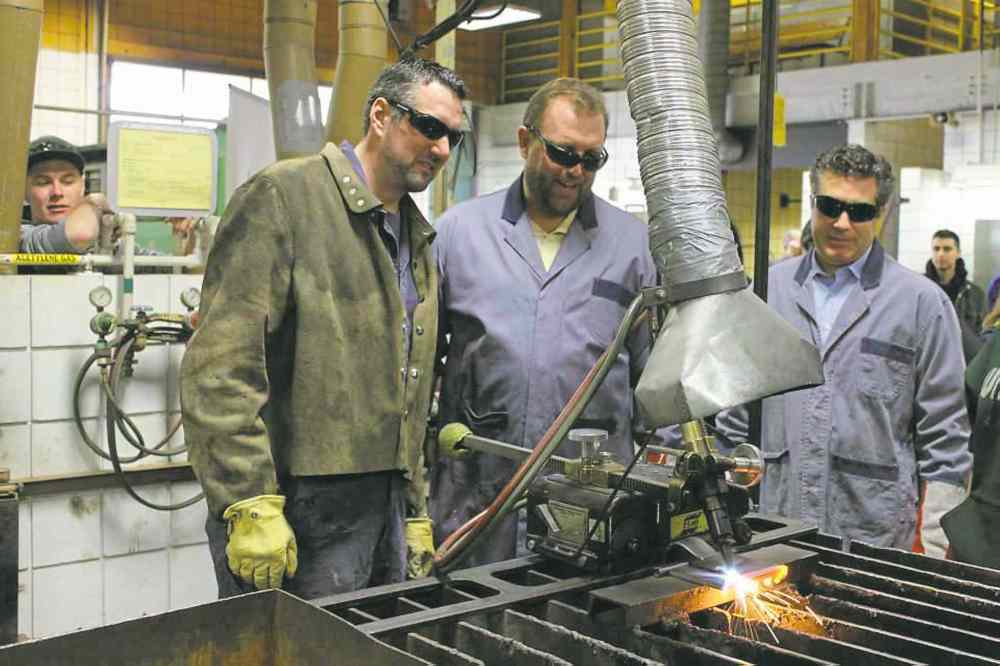
The province of Manitoba is investing $4 million in funding for an expanded welding shop and campus expansion at the Manitoba Institute of Trades and Technology (MITT).
Education and Advanced Learning Minister Peter Bjornson made the announcement on March 19, adding that the investment is part of the province’s education strategy to support the workforce.
“This expansion will double the institute’s capacity to train apprenticeship-track industrial welders and give young people more opportunities to learn and develop the skills they need to get the good jobs that are available right here in Manitoba,” Bjornson said in a statement.
The expansion, which will see shovels hit the ground in late summer, supports MITT’s (formerly Winnipeg Technical College) new mandate as a secondary or high school institution.
In July 2014, the province expanded MITT’s education mandate to include a high school component.
Starting in Sept. 2015, students entering Grade 11 can attend MITT full-time, pursuing a pre-employment certificate in welding and other trades while also completing English, math and gym requirements to fulfil the requirements of a high school diploma.
“In September of 2015, what we are shooting for is to turn on our own high school within our own walls,” MITT president and CEO Paul Holden told The Sou’wester. “And those would be for individuals who truly know exactly what it is they want to do. They can come to us and get their full high school experience.”
The institute is currently looking for 50 students to begin this fall.
MITT currently provides vocational training for high school students in the Pembina Trails School Division and the Louis Riel School Division, as well as other rural school divisions. Students interested in vocational studies currently attend MITT part-time through partnerships established with school divisions where the training is unavailable at the student’s home campus.
Pembina Trails superintendent Ted Fransen says the school division’s partnership with MITT is critical.
“MITT provides all of our high school technology vocational programming. So it’s a very important partnership for us,” Fransen said. “Our four high schools do not have a technical vocational program. This is it.”
Fransen is also glad to see more funding invested in trades training within the province.
“It’s an important step by the provincial government to provide funding to MITT because there are certain selected program areas within MITT where our students are on a waiting list because of high demand and welding is one of them,” he added.
High school students attending MITT also have the added benefit of having tuition costs covered. With its new mandate as a high school, the institute is considered to be its own school division and courses are funded in full by the province. On average, a 10-month program at MITT can cost between $4,000 and $5,000 and nets a pre-employment certificate — the same one high school students can now earn.
“You’re really getting triple credit, when all is said and done,” Holden said, “Which opens doors to you that allow you to go to work with the pre-employment certificate, or it allows you to go work but continue on with the apprenticeship program which means that we would articulate you into Assiniboine Community College for the apprenticeship welding program.”
MITT is also collaborating with Red River College, University College of the North and the University of Winnipeg to have programs recognized at those institutions. Holden also notes that MITT is developing three post-secondary diploma programs to be announced in April.