



A secret revealed
Shepsel Shell's family reunification subject of new doc
Advertisement
Hey there, time traveller!
This article was published 24/05/2016 (3504 days ago), so information in it may no longer be current.
Nearly 70 years after his birth and just years before her death, in front of a handful of video cameras and recently acquired family, Shepsel Shell met his mother for the first time.
There is more to the story of the blind River Heights man known for running the marathon at the 1988 Paralympics, as the world, and Shell himself, is beginning to learn.
Shell, 70, is featured in the documentary Aida’s Secrets which had its world premiere at the Hot Docs festival in Toronto on May 3.
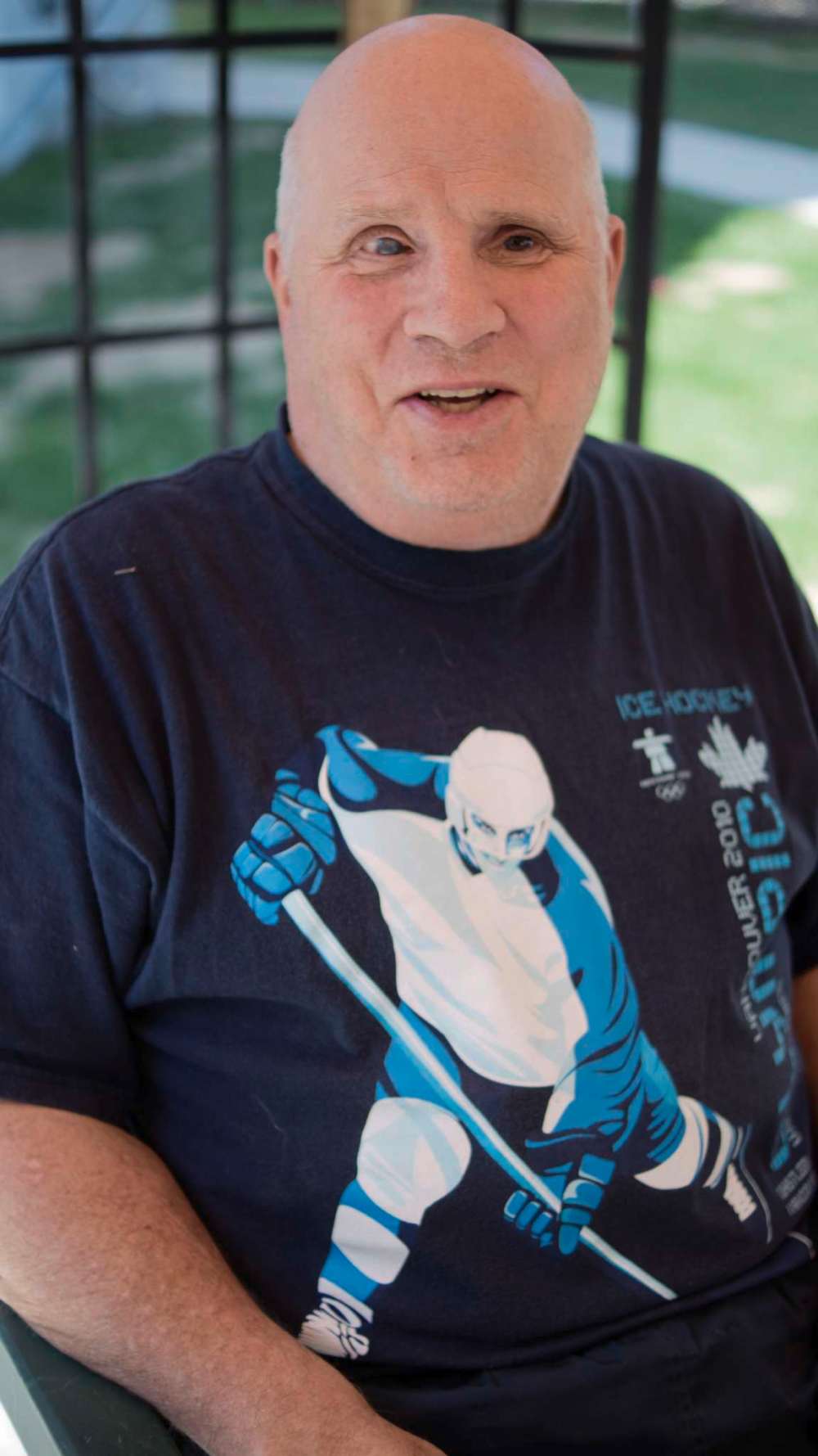
Directed by Alon Schwarz and co-directed by Shaul Schwarz, two Israeli filmmakers, Aida’s Secrets tells the story of Shell, his long lost brother Izak Szewelewicz, and their mother Aida, framed by the diaspora caused by war and the Holocaust. After a genealogical search connects the two, Izak brings Shell to meet Aida, who is living in a Quebec nursing home.
“I found out that my mother is living in Canada, a two-hour flight away from me, for 67 years,” Shell said, sitting in his gazebo with his seeing eye dog and two other pups at his side. “I was really stunned and shocked about that, and angry too in a sense. Because from what I understood, she never told anybody that I existed.”
The film has captured the hearts of audiences and was selected as a top 10 film by viewers at Hot Docs. It was also screened in sold-out theatres and received at least two standing ovations during the festival, Shell said.
The experience of participating in the documentary was difficult in some ways, Shell admitted, but it also provided an opportunity to find the truth.
“This whole episode has brought me a sense of closure — that I’ve closed a circle. I’ve met my brother, I’ve met my mother, I have roots,” he said. “And that makes me feel very good.”
The search begins for answers
At 16 years old, after an ugly family fight, Shell learned the woman who raised him was his adoptive mother. So in 2002, he began the search for information about his family.
“I was able to determine that my mother came over in 1949 to Canada but I didn’t know where she was,” Shell explained. Furthermore, he found information that he might have a brother who was also born in the Bergen-Belsen displaced persons camp, but without an address the search came to an end.
“I gave up and filed all the information that I had and let it go. It was pretty tedious and I needed help,” he said.
From what I understood, she never told anybody that I existed.
According to Ava Block Super, an archivist with the Jewish Heritage Centre of Western Canada, in terms of genealogy, very few Jews of European descent are untouched by the Holocaust and family lines have been fractured or completely decimated.
“Strangely enough, I don’t get many requests from people requesting genealogy from the Holocaust era, mainly because most Jews understand there are gaps that cannot be accounted for,” Block Super said. “And for many there will never be concrete answers.”
Though many books have been written since the Second World War attempting to piece together the missing parts, and resources exist to point researchers in the right direction, much of the sleuthing is guesswork, Block Super said.
The best sources of information come from survivors themselves, but when that fails, technology is also useful, she said.
“Were it not for the advent of the internet, genealogical research would not have the resurgence in popularity that it has,” Block Super explained. “There are various websites that specialize in genealogy of the Holocaust. Yad Vashem is a museum in Jerusalem dedicated solely to the study of the Holocaust. Prior to the internet, you would have had to correspond by (snail) mail or in person, at great expense, for answers.”
A connection online is what ultimately led to Shell’s family reunion. In 2013, he was contacted by a genealogist from MyHeritage after his daughter uploaded his research to an ancestry website.
Family portrait becomes more complete
Shell learned he indeed had a brother in Israel who was married with three children and eight grandchildren, but he needed to meet them first to believe it.
.jpg?w=1000)
“With the things that have happened in my life since the time I was a teeny child I have very strong abandonment issues… I am very skeptical,” Shell explained.
In October, Izak came to Winnipeg with his family to meet Shell, with the film crew in tow.
“We all got together and we were discussing, how did you do this, how did you grow up, what do you do — the whole thing. We had to catch up 67 years!” Shell said.
Even after years of research and meeting his mother, questions remain for Shell and and Izak about their past. Yet Aida, who may have held the answers, turned out to be a reluctant source.
“It was hard to get information out of her,” Shell said. “Whenever we got into sensitive territory she’d say ‘Oh look at the snow, look at the Christmas tree,’ anything to head off questions.”
Although Aida stonewalled, Shell continued the search and found a reference in a Montreal archive that Aida was pregnant when she arrived in Canada, opening up the possibility of a second sibling, a suggestion she denied.

“So the mystery still exists. She took that to her grave. We know there’s a third brother and we know he was adopted and we know his birthdate,” Shell said. “He hasn’t come forward yet and he may never come forward and I can understand that. He’s got a history and if he comes to us his history totally changes.”
.jpg?w=1000)
“If it’s beshert, if it’s meant to be, it will happen.”
Producers say they are working to arrange a screening of the film in Winnipeg and it is scheduled to appear at several more festivals before a traditional theatrical release.
For more information go to www.facebook.com/aidassecrets