


Manitoba’s majestic Mallard duck
Advertisement
Hey there, time traveller!
This article was published 09/05/2017 (3298 days ago), so information in it may no longer be current.
Our neighbourhood would not be the same without its decorative wildlife.
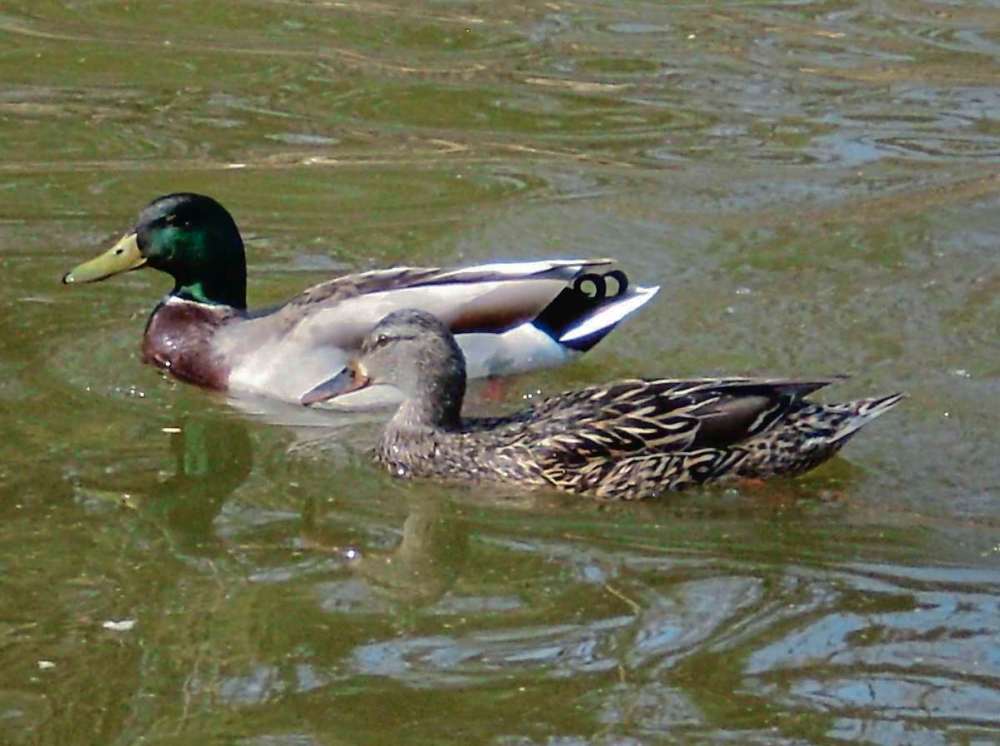
One of the first snowbirds to arrive back to their spring and summer habitats are the mallard ducks, or anas platyrhynchos. A beautiful spring sight is the mallard ducks landing on the water with their bright orange legs and feet outstretched: the handsome male duck with his iridescent green head and upper neck, a shiny brown breast divided by a white collar, a purplish hue on his wings, and his curly tail, along with his female friend, a humble mottled brown with a yellow bill.
In early spring to late fall, mallard ducks can be seen waddling around many local parks and the shores of the Red River. Their favorite habitat is the grassy areas that surround marshes, sloughs, or ponds. As dabblers, they can be seen tail-up in the ponds and rivers foraging for food near the water’s surface.
In the spring when the ducks look for a place for their nest, the female chooses an area that was close to her birthplace. Some choose the same site for years, usually near a water source. Once her nest is built, the female lays one egg every day for up to eight to 12 eggs in a nest.
Once the last egg is laid, the incubation time starts so that all the eggs hatch at around the same time. With the fine feathers from her belly, the female insulates the nest and covers the eggs. When she leaves the nest to feed, she covers the nest with the down, which keeps the eggs warm and also camouflages the nest.
After an incubation period of around 28 days, little bundles of yellow and brown fluff hatch. As soon as the ducklings are dried off, the mother takes them on their first outing to the water. If the trek to the water is a long one, the mother stops to collect her babies to warm them. Once they reach the water, the ducklings catch meals of insects and tiny water plants. In the next 10 weeks the yellow down changes to adult plumage, and they are on their own.
After the breeding season, both females and males shed their feathers, known as eclipse plumage. The males lose their bright colours and both males and females shed their flight feathers. For about one month they cannot fly. During this time, they find shelter in reeds until they gain new feathers. As summer nears its end, young and old ducks begin to gather. They can be seen sitting in fields and feeding on grain, getting ready for their migration south. The mallard duck is a very hardy bird and can spend the winter in cold climates as long as they can find open water, but most ducks migrate to ice-free ponds in central and southern United States.
You can learn more about the mallard from Hinterland Who’s Who at www.hww.ca/en/wildlife/birds/mallard.html
Helen Lepp Friesen is a community correspondent for Fort Garry. You can contact her at helenfriesen@hotmail.com