



Conquering fear at Drop Zone
Annual rappel continues to inspire courage
Advertisement
Hey there, time traveller!
This article was published 31/08/2018 (2750 days ago), so information in it may no longer be current.
As a crew of rope access technicians tied Samantha Brouillette and her wheelchair in for a once in a lifetime descent, she mustered a nervous smile for the camera.
“Are you freaking out yet?” she asked me, just a few metres away from the edge of the 23-storey Manitoba Hydro Place. “I’m going to keep my eyes closed the entire time.”
Brouillette was one of over 70 participants — myself included — in the 14th annual Society for Manitobans with Disabilities Foundation/Easter Seals Manitoba Drop Zone event on Aug. 28.

Brouillette and I had met that morning while waiting to be fit with the harnesses organizers assured would make our 272-foot rappel to ground level a safe one.
Heights aren’t Brouillette’s strong suit, she revealed. Even looking out a window from a dozen storeys up is enough to strike terror into the 27-year-old’s heart, she said.
Yet when she was nominated by a co-ordinator with SMD’s recreation and leisure program to take the drop and face her fears, Brouillette didn’t hesitate to accept the challenge.
“SMD has helped me so much in my life, I want others to have the same type of experiences,” Brouillette explained.
When she was 11 years old, Brouillette started to have symptoms of Blount’s disease, which causes the bones in the lower legs to grow at an inward, or bow-shaped, angle. Within a week, she was unable to walk and, despite numerous surgeries on both legs, has relied on a power wheelchair since.
With support from SMD in the form of programs and services, the Bridgwater Lakes local has played power wheelchair hockey for 11 years (she’s since retired to handle the program’s social media), and said the people she’s met along the way have become family. A group of supporters, dubbed Samantha’s Squad, waited nearby to cheer on their friend.
“With the money I’ve fundraised, other people get to experience things I have,” she said. “SMD is a big part of my life.”
With harnesses and helmets in place, Brouillette and I took the cargo elevator together to the roof of the building, ears popping along the way. We moved onto the rooftop and an early morning mist lingered in the air, along with the fear and excitement.
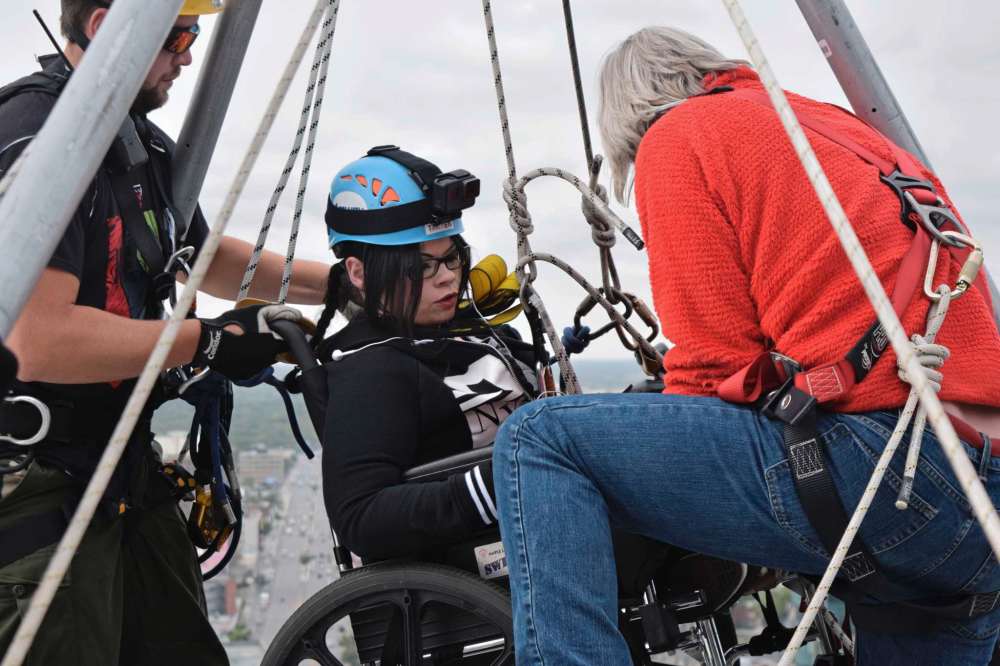
I waited in the queue while a crew readied Brouillette’s rig, and Craig Spakowski, a trainer with the Drop Zone event who oversees the dozens of descents, made a remark about trust.
One year, a participant told Spakowski that tilting forward can be one of the most unsettling feelings when in a wheelchair, and asked if he could depend on the crew to keep him level during the rappel. That trust extends to everyday scenarios too, the participant told him — a hopeful confidence that accessibility is prioritized in the community and barriers eliminated.
Through the Drop Zone event — which raised over $130,000 for the foundation this year and $1.3 million in Manitoba since 2005 — SMD is able to advocate for the inclusion of people of all abilities and demonstrate that descending into the unknown doesn’t have to be intimidating.
While I watched Brouillette’s chair sink below the ledge — and contemplated my own rappel — it looked like some of her terror had subsided, and with a reassuring look directed my way, she inched towards the ground — just 270 feet to go.