



Keep reducing, reusing and recycling

Advertisement
Hey there, time traveller!
This article was published 27/11/2018 (2628 days ago), so information in it may no longer be current.
It’s been about 50 years now since the 3Rs —“reduce, reuse and recycle” — were introduced and it’s likely that most of us regularly recycle.
The curbside recycling program began in Winnipeg 17 years ago this month, with rollout carts being introduced in 2012. It’s a great idea, and people get a fair sense of accomplishment from doing something positive for the environment, but I was surprised to recently learn about the number of things you still can’t recycle.
As you probably know, items such as paper, cardboard, aluminum containers, glass, and hard plastic bottles can be readily tossed into the blue cart.
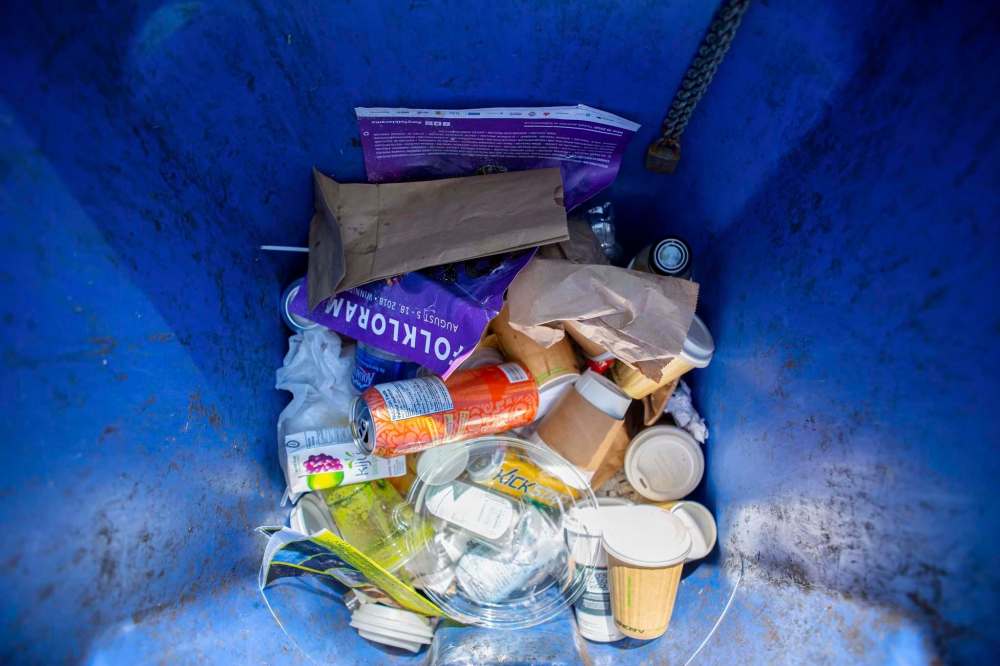
But, like most cities, in Winnipeg you cannot recycle things such as paper towel and tissue, aluminum foil, disposable coffee cups, black plastic and plastic bags and straws. If you put them in the blue cart they end up in the landfill.
The issue with paper towels and tissue paper is that they’re typically already made from recycled material and the fibres that are bound together to form the sheets get shorter after recycling and can no longer be used.
For most other materials the challenge is that the current process doesn’t have the equipment to sort and separate them. With aluminum foil it’s the presence of food residue, and with disposable coffee cups it’s plastic lining. The problem with black plastic containers or lids is that the sorting scanners can’t properly detect them.
Perhaps the biggest challenge is plastic. Many local supermarkets have dropoff bins for plastic shopping bags. However, for items like plastic straws, current processing facilities just aren’t designed to handle something so small — they simply fall off conveyor belts.
What’s perhaps more challenging is the lack of a market for a lot of the recycled material. Unless the process is profitable there’s no incentive. For decades, China was a major purchaser but it recently established strict guidelines for the condition of material. The result is that only a small portion of the material in your blue box actually gets recycled.
So, while technology is evolving, there are still issues with a number of products, and perhaps we also need to look more close at the reducing and reusing components of the 3Rs.
There are encouraging signs. For example, Canada is one of several G7 countries that signed a charter to work towards developing 100 per cent reusable, recyclable or, recoverable plastics by 2030, and to recover 100 per cent of all plastics by 2040.
Nick Barnes is a community correspondent for Whyte Ridge.
Nick Barnes
Whyte Ridge community correspondent
Nick Barnes is a community correspondent for Whyte Ridge.
Our newsroom depends on a growing audience of readers to power our journalism. If you are not a paid reader, please consider becoming a subscriber.
Our newsroom depends on its audience of readers to power our journalism. Thank you for your support.
Nick Barnes
Whyte Ridge community correspondent
Nick Barnes is a community correspondent for Whyte Ridge.
Our newsroom depends on a growing audience of readers to power our journalism. If you are not a paid reader, please consider becoming a subscriber.
Our newsroom depends on its audience of readers to power our journalism. Thank you for your support.
Advertisement Advertise With Us