


Acadia wins big in robot rumble
Advertisement
Hey there, time traveller!
This article was published 01/04/2019 (2607 days ago), so information in it may no longer be current.
In a battle of the smartest bots, Acadia Junior High School’s robotics club is punching above its weight.
The club wrapped up the 24th annual Manitoba Robot Games with a first-place finish in the Mini Sumo
Autonomous category, brought home by Grade 9 student Richard Ding.
Club director and Acadia science and mathematics teacher Jared Thorlakson said it was a proud moment for the club. This is just the second trophy in the club’s 10-year history, although students have earned a number of runner-up plaques over the years.
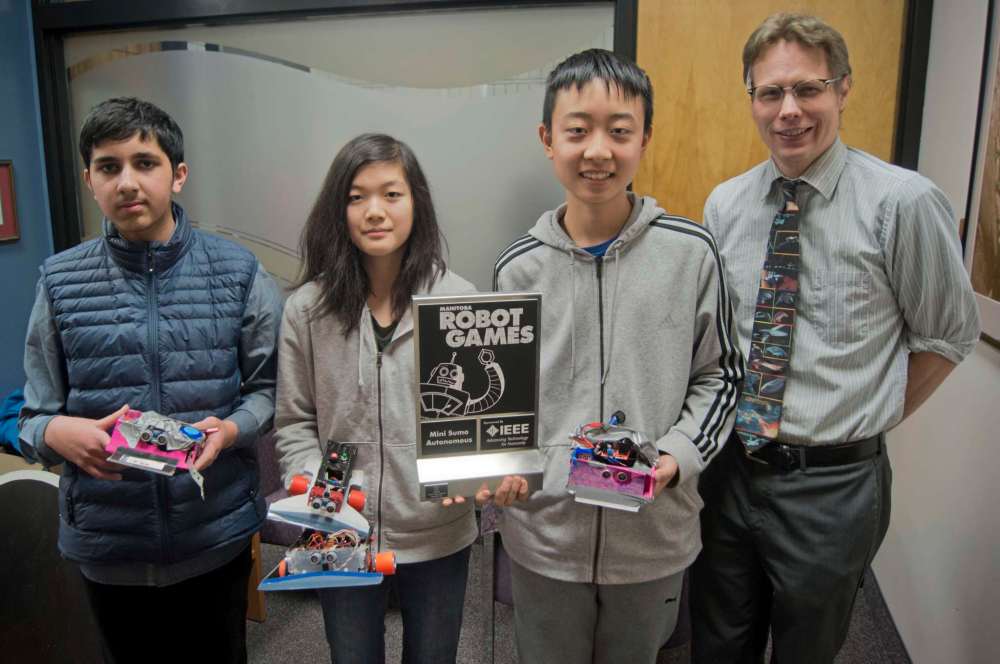
“In this category they’re competing against college students, theoretically,” Thorlakson said.
“The fact that they’re consistently bringing home plaques, and now two years in a row trophies, is just astounding.”
This year’s event happened on March 16 at Tec Voc High School. Over 200 robots competed in the games in 15 events, including drag race, line maze, super scramble, tractor pull and sumo wrestling.
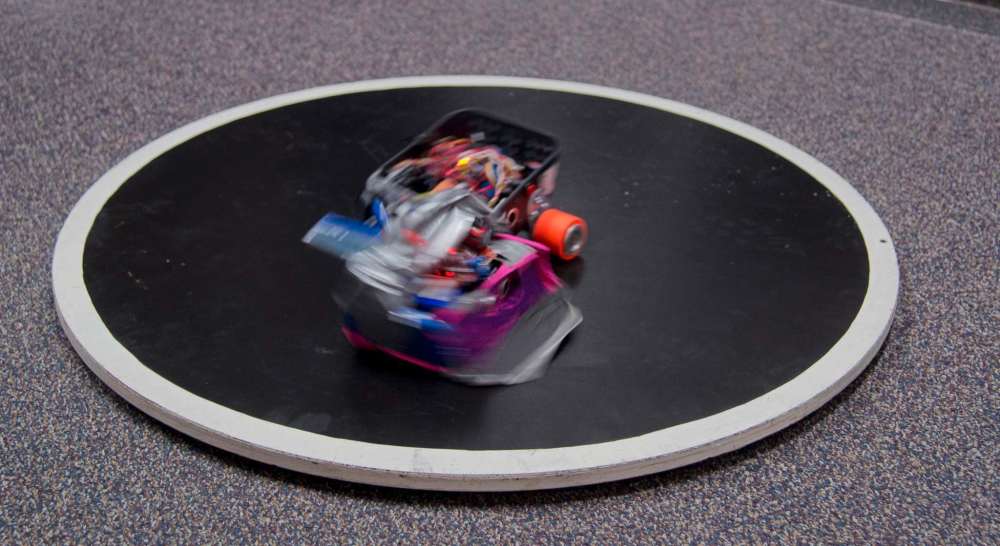
In the Mini Sumo Autonomous event, Ding’s creation, called Red Stone Ray, went through the round robin with just one loss, and proceeded through the elimination round undefeated.
The objective for Red Stone Ray was to push its opponent out of the approximately metre-wide ring first.
In each round, the robots are placed side-by-side in the centre of the battle zone. Drivers hit the launch button and after a five second delay the robots are on their own, using built-in sensors to locate their opponent and various tools, like blades, arms, and wheels to force the opponent out.
Red Stone Ray, Ding explained, has a blade able to get beneath most bots, making it a fierce competitor. And despite the effective design, Ding said he was surprised at his robot’s results after nearly being disqualified due to a technical error.
“I didn’t think I had a big chance, because in the round robin my robot broke,” the 14-year-old said. “It didn’t get any power so, Mr. Thorlakson fixed it for me.”
Last-minute troubleshooting and repairs are not uncommon, Thorlakson said. Often students are scrambling to get their machines ready for competition and correct design faults.
“We managed to twist the right wires together that we found were broken at the last moment,” Thorlakson said, allowing Ding to continue to the title. “If we just wanted to win, we could probably buy kits that would do better, but that’s not my objective.”
Each fall, students in the club brainstorm what type of robots they wish to create and place parts orders, that arrive in early winter, Thorlakson explained. They can 3D print a chassis, or create one from found items, like in the case of Hannah Tao’s Bolt robot.
“When I first heard of this club I was really excited because I thought it would be interesting and I wanted to build something and be hands on,” Tao, 14, said.
It wasn’t long before Tao was making a name for herself at competition. Bolt was the first Acadia creation to win a championship title in the Mini Sumo Autonomous event. It has a dollar store shovel head for a chassis, ultrasonic eyes, and two sensors to orient the robot. Tao’s robot made it to the semifinal in this year’s event, but a low battery ended her attempt at a consecutive championship.
In addition to the physical design, students must also code the robot’s on board computer to carry out its tasks. This is where Acadia excels, Thorlakson said.
“Our strengths are in coding and autonomy,” Thorlakson said. “We’re good at making smart robots.”