


Year of the elm trees
Iconic trees losing battle with Dutch elm disease
Advertisement
Hey there, time traveller!
This article was published 25/01/2021 (2078 days ago), so information in it may no longer be current.
It’s not a good year to be an American elm tree in Winnipeg. Dutch elm disease is spreading rapidly, and a tree preservation organization is sounding the alarm.
Since 2016, according to City of Winnipeg statistics, the city has lost more than 33,000 elm trees to the disease. For comparative purposes, that’s the equivalent of losing all the trees on 330 city blocks in just five years as, on average, there are about 100 elm trees per Winnipeg block.
Gerry Engel, president of Trees Winnipeg — which has its headquarters at 1539 Waverley St. — said the organization is launching a year-long information campaign to educate and encourage residents to save the elms.
“There is more urgency than most Winnipeggers realize,” Engel said. “Dutch elm disease (DED) is now taking whole neighbourhoods. It is the tipping point for Winnipeg’s urban canopy. If we don’t act now, in a generation or less, our elm canopy will be significantly smaller than what we enjoy today, and we’ll join cities like Toronto and Montreal that have been devastated by DED.”
DED is highly contagious and quick removal of all infected trees is key to stopping the spread. DED was first identified in Winnipeg trees in 1975, when Winnipeg’s American elm tree population was 275,000.
“DED is spread by the elm bark beetle. The beetle and the elms have lived together for millennium, but now, the beetles pick up the spores and move them from tree to tree,” Engel said, adding the disease — caused by a variety of sac fungus — can also be transmitted between trees when their roots intertwine.
Unfortunately, significant delays in removing the tagged elms, inadequate budget allocation, misinformation and other factors have caused DED infection rates to skyrocket in recent years, according to Trees Winnipeg.
“The public perception is that DED continues to be adequately managed in Winnipeg, that tree banding prevents the spread, and that the City of Winnipeg is solely responsible for monitoring and caring for public trees only. But these assumptions are outdated and are partly to blame for why we’re quickly losing the fight against DED,” Engel said.
Another misconception is that American elms were imported to the city when the boulevards were being laid out along the streets as they were developed.
“The American elms had a riparian presence along the riverbanks, which the community propagated for planting,” Engel said. “These trees didn’t come from afar. They are native to the area.”
The aim of Trees Winnipeg’s “Year of the Elm Tree” campaign is to get timely and simple elm tree care information and tips into the hands of Winnipeggers to help stop the spread of DED.
“The simple act of regularly watering an elm on a City boulevard could give it the edge it needs to survive, which in turn will help protect any surrounding elms, including the ones on your property,” Engel said, adding neighbourhoods like River Heights and Wolseley take an interest in taking care of their elms, while more work needs to be done in the West End.
Elms should be banded in the fall to catch various insects. In the spring, trees can be sprayed with a biological insecticide, to help them survive the annual caterpillar buffet. Residents can pay for a certified arborist to check their elms for signs of DED, and for injections into the root system, Engel said.
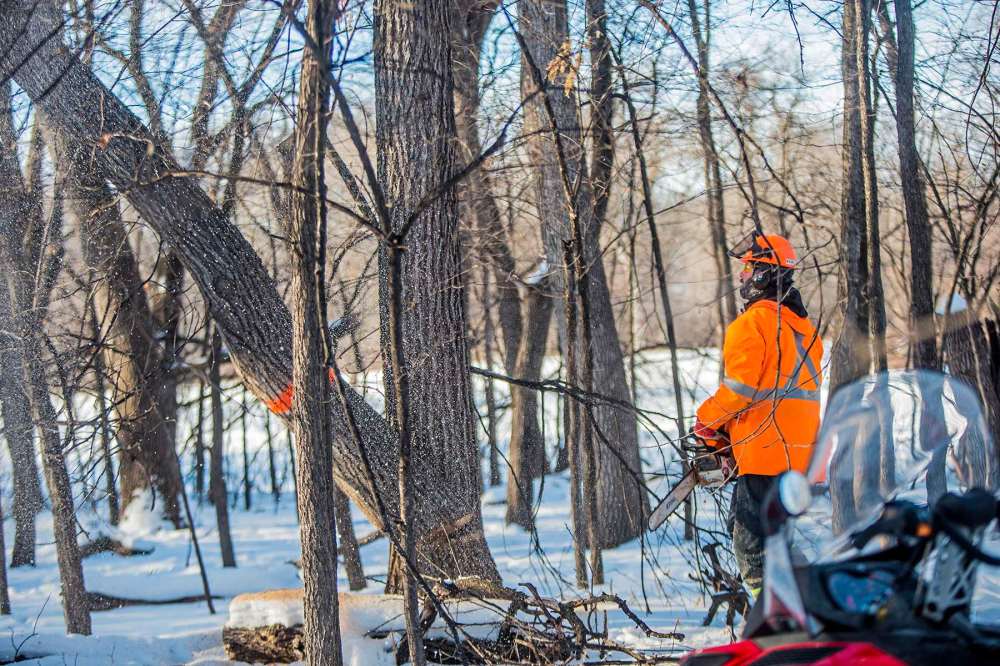
During the winter months, the City is removing diseased American elm trees and burning the wood. Do not take any of the wood rounds from the cut-up trunk — what Engel refers to as “cookies” — or the branches. “Taking diseased tree parts only moves the infection,” he said.
If an American elm has been removed from your property, Engel suggests planting a different species to improve diversity. If you have to have an elm, the Discovery elm species has been shown to be resistant to DED.
“I have several elms on my property,” he said. “They define my yard. They provide shade in summer and block wind in winter. The hoar frost we saw recently created all kinds of magic. I sincerely hope that everyone will take an interest in preserving our elm trees.”
For more information, see treeswinnipeg.org/dutch-elm-disease/