


Science Rendezvous explores Manitoba ecosystems
Science chase challenge
Advertisement
Hey there, time traveller!
This article was published 30/04/2021 (1946 days ago), so information in it may no longer be current.
Manitoba’s ecosystems, both at large and at a microscopic level, will be explored online during the annual Science Rendezvous Winnipeg hosted by the city’s two major universities.
The May 8 event is aimed at educating and entertaining elementary school students, with an eye to getting them excited about science, math and engineering, according to the organizers. The free event is part of Science Rendezvous, Canada’s largest public science outreach event.
“This year’s ecosystem theme will draw your attention to ecosystems unique to Manitoba, and to your personal ecosystems, such as your gut bacteria, or the RNA which is part of your cells and also plays an important part in the MRNA used in the coronavirus vaccines,” said Jennifer MacRae, communications and outreach with the faculty of science at the University of Manitoba.

Students and faculty at the U of M and the University of Winnipeg worked on five challenges that are a part of a national Science Chase activity on May 8, and also on an elementary school tree planting challenge to be held in June.
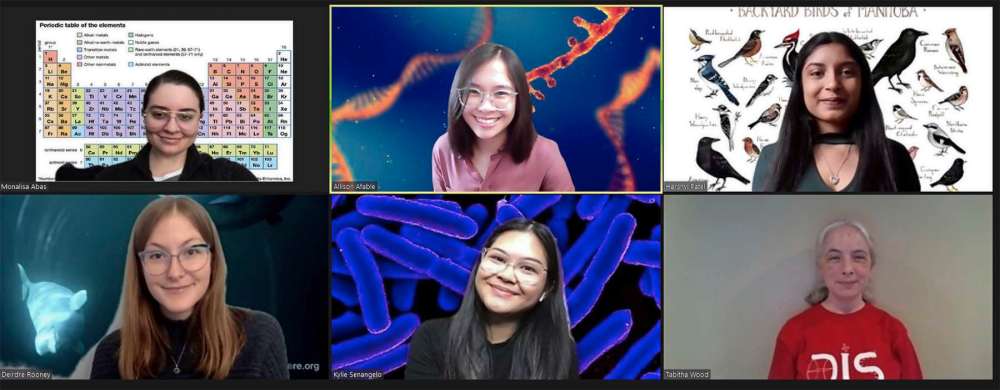
U of W students Allison Afable, Harshvi Patel, Deirdre Rooney and Kylie Senangelo have been working remotely as a group to plan activities, with leadership from associate dean of science Dr. Tabitha Wood and master of science in bioscience, technology and public policy student Monalisa Abas.
Four of the online science race challenges were set by the U of W students, with the fifth coming from the U of M. The first four challenges include experiments to be conducted around the topics of the Christmas Bird Count, Microorganism Games, Little White Whales, and RNA sculptures. The final challenge is on the topic of Trees Native to Manitoba.
While Patel and Rooney have taken part in Science Rendezvous activities in the past, this is a first-time experience for Afable, Senangelo and Abas. All say the experience has inspired them to want to be more involved in science outreach in the future.
“The thing that I enjoy most about the Manitoba Citizen Science project is exploring the various ways in which citizens can take part in science research, regardless of their knowledge or background,” said Patel.
Rooney’s activity introduces participants to Beluga Bits, a citizen science project that allows interested individuals to actively participate in the classification and identification of belugas. Afable is leading an eteRNA game, where players solve puzzles related to the folding of RNA molecules. Patel’s activity introduces participants to the Christmas Bird Count, a census of early-winter bird populations that helps conservation biologists and naturalists assess the population trends and distribution of birds in Manitoba.
Senangelo is leading a Colony B game, where participants identify clusters of bacteria to contribute to research on the human microbiome. “The game helps us understand how each person has a different digestive system bacteria depending on their diet, lifestyle, and other things,” Senangelo said. “This is important because it shows people how science affects them directly. I believe that making people aware of this can help continue and improve the support given to research.”
In addition to the mentorship they are receiving from Wood and Abas, the undergrad students have received funding to support their projects.
Rooney’s work is supported by UWinnipeg’s experiential learning fund, Patel is supported by UWinnipeg’s work study program, and Afable and Senangelo received Canada summer jobs grants, allowing them to gain work experience through science outreach activities.
The Win Herbarium, a vascular plant collection at the U of M, is one of North America’s largest collection of plant species and seeds, according to MacRae, and it planted the seed for the fifth challenge. “We’ve set the science chase challenge to have students identify leaves from Manitoba trees,” she said.
In a non-pandemic year, the Science Rendezvous would attract up to 7,000 visitors at the two university campuses and require 800 volunteers to run the hands-on activities, which showcased robots and race cars, arctic research and see kids putting their hands into goo, and watching lots of chemical reactions going off. This is the second year the annual event has been offered remotely.
U of M dean of the faculty of Science, Stefi Baum said the Science Rendezvous plays an important role in showcasing the wonders of science to all.
“It also helps our students develop their leadership skills, connect with each other and with the broader community. The ability to simplify complex ideas and present them in a way that even the youngest audiences can understand — something which most scientists still find challenging — is probably one of the most important skills students develop by being involved in Science Rendezvous,” Baum said.
MacRae said the U of M students learn about how to communicate science to younger grades and people who don’t have a science background. “Our students have to think about how to make the information fun and accessible, and about how they can animate the presentations with graphics or videos,” she said.
U of M students are also working on how the June 10 tree planting event will happen at Manitoba elementary schools. The school tree planting challenge will see up to 5,500 white spruce trees planted in the province by grade 5 and 6 students.
“Never a dull moment when you are volunteering for Science Rendezvous. I have learned about our ecosystem in Manitoba, met brilliant people, and communicated science like never before!” U of M graduate student in computer sciences Kimia Shadkami said.
For more, see www.sciencerendezvous.ca/event_sites/university-of-manitoba/