


Hockey training goes high-tech
Advertisement
Hey there, time traveller!
This article was published 02/11/2011 (5370 days ago), so information in it may no longer be current.
There was a time — not so long ago — when the most “high-tech” thing the average minor hockey player encountered was an automatic skate-sharpening machine at the entrance to their neighbourhood rink.
Those days have gone the way of the wooden stick, a relic lost in a sea of carbon fibre, Kevlar and titanium.
Today, young players and teams in Winnipeg have access to many of the same training tools as their NHL heroes. Whether they want to improve their skating, stickhandling or shooting, there’s a 21st-century gizmo ready to help.
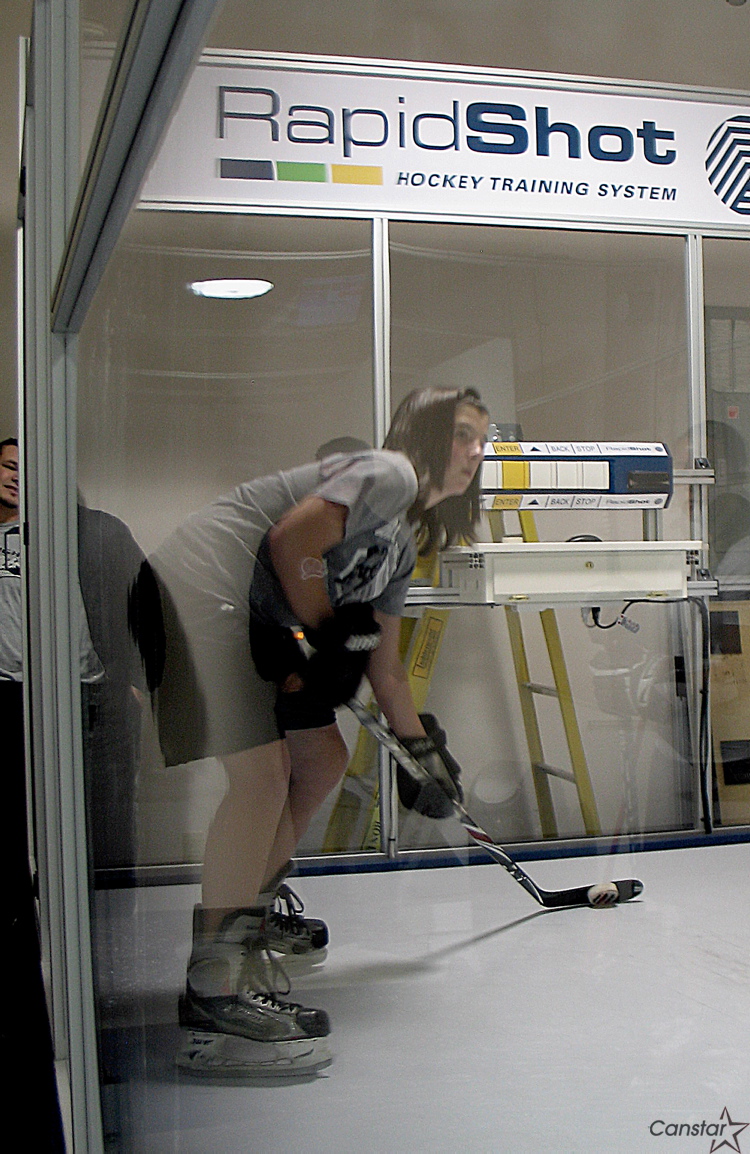
The latest futuristic devices to come down the pipeline arrived last week at NRG Athletes, a training centre on Dublin Avenue. Owner Scott Miller believes the RapidShot and RapidHands systems that he just installed will propel his athletes to harder and more accurate shots, and more effortless control of the puck.
The simplest way to describe RapidShot is as a batting cage for hockey players — but that doesn’t do it justice.
“This is the only one in a training facility in Manitoba,” said Miller, a Garden City resident. There is a similar machine in Pro Hockey Life’s St. James Street store, but it’s only used to sell sticks and players can’t wear their skates.
In Miller’s gym, players wear their blades on a synthetic ice surface as they take passes from the machine — at speeds ranging from 32 to 61 km/h and at intervals of 1.6 to four seconds between each pass — and then shoot at targets.
Each corner of the net has three coloured targets that get progressively smaller and a light that indicates where to shoot.
Sensors along the walls and on the targets measure everything from the shot’s accuracy and velocity to the player’s reaction time.
“We want to work on accuracy and reaction time first,” said Colan Jackson, a Riverbend resident who is one of Miller’s instructors. “Then we build up speed. The players all want to see how fast their slap shots are, but we want them to take snap and wrist shots first.”
After a cycle of 16 shots, players can crunch all the numbers they desire on a computer monitor. If they swiped their own personalized card before shooting, they can even go to a website to compare their stats against everyone in the world, including pros like Ryan Kesler (who has a machine in his garage) and Alexander Ovechkin (who has a machine in Russia).
“It was really good,” said Savannah Rennie, a 12-year-old centre from East St. Paul, after taking her first crack at the machine. “It’s exciting. It gives you a better feel for what it will be like on the ice.”
Rennie, who said she was hoping to work on a quicker release, was at the gym with her Selkirk Fishermen teammates.
The players were also put through the paces on RapidHands, a system that is designed to develop puck-handling skills.
Players — again, wearing skates — are forced to keep their heads up, and based on the instructions on a monitor must stick handle over one of five sensors.
Gord Smith, the coach of the St. James Canadians AA peewee team, was impressed after his team’s first encounter with the new technology.
“It’s going to be really good for the kids,” Smith said. “Their stick handling will really improve.”
Miller is hoping to get 15 teams using his facility regularly, leaving 20 to 30 hours a week for individuals to use RapidShot and RapidHands.
A strong, accurate shot and the ability to control the puck like it’s on a string are all good and nice.
But hockey still comes down to explosive skating ability. And that’s where the skating ramp at THC Winnipeg comes into play.
Jeff Wood, a North Kildonan resident who manages high-performance training at the MTS Iceplex-based facility, said the 60-foot ramp with a synthetic ice surface was the first of its kind in Canada.
“Hockey nowadays is all about winning short races, and battles for the puck,” Wood said.
Timing sensors measure how long it takes players to get 10 yards up the ramp, which has a 4% incline.
During the summer, everyone from eight-year-olds to NHL superstars can be found powering up the ramp, sometimes with bungee cords adding even more resistance.
The fastest clocked time? Jonathan Toews at 1.03 seconds.
“Travis Zajac has been close to that,” Wood said. “Cody Eakin is really explosive. And Zach Bogosian… I bet he’d be pretty close.”
Head downstairs and take a stroll to a remote corner of the Iceplex and you’ll find the Ice Lab, a small rink dedicated to training goaltenders. Soon, there will be a high-definition video camera trained on one of the creases and a big-screen TV on the wall.
Goalies will be able to watch themselves in slow-motion, and even superimpose themselves over images of NHL netminders making saves so they can see how their technique matches up.
With all this technology, what else can they come up with? Better prescription lenses for the referees may be all that’s left.
avi.saper@canstarnews.com