


An Olympic upset made in Winnipeg

Advertisement
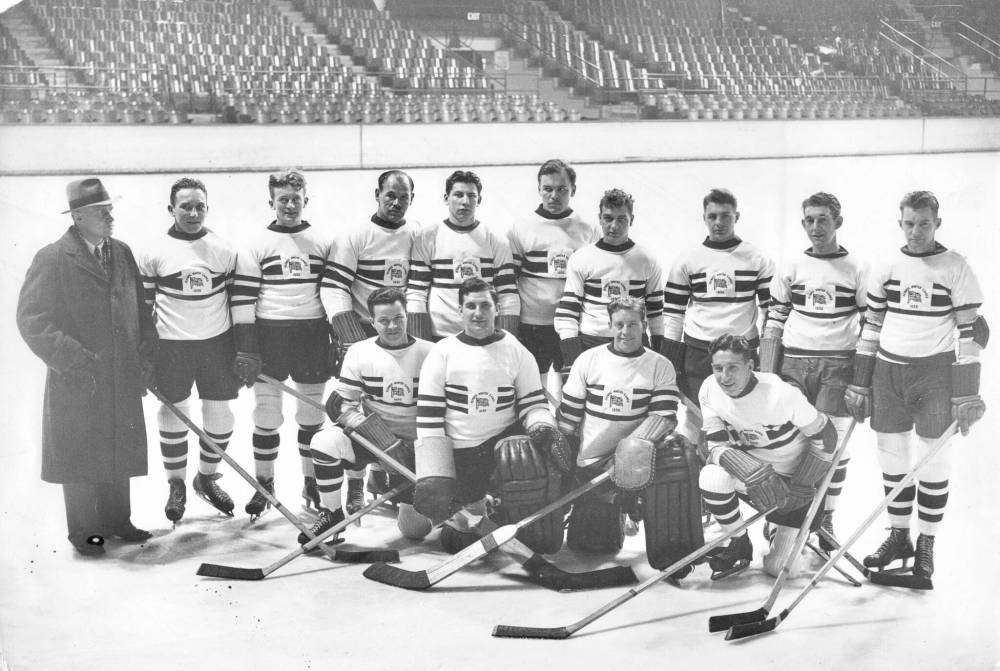
The name Jimmy Foster might not be familiar to many Manitoba sports fans. He did, however, play the major role in one of the biggest upsets in Olympic hockey history in 1936 – when Great Britain won gold.
Hockey historians will know that the Winnipeg Falcons captured the gold medals in the first Olympic hockey competition in 1920. In the next three Winter Olympics, Canada continued to be the best in the world. In 1924, Canada was represented by the Toronto Granites, who had won the Allan Cup, emblematic of the Canadian senior championship the previous two seasons. In 1928, the rep was the Toronto Varsity Grads, and the Winnipeg Hockey Club, a.k.a. the Winnipegs, was on top of the world in 1932. Both were Allan Cup champions. The Winnipegs lineup included future Manitoba Hockey Hall of Fame members Bill Cockburn, Vic Lindquist, Walter Monson and Romeo Rivers.
A goaltender, Foster was born in Glasgow, Scotland, and came to Winnipeg with his family when he was six. Beginning in 1922-23, he played three seasons of junior for the Argonauts and the University of Manitoba and then senior with several teams, including the Winnipegs and the Elmwood Millionaires. Foster moved east for the 1931-32 season and helped the Moncton Hawks win back-to-back Allan Cups in 1933 and 1934. English hockey then came calling and Foster joined the Richmond Hawks in London. His coach in Moncton and England was Percy Nicklin, whose son Jeff won the Grey Cup with the Blue Bombers in 1935 and 1939.
puckstruck.com
The Great Britain team which won the gold medal in hockey at the 1936 Winter Olympics in Garmisch-Partenkirchen, Germany. Winnipeg-raised goalie Jimmy Foster, the team’s undisputed star, is second from right in the front row.
The 1936 Winter Olympics were held in Garmisch-Partenkirchen, Germany, with 15 countries competing in hockey from Feb. 6–16. Due to players either moving away or being unavailable, the 1935 Allan Cup champion Halifax Wolverines could not represent Canada, so the runner-up Port Arthur Bear Cats were selected as the replacement. The Port Arthur squad was bolstered with players from other Canadian teams plus former Bear Cat Jim Haggarty, who was playing in England for the Wembley Canadians.
In addition to Foster, the Great Britain team, identified as England at the time, had right winger Alex (Sandy) Archer and several other British-born players who had moved to Canada. In Manitoba, Archer played for the Millionaires, the Native Sons and the Selkirk Fisherman before joining the Saint John Beavers in New Brunswick. Foster and Archer were originally ruled ineligible to play by the International Ice Hockey Federation (IIHF) because they hadn’t received releases from the Canadian Amateur Hockey Association. The CAHA, headed by E.A. Gilroy of Portage la Prairie, withdrew its protest on the eve of the competition.
On the ice, the teams were divided into three divisions of four teams and one of three. Canada topped group A, Germany and the United States tied in group B, and Czechoslovakia took group C. England won two straight in the three-team fourth group. The top two countries in each division advanced to the semi-final round.
Canada and England were placed in the same four-team group. In our country’s first loss in Olympic hockey history, England upset Canada 2-1. Twenty seconds into the game, Gerry Davey from Port Arthur, who had played for the Elmwood midgets, lobbed a long shot that fooled Canadian goalie Dinty Moore. Ralph St. Germain tied it 13 minutes later. The winning goal was scored by Ed Benchley from Niagara Falls on a pass from Winnipeg-born Gordon Dailley, a former St. John’s College student.
Now the format became complicated. Olympic authorities announced after the second round that those matches would count in the third-round standings. To add to that, another complex rule meant that a team which had beaten another team in the previous round did not have to play that team again and would be awarded two points for the victory. Canada would thus not have the opportunity to avenge the defeat by England. A 5-0 win over the Czechs and a scoreless tie between England and the United States that included three overtime periods gave Foster and his teammates five points and gold. Canada earned four with shutouts over the Czechs and the U.S.
A report in the Winnipeg Free Press read that never in Olympic history had anyone put on a more scintillating net-minding display than Foster. In seven games, he allowed just three goals and had four shutouts. His performance was rated as the best of the 1936 Games along with that of Norwegian figure skater Sonja Henie, who won her third straight gold medal.
Wikipedia
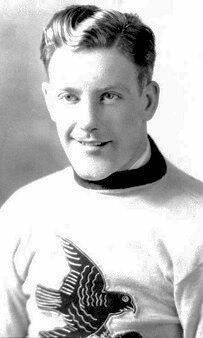
Jimmy Foster was inducted into the Manitoba Hockey Hall of Fame in 1992.
After helping England win silver in the world championships in 1938 and 1939, Foster returned to Canada and worked in Winnipeg until he died in 1969, at age 63. At the time of his death, Winnipeg’s Stew MacPherson, who broadcast the game between Canada and England, told the Free Press that the game would have been no contest but for Foster.
Our province has been blessed with many great goalies, including Charlie Gardiner, Turk Broda, Sugar Jim Henry, Terry Sawchuk and Ed Belfour. Foster, who was inducted into the U.K. Hockey Hall of Fame in 1950, the Manitoba Hockey HOF in 1992, and the IIHF hall in 2023, may be the best who never played in the NHL.
T. Kent Morgan
Memories of Sport
Memories of Sport appears every second week in the Canstar Community News weeklies. Kent Morgan can be contacted at 204-489-6641 or email: sportsmemories@canstarnews.com
Our newsroom depends on a growing audience of readers to power our journalism. If you are not a paid reader, please consider becoming a subscriber.
Our newsroom depends on its audience of readers to power our journalism. Thank you for your support.
T. Kent Morgan
Memories of Sport
Memories of Sport appears every second week in the Canstar Community News weeklies. Kent Morgan can be contacted at 204-489-6641 or email: sportsmemories@canstarnews.com
Our newsroom depends on a growing audience of readers to power our journalism. If you are not a paid reader, please consider becoming a subscriber.
Our newsroom depends on its audience of readers to power our journalism. Thank you for your support.
Advertisement Advertise With Us
Advertisement Advertise With Us