



Our future will be secure
High school cybersecurity teams qualify for national finals

Advertisement
Hey there, time traveller!
This article was published 12/04/2023 (1088 days ago), so information in it may no longer be current.
Students at two Winnipeg schools are among Canada’s brightest young cybersecurity minds, and they have the awards to prove it.
Pembina Trails Early College’s sudo rm-rf/ team and a group called Syntax Error from Sisler High School have made the finals of the CyberTitan competition, scheduled for May 8 to 10.
Run by the Information and Communications Technology Council (ICTC), CyberTitan helps students develop digital and critical skills that will help them pursue education in cybersecurity and STEM (science, technology, engineering, and math).
Supplied photo
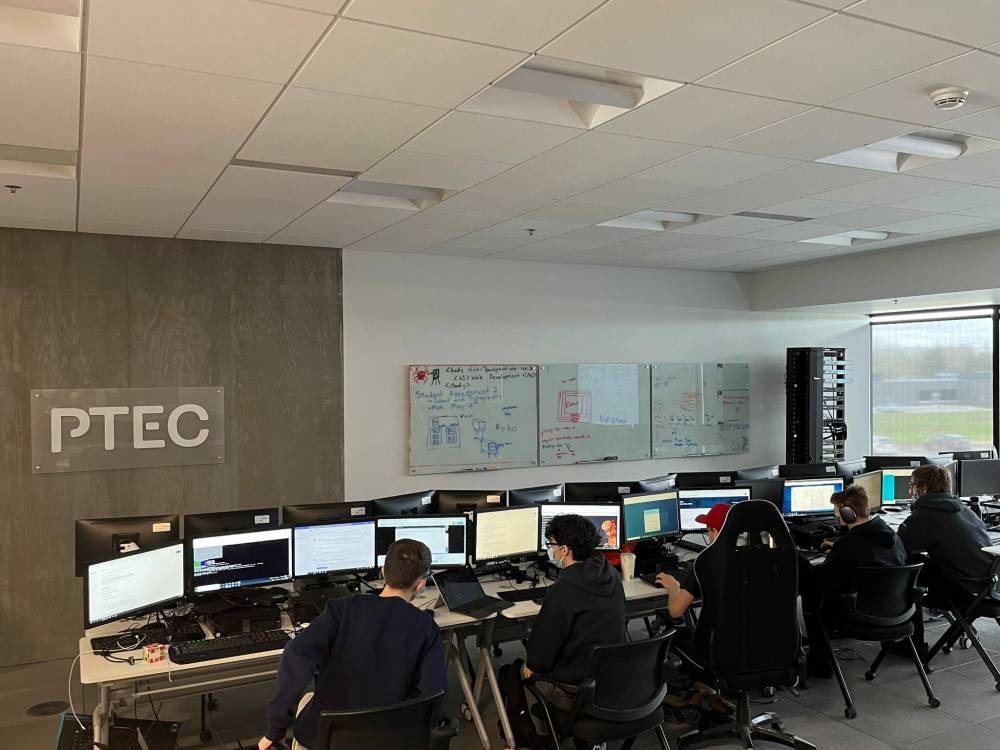
The Pembina Trails Early College CyberTitan team, which calls itself sudo rm-rf/, gathers one Saturday each month to work on the problem it was asked to solve.
Scott Hardman has coached PTEC’s students for four years. He credits his students for their dedication to the competition, which requires them to regularly attend school on Saturdays. Hardman helps them learn how to diagnose issues, discusses the latest developments, and brings mentors from companies such as Broadview Networks and Exchange Technology Services to share their experiences.
“As individual mentors, they are a little bit more familiar with cybersecurity practices and how to harden different operating systems,” Hardman said.
PTEC’s team is a blend of students from Grade 9 through Grade 12, and some of the older ones have competed for all four years they’ve been at the school. Beginning each fall, the team meets one Saturday per month for six hours. Its competition task was to diagnose, fix and secure a virtual operating system that organizers have tampered with.
“It’s quite lengthy and gruelling,” Hardman said. “There’s a lot of problem-solving and tough thinking they have to do. It’s amazing the things they do in a six-hour time frame.”
Hardman helps the students by preparing them for common industry themes he’s seen over the four years. He researches resources, learns about industry standards, and scans the news for topical examples.
One recent example involved a security vulnerability with Apache’s Log4j software. Hardman explained its importance and described what was done to prevent further damage. The team’s corporate mentors also discussed it.
“Having those mentors that come in is super important and valuable to this experience,” Hardman said.
If any students who participate in the competition opt to pursue a cybersecurity career, they’ll be welcomed with open arms, the ICTC said. While 124,000 cybersecurity professionals are employed in Canada, another 25,000 are needed. Across the world, the cybersecurity talent shortage is 2.72 million. In 202, the global cost of cybercrime totalled $6 trillion.
According to IBM, cyberattacks on Canadian companies are among the most expensive to fix. Forty per cent of small and medium-sized Canadian companies experienced virus and phishing attacks in 2021, while one-third saw Trojan or spyware attacks and 27 per cent experienced ransomware attacks.
Tony Zerucha
East Kildonan community correspondent
Tony Zerucha is a community correspondent for East Kildonan. Email him at tzerucha@gmail.com
Our newsroom depends on a growing audience of readers to power our journalism. If you are not a paid reader, please consider becoming a subscriber.
Our newsroom depends on its audience of readers to power our journalism. Thank you for your support.
Tony Zerucha
East Kildonan community correspondent
Tony Zerucha is a community correspondent for East Kildonan. Email him at tzerucha@gmail.com
Our newsroom depends on a growing audience of readers to power our journalism. If you are not a paid reader, please consider becoming a subscriber.
Our newsroom depends on its audience of readers to power our journalism. Thank you for your support.
Advertisement Advertise With Us