


Recovery through a new lens
Men’s continued recovery program uses collaboration as an asset

Advertisement
Hey there, time traveller!
This article was published 19/02/2025 (564 days ago), so information in it may no longer be current.
Matthew Hodgins has been involved with the men’s continued recovery program at St. Raphael’s Wellness Centre (SRWC) since 2021.
His focus is on providing support to vulnerable men learning to negotiate the world as newly sober people, often after years of living with addictions. It’s not easy work, as men are historically hesitant when it comes to discussing vulnerability.
“(It’s) not the requirement, but I think most guys end up in this group after completing a residential program, and the focus is to stress the importance of aftercare and having supports after you leave treatment,” Hodgins said.
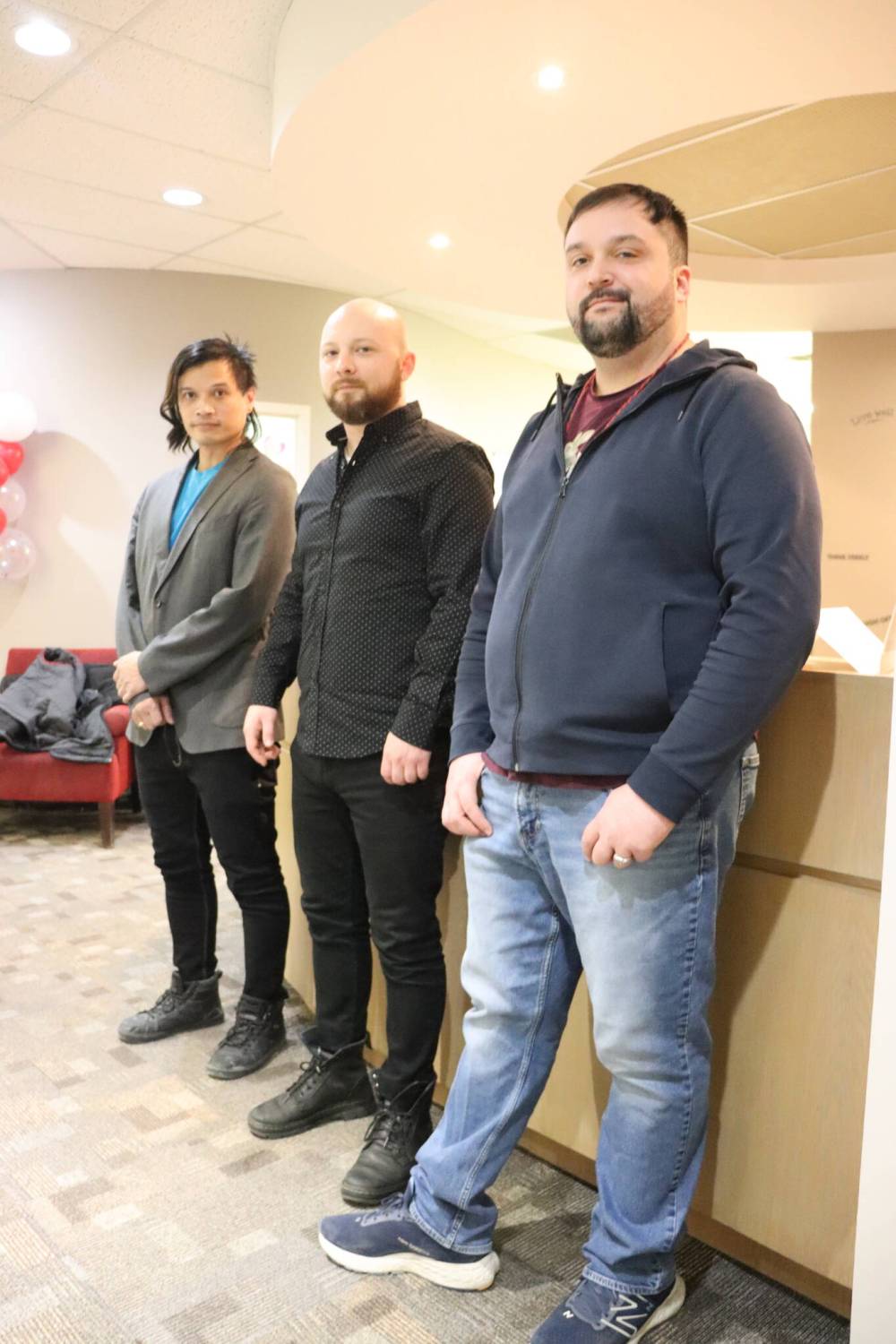
Photo by Emma Honeybun
(From left) Francis Liwanag, Matthew Hodgins and Josh Dyer are pictured at St. Raphael’s Wellness Centre (280 Smith St.) recently. Hodgins facilitates the non-profit’s continued recovery group for men, while Liwanag and Dyer are both participants.
Men’s recovery participants attend 40 sessions, held Monday, Tuesday and Thursday afternoons at St. Raphael’s Wellness Centre and work towards a certificate. Many participants end up attending SRWC’s evening sessions even after their 40 sessions are up, Hodgins added.
The centre, a non-profit which focuses on helping individuals through recovery from drug and alcohol addiction, is located downtown at 280 Smith St. While the space itself is small, the program’s effect extends far beyond its square footage. Hodgins’ group is no exception.
Josh Dyer joined the program last November and said it’s been a very eye-opening experience. The 39-year-old celebrated four months of sobriety on Feb. 13. He originally began using cannabis in his 20s, he said, and then became dependent on alcohol and cocaine.
“I had 20-plus years of juggling substances in my life, and I was like, ‘I can’t just expect to be cured when I’m done here,’” he said, referring to his initial month of treatment.
Dyer felt settled in the SRWC group after the first few sessions, he said, adding that while similar programs give everyone a turn to speak, this one will direct participants in a specific direction relating to a theme — which can range from relationships to relapse prevention — and give everyone a chance to learn from each other and go in-depth about how they’re personally navigating certain aspects of everyday life.
“I quickly learned that addiction was just a small part of (myself),” he said.
“It felt so big. It was ruining my life, controlling me, but it was such a small part of who I am … Now, it’s like I’m just growing and expanding — obviously, the longer I’m sober, that stuff is helping, too — but I come here and it’s like it’s not a chore to come here. It’s like I want to be here and I want to listen, because I know I’m going to get something that I can keep this time.”
“(This is) the longest I’ve been sober since I ever had a sip of alcohol or trying cannabis,” Dyer continued.
“I’m starting to not rush through life like a chicken with my head cut off … the curriculum here, and a great instructor, has brought together very meaningful experiences for me. Combined with my own actual putting my foot down and taking some steps … I feel very hopeful for my future, now.”
“This program reinforced my mental health,” said Francis Liwanag, who is also a participant, adding that he’s combined the regular sessions with 12-step work outside SRWC.
“I’m very happy with where I am in life right now, really. I mean, there’s good things to happen soon enough, but I’m comfortable taking the pace that I am right now to get to that point,” he said.
The program is open to men who have been sober for a month. It’s not free, but St. Raphael’s offers a sliding pay scale. Alongside the guided sessions, there’s also room for fun in the form of games and activities Hodgins organizes for the group.
For example, Valentine’s Day meant a lesson on self-care, which was accompanied by a quiz to win a self-care package to take home.
Each week, one person is awarded a ‘rock star certificate’ to help recognize their ongoing work throughout the recovery process.
“If you can maintain your sobriety in a society that’s quite obsessed with alcohol and just chasing dopamine in general, you can achieve anything,” Hodgins said.
“Don’t let them get you down,” Liwanag added.
St. Raphael’s Wellness Centre also offers programs for women, mothers, and families. For more information, or to donate, visit srwc-mb.ca
Our newsroom depends on a growing audience of readers to power our journalism. If you are not a paid reader, please consider becoming a subscriber.
Our newsroom depends on its audience of readers to power our journalism. Thank you for your support.
Our newsroom depends on a growing audience of readers to power our journalism. If you are not a paid reader, please consider becoming a subscriber.
Our newsroom depends on its audience of readers to power our journalism. Thank you for your support.
Advertisement Advertise With Us
Advertisement Advertise With Us