


The wonders of a betta fish

Advertisement
Hey there, time traveller!
This article was published 29/01/2014 (4551 days ago), so information in it may no longer be current.
The Siamese Fighting Fish has long been a staple of the pet industry. These hardy, gorgeous fish have so many things going for them they can’t help but be the most popular aquatic pet.
First, they are beautiful. Most of the ones we see in pet stores are males, mainly because like so many animals in nature, the male is more gaudy to attract the female and fend off competing males. They are the home designer’s best pet friend, available in myriad colours, from icy blue white through to the deepest blue, or a full pallet of reds, pinks and purples. But don’t expect to find them in green, orange or black. Those colors are extremely rare at best.
Second, they are very undemanding in their environment. Part of the anabantoid (from the Greek word to “travel up”) group of fish, they have what is basically a rudimentary lung in their heads known as a labyrinth organ. This allows them to get oxygen from air instead of through their gills, which is very important as the waters they come from, usually rice paddies or seasonal waters, rarely have enough oxygen to support fish with only gills.
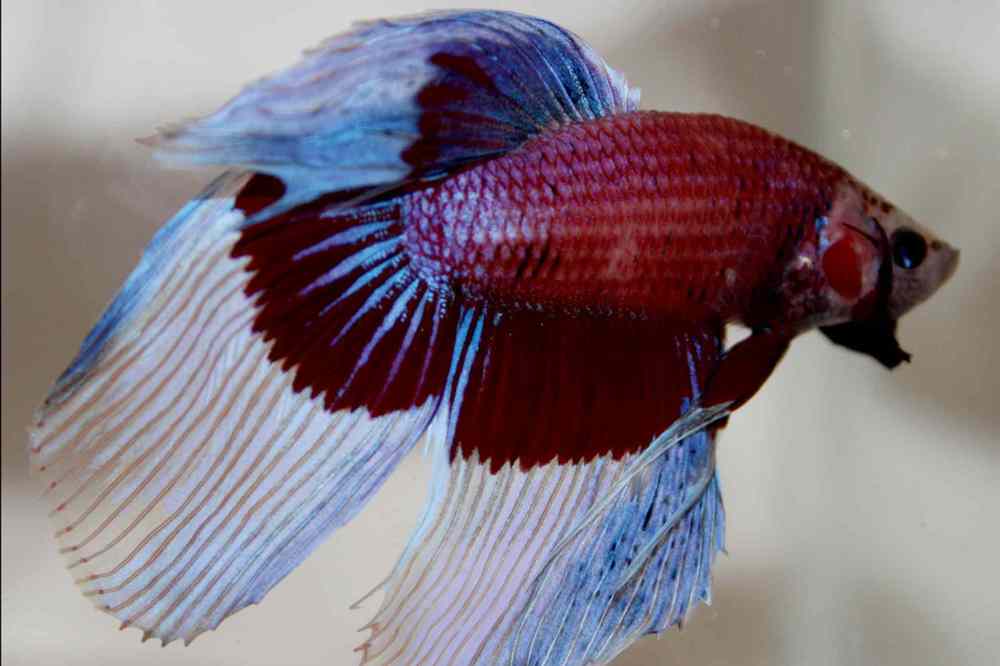
Third, they are solitary animals. They do not do well in a group, hence the “fighting fish” name. In their native Thailand, they are bred for this trait, and are bet on much the way we bet on mixed martial arts or boxing in North America. Two short-finned males are put together, where they will display and peck at each other until one submits and retreats to a corner of the bottom in the tank. But this, with the ability to breathe air, makes them a great bowl fish.
We recommend them in two-litre to two-gallon bowls or tanks. These don’t need aeration or filtration, as they live in stagnant waters. In fact, many male bettas with long fins can actually be disturbed by moving water, and end up hiding away from the flow.
Bettas do come from a very tropical area where the temperatures can reach 92 degrees Fahrenheit (34 degrees Celsius). But many will do well in normal room temperature (72F, or 21C). If they act sluggish, or don’t seem to want to eat, it may be because they are at too low a temperature. As well, many houses and offices have setback thermostats which reduce the temperatures at night, and this can be disastrous for Bettas. In these cases, you may need a heater for the bowl/tank. Not just a light, as they don’t want 24-hour light, and then it will get cold at night. There are many small heaters now on the market designed specifically for the purpose of keeping small tanks warm.
Males will often build a “bubble nest” in their bowl/tank. This is a sign of a happy, healthy fish. In the wild, they use these bubble nests to provide an area of oxygenated water for the eggs and fry to develop in, until they develop their own labyrinth organ. A male with a big bubble nest will attract a female, and after spawning, the male will spit the eggs up into the nest and chase the female away. He then cares for the eggs and babies, replenishing the bubbles and catching any eggs or fry that fall out and replacing them in the nest, until they can escape him and strike out on their own.
A few pellets of food a day and a water change every week or two is all the care these little fellows need. For someone wanting a gorgeous, low maintenance pet, these guys are perfect.
Contact Jeff with your questions or ideas at aardvarkpets@shaw.ca or visit www.aardvarkpets.com
Jeff McFarlane
Pets Are People, Too
Jeff McFarlane is the owner of Thrive Pet Food Market. Contact him with your questions or ideas thrivepetfoodmarket@shaw.ca or visit www.thrivepetfoodmarket.com
Our newsroom depends on a growing audience of readers to power our journalism. If you are not a paid reader, please consider becoming a subscriber.
Our newsroom depends on its audience of readers to power our journalism. Thank you for your support.
Jeff McFarlane
Pets Are People, Too
Jeff McFarlane is the owner of Thrive Pet Food Market. Contact him with your questions or ideas thrivepetfoodmarket@shaw.ca or visit www.thrivepetfoodmarket.com
Our newsroom depends on a growing audience of readers to power our journalism. If you are not a paid reader, please consider becoming a subscriber.
Our newsroom depends on its audience of readers to power our journalism. Thank you for your support.
Advertisement Advertise With Us
Advertisement Advertise With Us