


Scotia Street hums with history

Advertisement
Hey there, time traveller!
This article was published 31/03/2015 (4085 days ago), so information in it may no longer be current.
This long and winding road may not have been home to the Beatles but guess who lived at 199 Scotia St.? Apparently, Randy Bachman lived there for a time while Burton Cummings lived not too far away on Bannerman Avenue.
There is a heap of history to discover on Scotia, not all of it of the rock ’n’ roll kind.
The name Scotia, Latin for Scotland, appears in the Winnipeg Free Press as far back as 1900. The tree-lined road winds and curves along the Red River, following the unique twists and turns of the river itself.
It was along these banks that much of the original Red River Settlement was located and it is to this area that Lord Selkirk came in 1817, when he is said to have dubbed the settlement Kildonan, named for the area in Scotland from which many of the settlers hailed.
In 1913 the area was promoted as a new suburb. Advertisements boasted that it was “situated on the Red River, where every pleasure of a summer resort can be had. Good boating and bathing, etc.”
Scotia was billed as the new “Wellington Crescent of the North.”
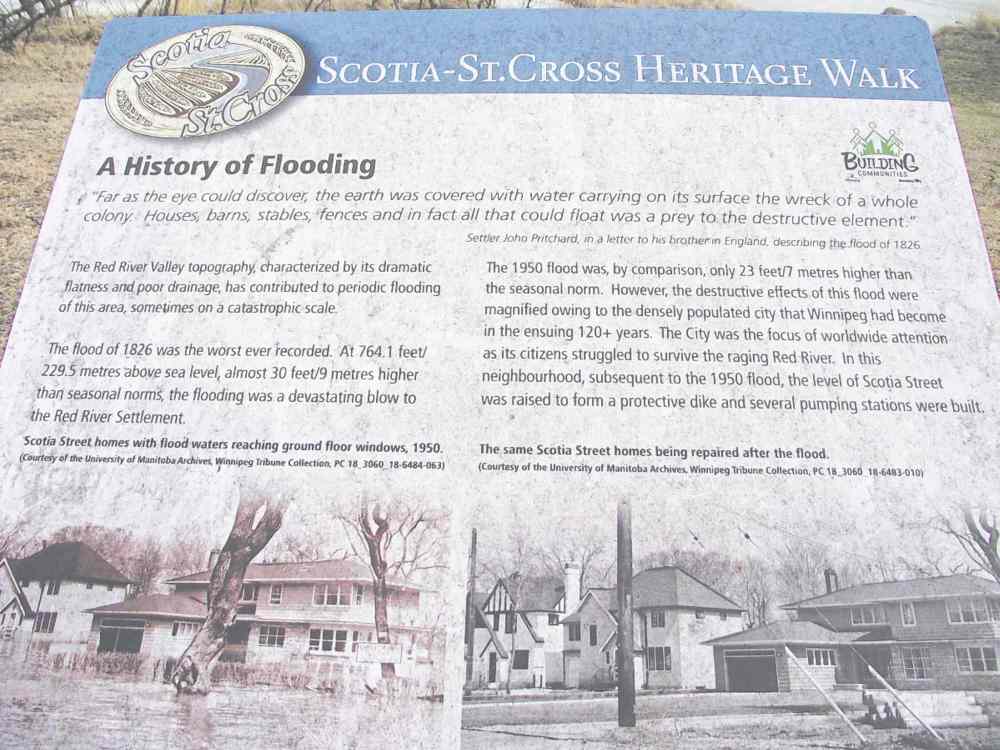
Today, those walking or biking in the area will notice plaques along the way, all part of a self-guided history tour known as the Scotia-St. Cross Heritage Walk.
First up on the tour is the idyllic Kildonan Park, founded in 1910 on land once belonging to several Selkirk Settlers.
Close by is the Louis Greenburgh Plaza named for a local community minded resident and Second World War pilot who led the battle to preserve that particular piece of land. A plaque here briefly describes the flooding that continually plagued the area. A marker visually illustrates the different flood levels.
Beside the plaza looms the large Marymound complex constructed around the historic, 23-room brick mansion built by E.P. Leacock in 1882. The extravagant Leacock was the uncle of the famous author Stephen Leacock.
Further down Scotia there is a plaque near Seven Oaks Boulevard. describing the original settlement and how it was divided into 24 narrow strips of land running back from the river.
A plaque in front of the Ukrainian Catholic Archeparchy traces the history of the Ukrainian and Jewish communities that later settled in the area.
On St. Cross Street, near the cathedral, a plaque highlights the historic St. John’s Anglican Cathedral and St. John’s Park nearby. There, a map depicts the original river lots.
Many notable people lived on Scotia, including Louis Slotin, R.F. Morrison and George Gardiner to name just a few.
And if we were really takin’ care of business, there are many places in North West Winnipeg that would be worth recognizing with plaques, green spaces and similar walkways.
Here’s hoping!
Cheryl Girard is a community correspondent for West Kildonan. You can contact her at girard.cheryl@gmail.com
Cheryl Girard
West Kildonan community correspondent
Cheryl Girard was a community correspondent for West Kildonan.
Our newsroom depends on a growing audience of readers to power our journalism. If you are not a paid reader, please consider becoming a subscriber.
Our newsroom depends on its audience of readers to power our journalism. Thank you for your support.
Cheryl Girard
West Kildonan community correspondent
Cheryl Girard was a community correspondent for West Kildonan.
Our newsroom depends on a growing audience of readers to power our journalism. If you are not a paid reader, please consider becoming a subscriber.
Our newsroom depends on its audience of readers to power our journalism. Thank you for your support.
Advertisement Advertise With Us