


A bridge between worlds
Advertisement
Hey there, time traveller!
This article was published 13/11/2015 (3828 days ago), so information in it may no longer be current.
Jade Hullen maintains her traditions in a modern world.
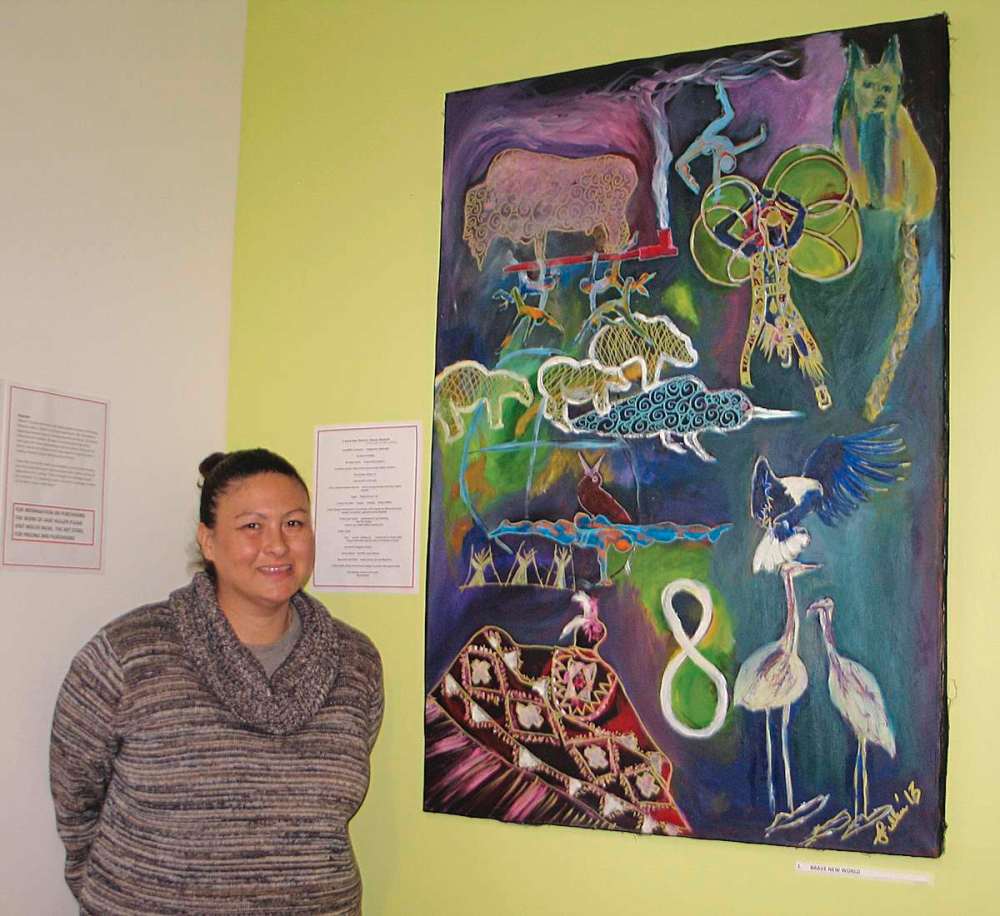
The Ojibwe artist’s first professional exhibition Brave New World is currently on display at Neechi Commons (865 Main St.).
The mixed-media exhibition touches on a wealth of subject matter, from water pollution problems to Hullen’s personal struggles, but there’s an underlying theme of the preservation of indigenous culture in a contemporary setting.
-Nov11.jpg?w=1000)
Brave New World’s eponymous painting best exemplifies that throughline, with a plethora of characters going in every different direction, but connected by one history.
“There is our people dancing, the hoop dance, which is a healing dance,” said Hullen, describing the components of the piece.
“There are bears, which represent introspection, the pipe which is a connection to the Creator, the buffalo which is respect, the lynx which is quiet watching and the bald eagle which is me, because I’m a Chief Eagle Woman (her spirit name). There is also the four directions symbol and the Métis symbol.
“There are also acrobats, which means we (indigenous people) can do everything today. We can bring in our gifts from back then, they are within us. We bring all of that forward as we walk today in whatever it is we choose to do.”
Hullen, 40, a West Broadway resident, is in a unique position to mix traditional and contemporary concepts. Adopted by a French couple, Hullen grew up in Winnipeg and France, where her mom would take her and her sister to art galleries, museums and castles.
It wasn’t until her 20s that Hullen began exploring her indigenous background and eventually identifying as indigenous. She noted a particularly enlightening experience in Baker Lake, Nunavut.
“I had this experience at the Co-op there,” Hullen said. “I was wearing a parka and I walked by a mirror and did a double take and said ‘Who’s that? Oh, that’s me. Whoa.’
“It was the first time I was in a community surrounded by indigenous people. The people I was staying with, the mom said to her son, ‘She looks more Inuk then you do.’ I thought that was amazing. That was the spark. It was the first time I had the experience of being around indigenous people and it was a beautiful moment.”
Hullen has since learned to connect her two cultures in her art. However, that connection wasn’t an easy one to make.
“I had to go through a period where I rejected my family, which I learned is a normal thing that happens when you’re an adoptee,” Hullen said. “But, I was able to get to this place where I am now, where I’m incorporating both cultures and I’m saying ‘It’s OK to be more than one thing.’”