



Searching for an elusive train

Advertisement
Hey there, time traveller!
This article was published 12/08/2016 (3531 days ago), so information in it may no longer be current.
I have always been curious to know where the small train that crosses Symington Road has come from and what its destination is.
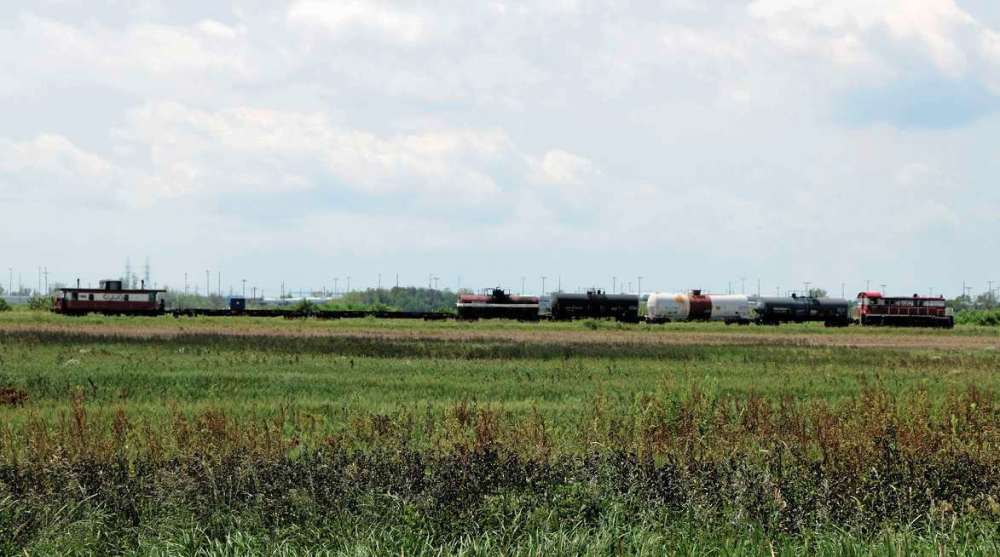
I have never been stopped at any of the crossings but I finally managed to grab a picture of the elusive train whose whistle I hear about once per month.
The Greater Winnipeg Water District Railway is a 168-kilometre stretch of track that runs from 598 Plinguet St. in St. Boniface to the aqueduct in Shoal Lake, Ont. Construction began on the line in 1914 and its purpose was to construct the main source of drinking water for the City of Winnipeg. The entire project was completed in 1919 at a final cost of $17 million dollars, which would be over $226 million in 2016 dollars.
That seems like a lot of cash to have spent in those days but the aqueduct has been noted among one of the world’s greatest engineering works. There is a 90 metre drop in the rail line/aqueduct from Ontario to Manitoba.
The line was used to transport workers to various sites along the way as well as residents of homes and cottages in Southeastern Manitoba. The railway raised revenue by selling the lumber that was cleared along the tracks, the gravel which was used for the rail bed and municipal road building, as well as hauling various supplies for customers along the way.
Until the 1950s the trains were hauled by steam locomotives, with the first diesel locomotive arriving in 1946. Three of the four locomotives that arrived in 1969 are still operating today and the city has recently been shopping for a new locomotive.
The railway now belongs to the City of Winnipeg and is used to haul chemicals and supplies to the Deacon Reservoir water treatment plant, the facility at Shoal Lake and also provides security and surveillance along the way.
Deacon’s Corner was named after Thomas Russ Deacon, the mayor of Winnipeg who drove the effort to secure the Shoal Lake Facility.
So now I know that when I hear that whistle there is a short little train with a red and white locomotive and a rare caboose, off to make sure our city has a safe and secure source of drinking water.
Louise Hedman is a community correspondent for Transcona.
Louise Hedman
Transcona community correspondent
Louise Hedman is a community correspondent for Transcona.
Our newsroom depends on a growing audience of readers to power our journalism. If you are not a paid reader, please consider becoming a subscriber.
Our newsroom depends on its audience of readers to power our journalism. Thank you for your support.
Louise Hedman
Transcona community correspondent
Louise Hedman is a community correspondent for Transcona.
Our newsroom depends on a growing audience of readers to power our journalism. If you are not a paid reader, please consider becoming a subscriber.
Our newsroom depends on its audience of readers to power our journalism. Thank you for your support.
Advertisement Advertise With Us