


Century-old McGregor Armoury is a busy place

Advertisement
Hey there, time traveller!
This article was published 15/08/2016 (3692 days ago), so information in it may no longer be current.
It’s not every day you see children using a Sherman M4A tank and a reconnaissance vehicle as play structures.
The machines are situated north of the McGregor Armoury, in Martin Park. The park is named after Lt.-Col. G. J. Martin, commanding officer of the Fort Garry Horse, who was killed in a training accident in 1969.
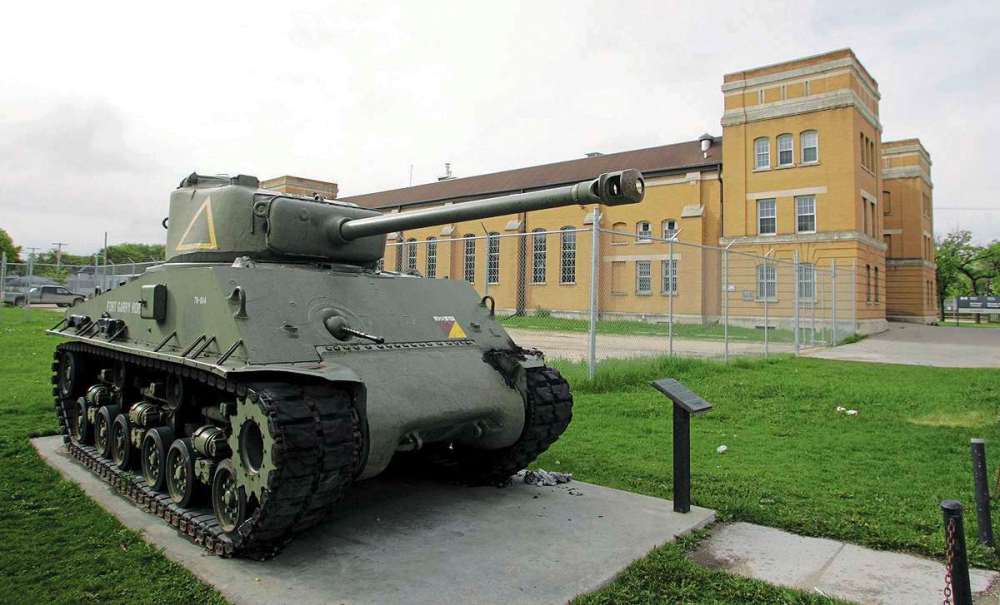
The “Garrys” are part of 38 Brigade Group, an armoured reconnaissance unit in the Canadian Army Reserve. Their role is to provide accurate technical information on the enemy and ground, using light, highly mobile vehicles.
Sharing the Armoury at the corner of Machray Avenue and McGregor Street is the 31 Engineer Squadron of the Canadian Army Reserve. Three cadet corps use the building in the evenings — 1226 Fort Garry Horse Royal Canadian Army Cadets; No. 6 Jim Whitecross Squadron, Royal Canadian Air Cadets; and No. 573 Andrew Mynarski VC Squadron, Royal Canadian Air Cadets.
During the 1920s, the large yellow brick structure served the community as educational and recreational space for the overflow from Ralph Brown School, the North Churches Baseball League and the Light Infantry Cadet Corps.
At the beginning of the Second World War, the Armoury became a recruiting centre and was transformed into a barracks, with tents pitched in its north field. The 17 and 19 Batteries of the Royal Canadian Artillery used the depot as its home throughout the war, and many men from the North End got their first taste of Army life here.
After the war the 16,575 square-foot building continued to support the Winnipeg Light Infantry as it returned from active duty. The community utilized the place for bingo, dances and other social events.
In 1965 Winnipeg’s own cavalry regiment, the Fort Garry Horse, rolled their Sherman tanks into the vehicle compound and made the building their home. The Garrys were formed in Winnipeg as the 34th Regiment of Cavalry in 1912 and served as a unit of the Canadian Cavalry Brigade in the First World War.
The Garrys trained on horseback until the beginning of the Second World War, when they became an armoured regiment. They were among the first to land on the Normandy beaches on D-Day and fought through France, Belgium, the Netherlands and into Germany.
The Fort Garry Horse Museum is located in the building and can be visited on Tuesdays from 7:30 to 10 p.m.
Freda Glow is a community correspondent for the North End.
Freda Glow
North End community correspondent
Freda Glow is a community correspondent for the North End.
Our newsroom depends on a growing audience of readers to power our journalism. If you are not a paid reader, please consider becoming a subscriber.
Our newsroom depends on its audience of readers to power our journalism. Thank you for your support.
Freda Glow
North End community correspondent
Freda Glow is a community correspondent for the North End.
Our newsroom depends on a growing audience of readers to power our journalism. If you are not a paid reader, please consider becoming a subscriber.
Our newsroom depends on its audience of readers to power our journalism. Thank you for your support.
Advertisement Advertise With Us
Advertisement Advertise With Us