


First English-Ojibwa bilingual school in Manitoba
Advertisement
Hey there, time traveller!
This article was published 19/09/2016 (3611 days ago), so information in it may no longer be current.
While tiny claps tried to follow the music’s rhythm, Riverbend Community School teacher Yvonne Young sang to celebrate their new English and Ojibwa bilingual program on Sept. 13.
For several decades, Aboriginal youth at residential schools were punished for speaking their own language. Some weren’t even taught, resulting in an imminent extinction of the tongue, as Derek Nepinak, Grand Chief of the Assembly of Manitoba Chiefs, said.
“We are introducing Indigenous languages in schools again so that the identity of our young people can flourish, can grow and that it can be celebrated, and that’s the way it’s supposed to be. We are supposed to celebrate diversity, we are supposed to celebrate who we are and where we come from,” he added.
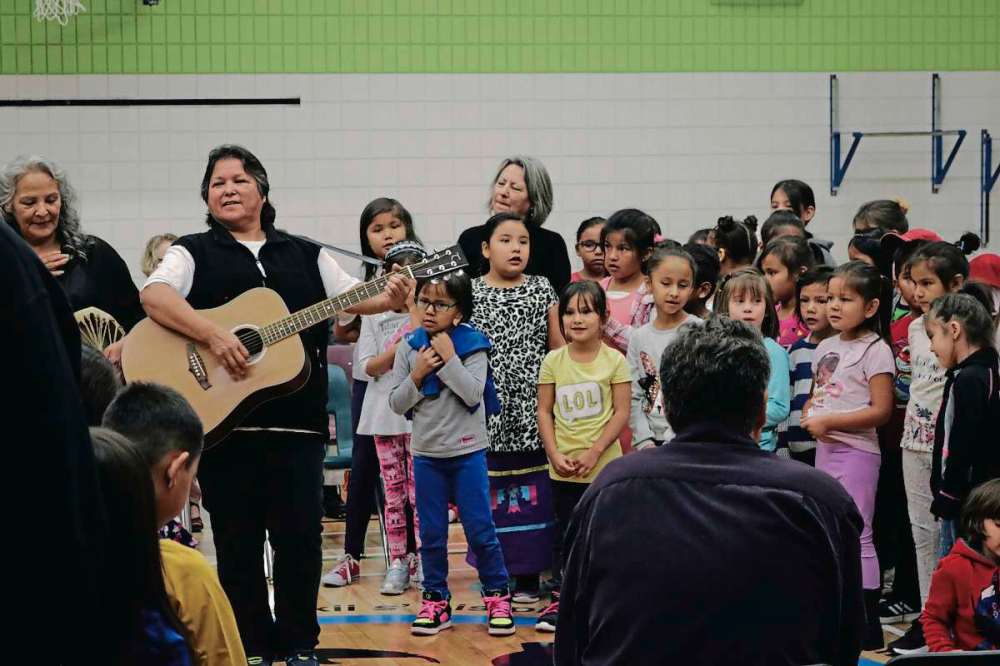
Nepinak cancelled several commitments in that morning to witness what he referred to as a historic event.
“It can’t be undervalued for what it is, it has to be recognized as a very important transition,” he said.
The milestone was especially important to him because his daughter attends Riverbend Community School and will learn more about her original culture. Frank Beaulieu, language and support worker at the school, added it’s an overwhelming feeling to know that the youth can regain their language.
Rebecca Chartrand, the Seven Oaks School Division Aboriginal education team lead, kicked off the initiative. The school division had the goal to open an Indigenous language immersion school and the development of language programming was identified as one of the key components. During this summer, many kids and parents participated in an Indigenous language camp where the Ojibwa language was introduced to them.
“We have a strong infrastructure here in Seven Oaks to support an initiative like this because we’ve laid down the foundation for the last number of years,” Chartrand said.
They’ve spent the last couple years hiring and training capable teachers that will provide learning experiences in Ojibwa.
Six months ago, SOSD received a grant from the National Indian Brotherhood and were able to move forward. What they thought would be a small program, already has a waiting list. The bilingual program is offered for kindergarten and Grades 1, 2 and 3.
Having a bilingual program is the first step for a future full-immersion Ojibwa school. There aren’t many resources available regarding curriculum and SOSD is working in creating one. Next year they’ll be opening the program for Grade 4 students.

“We have an amazing team of people working… We couldn’t do this without a community and team of people working together,” Chartrand said. “I think this is what reconciliation looks like.”
Brian O’Leary, Seven Oaks School Division Superintendent, told the students they are lucky to be part of a school that celebrates diversity. He asked the children to be grateful for Indigenous people because when new settlers came to Winnipeg, they welcomed them to their land.
“If you go back and talk to your families, you’ll find that lots of them left another place…either because they were expelled by the government, they ran out of food, ran out of jobs, or they weren’t safe,” he informed the children. “And thanks to the original people in this country we were made welcome. We owe our home to them. We are inviting them back in to once again share their culture, their history, their language with us.”
Nepinak said there has to be a commitment of First Nations communities when working with the First Nations Education Resource Centre to have more bilingual and full-immersion schools in Manitoba, where the language can survive.