



Norwood Honey brings extra buzz to the area

Advertisement
Hey there, time traveller!
This article was published 22/09/2021 (1645 days ago), so information in it may no longer be current.
Carol Wenaus has been stung a few times.
She doesn’t mind. It’s part of the gig. She’s a beekeeper in Norwood.
In early September, Wenaus set up shop in her front yard, selling 880 pounds of this year’s Norwood Honey crop.
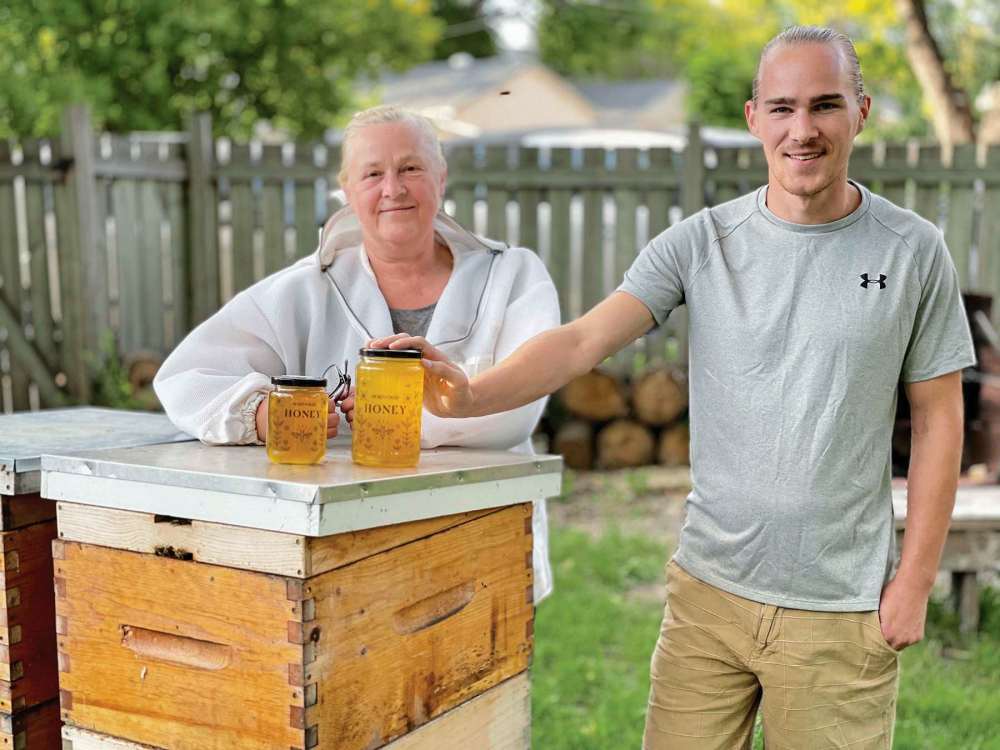
While beekeeping sounds like hazardous work, Carol sees it differently.
“I grew up on a farm and see my work with bees as a natural extension of my love for nature,” she said.
Five years ago, Carol and her son, Niklas Konowal, took a course in bees at the University of Manitoba through the faculty of agriculture. They also joined the Red River Apiary Association (RRAA) to connect with folks involved in urban and conventional beekeeping and to learn about best practices.
They began by purchasing ‘nucs’ or nucleus colonies of Manitoba-bred bees to ignite their four hives.
Each hive can house up to 60,000 bees. The single queen bee’s only job in each colony is to lay between 1,000 to 1,500 eggs a day and a male drone’s sole job is to mate with the queen. The female workers, who outnumber the male drones 100 to 1, do all the real work.
The life cycle of a bee colony follows the life cycle of flowering plants – each spring, the colony builds up its workforce; in summer, the workers leave the colony to gather nectar from various flowering plants for the honeycomb; in September, the bees slow down as temperatures cool.
In fall, Carol and Niklas jar the honey by removing the caps of wax from the wooden frames in each hive and spinning them to extract the precious bounty.
In winter, the hives are wrapped in insulated covers to keep the bees alive during winter until they emerge in spring to start all over again.
Successful hives require special attention to thrive. Bees require regular water and a special syrup solution just before winter. The hives are specially treated to ward off predators such as the invasive varroa mite.
Carol recommends patience and attention to detail for aspiring apiarists eager to build flourishing hives.
“Don’t worry about not having success in the first year,” she said. It takes time to establish the colonies. Learn as much as you can by joining the RRAA mentorship program.”
Norwood neighbour Deenie Halas is a regular customer.
“I’ve been buying Carol’s honey as Christmas and hostess gifts. It’s a unique made-in-Norwood gift,” Halas said.
The beautifully labelled honey jars sell for $10 (500 ml) and $20 (1 litre).
Contact Carol at norwoodhoneybees@gmail.com to purchase some of this year’s golden honey harvest.
Adriano Magnifico is a community correspondent for St. Boniface. You can contact him at anomag60@gmail.com and follow him on Twitter: @AnoMagnifico
Our newsroom depends on a growing audience of readers to power our journalism. If you are not a paid reader, please consider becoming a subscriber.
Our newsroom depends on its audience of readers to power our journalism. Thank you for your support.
Our newsroom depends on a growing audience of readers to power our journalism. If you are not a paid reader, please consider becoming a subscriber.
Our newsroom depends on its audience of readers to power our journalism. Thank you for your support.
Advertisement Advertise With Us