


Big benefits to kennel training

Advertisement
Hey there, time traveller!
This article was published 20/10/2015 (3897 days ago), so information in it may no longer be current.
Things change in a household when you bring home a new pet. Adding a puppy to your family creates a new set of routines and responsibilities, for both the family and the pet.
Once you have your puppy home, there are decisions to be made. A big one is whether to kennel train or not. Each dog and each situation is different. Personally, I think that kennel training is a great thing for most dogs, and a must for anyone who travels.
Kennel training is easy, and has the added benefit of reducing damage to the home that can happen while you are away. Giving a pet a set routine, with boundaries to which it is trained, can actually make him or her better adjusted. Some people think that locking dogs away when you aren’t home is cruel, and that they should be left to roam. Most dogs can handle this freedom and just lay in one spot most of the day anyway, which is what they would do in the kennel. But some get into trouble, and that’s what we are trying to avoid.
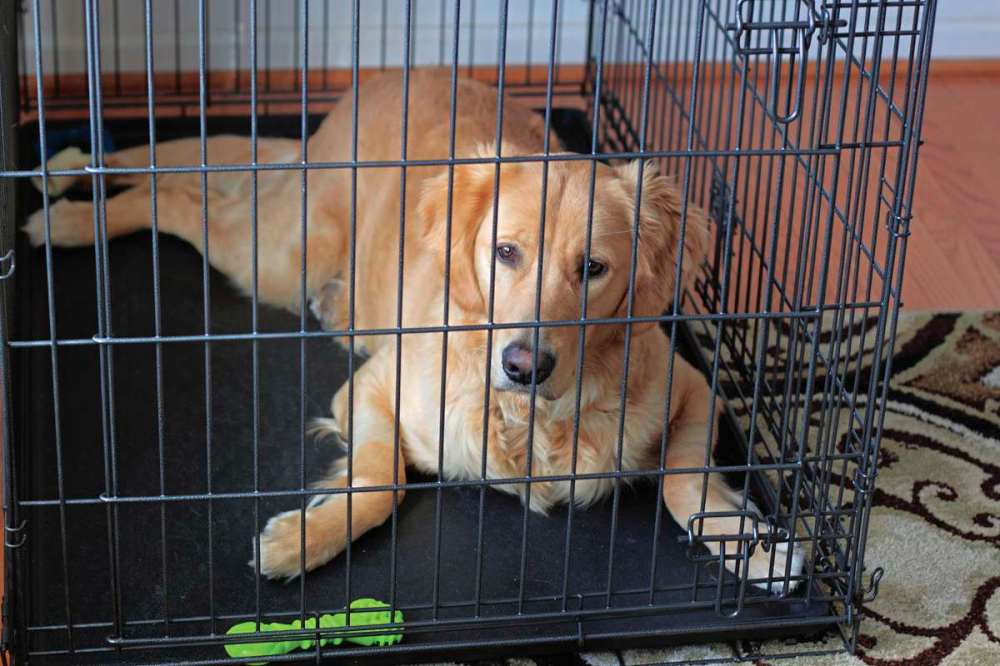
A proper kennel is large enough to stand up and turn around in. And that’s it. Bigger than that allows the pup to pee in one end and sleep in the other, and you don’t want that. And big metal cages are just that, cages. They give the animal a trapped feeling, which can actually increase separation anxiety. A properly sized plastic kennel is a den, a safe haven, a secure home for a dog. You can buy a kennel sized for the adult dog, and block part off of it with a cardboard box as he grows into it.
When you are home, the door is open, and the dog is allowed to come and go. The last person to leave and the last person to bed makes sure the dog has gone outside, and then announces “bedtime” or “kennel,” getting the pup to go in the kennel and giving it a little treat. Leave no food or water in the kennel, they will eat/drink out of boredom and have to go to the bathroom.
The first one home or out of bed needs to let the pup out of the kennel and immediately take it outside. The kennel door remains open, allowing the animal to come and go. You’ll find that, a lot of the time, your dog will choose the kennel, even if the door is open, especially if it’s are upset by visitors or stormy weather.
You should never confine a pup in the kennel when people are home and walking around. This turns the kennel into a prison rather than a safe haven and the pup may begin to resent the kennel and not want to use it, or it will fight once it is kennelled. If you need to restrict a puppy when visitors are over, restrict it to a room, with the kennel in the room, kennel door open.
Once your dog is properly kennel trained, you open up possibilities of taking the animal with you while travelling that don’t exist with dogs that have not been kennel trained. Being able to leave the dog in a hotel room in his kennel while you go out without having to worry about it barking and fighting to get out gives you the freedom to enjoy your vacation while having your pup with you.
Contact Jeff with your questions or ideas at aardvarkpets@shaw.ca or visit www.aardvarkpets.com
Jeff McFarlane
Pets Are People, Too
Jeff McFarlane is the owner of Thrive Pet Food Market. Contact him with your questions or ideas thrivepetfoodmarket@shaw.ca or visit www.thrivepetfoodmarket.com
Our newsroom depends on a growing audience of readers to power our journalism. If you are not a paid reader, please consider becoming a subscriber.
Our newsroom depends on its audience of readers to power our journalism. Thank you for your support.
Jeff McFarlane
Pets Are People, Too
Jeff McFarlane is the owner of Thrive Pet Food Market. Contact him with your questions or ideas thrivepetfoodmarket@shaw.ca or visit www.thrivepetfoodmarket.com
Our newsroom depends on a growing audience of readers to power our journalism. If you are not a paid reader, please consider becoming a subscriber.
Our newsroom depends on its audience of readers to power our journalism. Thank you for your support.
Advertisement Advertise With Us
Advertisement Advertise With Us