



The raw and the cooked

Advertisement
I talk with people every day about nutrition and their pets. It’s my job and my passion. But, as regular readers of this column know, I don’t always agree with the conventional wisdom that pets are meant to only eat little brown pebbles. Yes, I know it is convenient, it can be less expensive, and it is “scientifically formulated for your pet,” but, given all the pets I have seen flourish by changing their diets away from ultra-processed foods, I will always be an advocate for fres,h clean food.
Some veterinarians, and I applaud them for taking the time, have done research and will work with clients to ensure they are feeding their pets raw foods correctly. Those who have not done so, or are required by their workplace to discourage raw feeding, are often misinformed about the differences between raw-fed pets and pets fed processed foods.
I recently had a client tell me about being shown an X-ray of their pet’s gut, in which little white spots of bone were pointed out in the digestive tract. The client was told that this was dangerous. It sounds reasonable, especially coming from a professional you are paying. Unfortunately, the veterinarian was wrong in this instance.
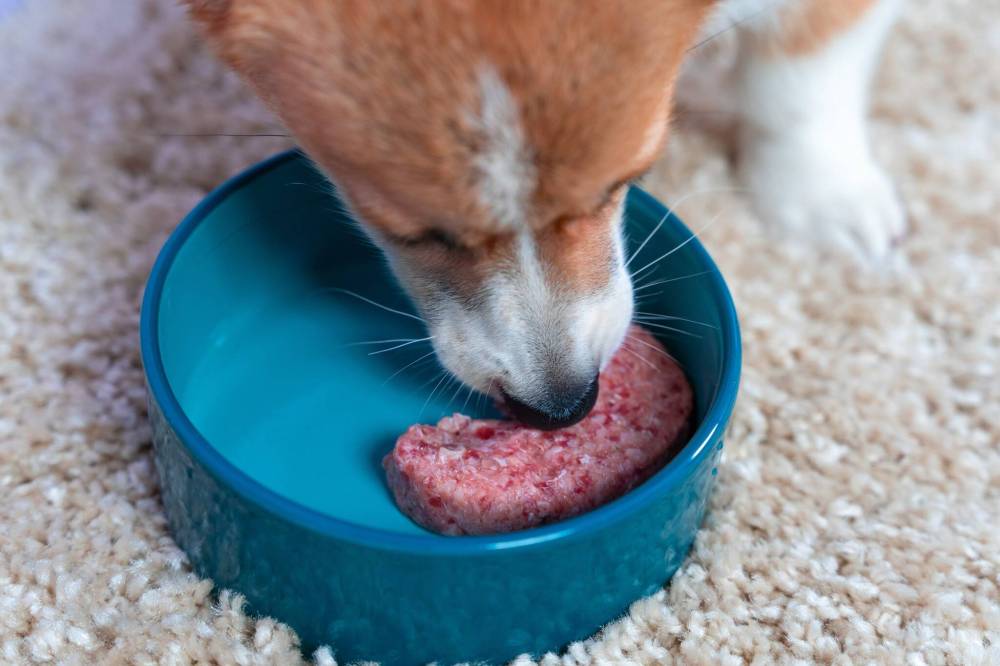
Adobe Stock photo
A corgi enjoys its raw-food meal.
Properly sized, uncooked bone fragments are vital parts of a raw diet, and they are something a dog’s gut is designed to process. The low pH of the gut (i.e., acid) dissolves these uncooked bones, from which the pet gets much of its mineral content.
Now, cooked bones are a different story. Many vets have dealt with a pet that got into a leftover turkey carcass or some chicken bones, and that is a serious issue. Cooked bones do not break down the same way and can have very sharp edges that can do damage as they work through the gut. Essentially, raw bones = safe; cooked bones = dangerous. But I can see why the interpretation of an X-ray could be misconstrued.
Blood and urine test results may also vary depending on what a pet is fed. This is one reason why it is important to inform your vet what you are feeding and, if your pet is fed raw, finding a vet who either already knows, or is willing to research what levels may be different. In a raw-fed pet, some levels, like hematocrit, blood urea nitrogen (BUNP or creatinine may be higher than a vet is used to seeing. While these values may be outside the ‘normals’ of lab tests but, if the pet is raw-fed, they may be completely normal. Going back to a processed food can bring these levels back to what is conventionally ‘normal’, but just knowing there can be differences will allow a vet to assess the lab reports in an informed way.
Every day, we see more veterinary professionals accepting their clients’ choices to feed their pets raw food, especially when done with professional guidance and using a variety of properly balanced and prepared foods. We can hope that one day all pets are fed clean, fresh food in the same way that we endeavour to feed ourselves and our children food that is less processed.
Jeff McFarlane
Pets Are People, Too
Jeff McFarlane is the owner of Thrive Pet Food Market. Contact him with your questions or ideas thrivepetfoodmarket@shaw.ca or visit www.thrivepetfoodmarket.com
Our newsroom depends on a growing audience of readers to power our journalism. If you are not a paid reader, please consider becoming a subscriber.
Our newsroom depends on its audience of readers to power our journalism. Thank you for your support.
Jeff McFarlane
Pets Are People, Too
Jeff McFarlane is the owner of Thrive Pet Food Market. Contact him with your questions or ideas thrivepetfoodmarket@shaw.ca or visit www.thrivepetfoodmarket.com
Our newsroom depends on a growing audience of readers to power our journalism. If you are not a paid reader, please consider becoming a subscriber.
Our newsroom depends on its audience of readers to power our journalism. Thank you for your support.
Advertisement Advertise With Us