


Two green thumbs up for fauna-friendly flora

Advertisement
Hey there, time traveller!
This article was published 16/08/2023 (1160 days ago), so information in it may no longer be current.
A local gardener is doing her part to help wildlife.
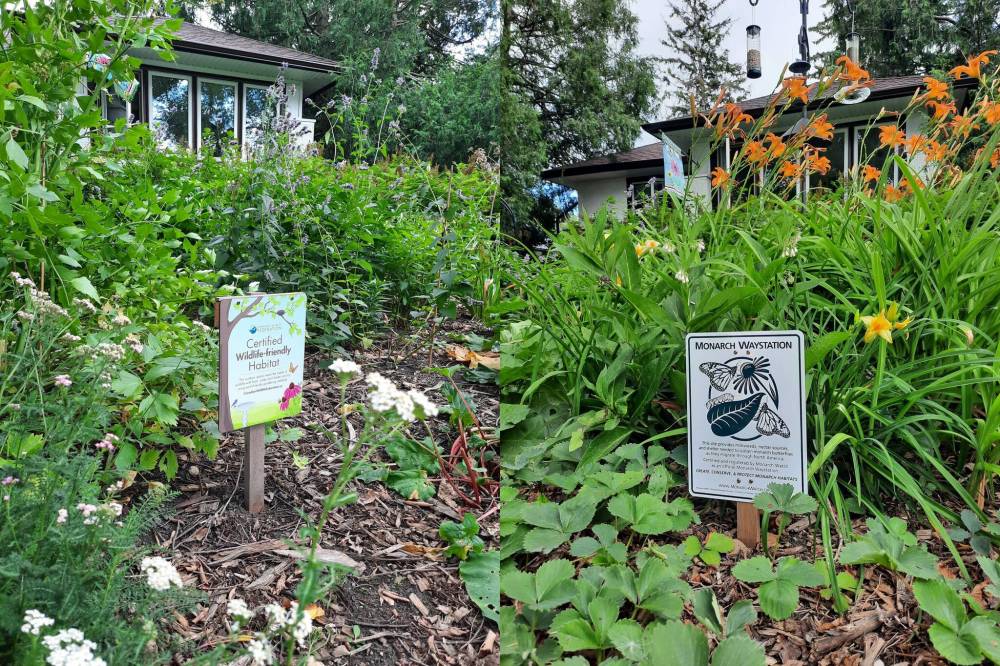
Maggie Svaling’s front yard in Riverview is not just nice to look at – it’s a certified habitat for local and migratory fauna. Among the plants are two signs indicating to passersby that her garden officially meets the needs of wildlife in general and butterflies in particular.
The garden certification programs are run by the Canadian Wildlife Federation and Monarch Watch. They aim to increase suitable habitat for wildlife by promoting the design and eco-friendly maintenance of outdoor spaces that provide food, water, and shelter for wild animals and insects. As “monarch waystations,” gardens such as Svaling’s also provide resources necessary for monarch butterflies to breed and sustain their phenomenal annual migration. Monarchs are among many species of wildlife endangered by habitat loss resulting from human activity.
Photos by Tracy Groenewegen
Nestled among Maggie Svaling’s plants are two signs indicating that her garden officially meets the needs of wildlife in general and butterflies in particular.
Originally inspired by English cottage gardens, Svaling’s wildlife haven is a mix of flowers, herbs, and food-producing plants, and features a bird bath, bird feeders, and other charming adornments.
“I wanted a garden in the front because I thought grass was useless,” she said. She later decided to certify her garden out of concern not only for butterflies but other pollinators such as bees, which are also in decline.
Svaling’s garden is teeming with bees, much to her delight. She has also observed monarchs and all kinds of birds, including finches, jays, woodpeckers, hawks, owls, and more. Birds of prey are attracted, Svaling surmises, by the rabbits and rodents which also frequent her yard.
While Svaling is a master gardener, virtually anyone can create a wildlife-friendly garden, according to CWF. From “acres of land to containers on a patio,” all outdoor spaces can benefit wildlife, regardless of a person’s location, level of experience, or budget, according to the CWF website, at www.cwf-fcf.org. Creating a monarch habitat, in particular, can be as simple as adding milkweed and nectar-producing plants to an existing garden, according to Monarch Watch (www.monarchwatch.org).
Svaling said the upkeep of a wildlife-friendly garden can be more or less work, depending on what is planted.
“You can plant some native plants that don’t require as much maintenance,” she said, adding that her garden is relatively high-maintenance due to its mix of native and non-native species.
For Svaling, it’s worth the effort.
“Because you get all the wildlife,” she said. “It’s very relaxing – the gardening and just sitting out and enjoying the birds and the bees and the butterflies.”
Tracy Groenewegen
South Osborne community correspondent
Tracy Groenewegen is a community correspondent for South Osborne. She can be reached at tracy.groenewegen@gmail.com
Our newsroom depends on a growing audience of readers to power our journalism. If you are not a paid reader, please consider becoming a subscriber.
Our newsroom depends on its audience of readers to power our journalism. Thank you for your support.
Tracy Groenewegen
South Osborne community correspondent
Tracy Groenewegen is a community correspondent for South Osborne. She can be reached at tracy.groenewegen@gmail.com
Our newsroom depends on a growing audience of readers to power our journalism. If you are not a paid reader, please consider becoming a subscriber.
Our newsroom depends on its audience of readers to power our journalism. Thank you for your support.
Advertisement Advertise With Us