



What a difference a year makes

Advertisement
A year ago, during the Christmas holidays, my office received numerous calls from local residents who had awakened to the sound of chainsaws in the beloved Lemay Forest. What ensued was nothing less than an all-out effort to protect the 22-acre area of St. Norbert. In the end, it stood as a powerful symbol of community resolve against the cold calculus of residential development.
The fight began with a local alarm. Residents, naturalists, and the Save Lemay Forest group mobilized and shared the news that this lush, river-bottom woodland was to be clear cut to make way for up to 5,000 units built a private developer. Their campaign was built on a powerful trifecta of arguments.
First was the land’s deep historical significance. These very woods were part of the historic Métis river-lot system, a living artifact of the Red River Settlement’s cultural and agricultural footprint.
File photo
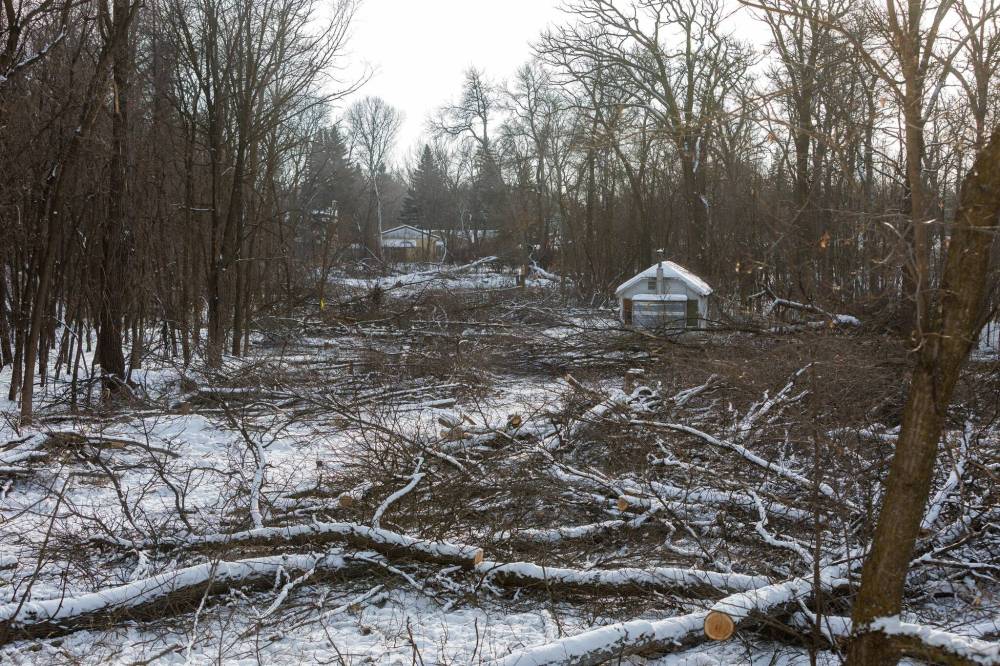
A year ago, developers began the process of removing trees in Lemay Forest to prepare for a proposed housing development.
Second was the profound cultural and ecological role the Lemay Forest plays in the area. As a riparian forest lining the Red River, it acted as a vital natural flood mitigator, water purifier, and a critical wildlife corridor in an increasingly fragmented urban landscape.
Finally, and perhaps most viscerally compelling, was the quality of the forest itself. These were not scrub trees. They were Grade A riparian river-bottom trees – mature American elm, basswood, and oak forming a dense, biodiverse canopy that had taken generations to establish.
For many years and well before my time in office, the community wielded these facts in presentations, rallies, and media campaigns. They argued that destroying such an ecological and historical treasure was a failure of long-term planning. The forest, once just background greenery to many, became a celebrated cause – a test of whether modern development could work around, rather than simply erase, these lands.
The provincial government’s decision to expropriate the forest in April 2025 was a fitting conclusion to the years of hope and effort that went into preserving these lands. In the harsh logic of infrastructure projects, a forest, even a historically and ecologically rich one like Lemay Forest, became an obstacle that would to be removed.
In the span of four seasons, the narrative now includes protecting a heritage ecosystem instead of documenting its loss. The mature, Grade A trees, the riverbank ecology, and the silent history in the soil were ultimately a superior argument against the weight of private development and the blade of the bulldozer. The Lemay Forest’s final state stands as a positive lesson – that years of passionate advocacy can successfully work towards the common good of preservation and leave a legacy to be enjoyed for generations to come.
Markus Chambers
St. Norbert - Seine River ward report
Markus Chambers is deputy mayor of the City of Winnipeg and city councillor for St. Norbert - Seine River.
Our newsroom depends on a growing audience of readers to power our journalism. If you are not a paid reader, please consider becoming a subscriber.
Our newsroom depends on its audience of readers to power our journalism. Thank you for your support.
Markus Chambers
St. Norbert - Seine River ward report
Markus Chambers is deputy mayor of the City of Winnipeg and city councillor for St. Norbert - Seine River.
Our newsroom depends on a growing audience of readers to power our journalism. If you are not a paid reader, please consider becoming a subscriber.
Our newsroom depends on its audience of readers to power our journalism. Thank you for your support.
Advertisement Advertise With Us