|
My friend Jaclyn gives the best hugs.
We have been friends since I was three and she was four; we grew up across the street from each other. We had those idyllic late-’80s-’90s summers: leaving the house in the morning and returning home when the street lights blinked on. Living on Pop Tarts and Slurpees and popsicles. Maybe taking reprieve from the afternoon heat to watch Days of Our Lives — especially in the peak Carrie and Austin years! — in her basement.
Then, she’d usually spend a few weeks at her family cottage in New Brunswick, and our reunions — which usually took place in the middle of our street — were always hug filled.
Advertisement

We’ve been pals for more than 30 years now, and this is the longest I’ve gone without hugging my friend who gives hall-of-fame hugs. Hugging her is like hugging actual sunshine. This week, now that we’re a month post-vaxx, we will be reuniting for our first summer hang — and you better believe there will be hugs.
By far and away, hugs topped the leaderboard of things people missed during a pandemic that effectively made hugging (hugging!) an anxiety-provoking and potentially dangerous activity. And many people suffered from this lack of touch — touch deprivation, another word for our pandemic lexicon — especially those who live alone.
Hugs, it turns out, are really good for us. Research shows hugging boosts your mood while lowering stress and blood pressure. Hugs can help us feel calm and safe.
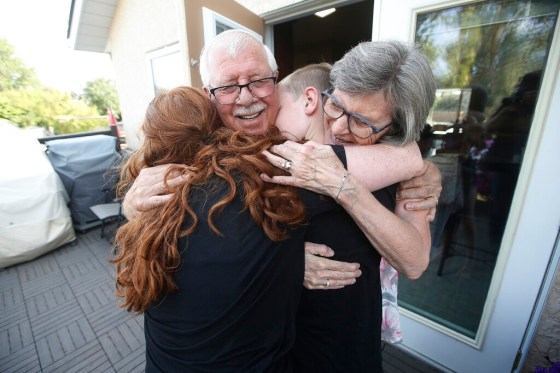
CPRichard and Linda Davis hug their grandchildren Miles and Linda Carnegie for the first time in fifteen months after Manitoba lifted some COVID-19 restrictions. (John Woods / The Canadian Press files)
And now, hugs are back, so long as you are fully vaccinated. Last month, the Public Health Agency of Canada released an infographic outlining what vaccinated Canadians can do. “Sharing a hug” is among those activities.
Being able to hug my immunocompromised mom, being able to hug my good friend who lost her father, being able to hug my niece, who is growing up so very fast (babies really don’t keep, do they?), being able to get a Jaclyn Hug from my oldest friend — those were all reasons I masked up and got the jab as soon as I was able. Forget a vaccine lottery; that was all the incentive I needed. And I am not even what you’d call ‘a hugger.’
So what’s next for hugging, now that many of us can? Consent.
I am already encouraged to see how comfortable people have gotten with asking permission, even if it’s something as casual as “are we hugging?”
The pandemic necessarily made many of us better at establishing and asserting personal boundaries; it also made many of us better at being aware of and respecting the personal boundaries of others. The truth is, many people have never been cool with hugs, especially as a way of casual greeting, and many people have stiffly accepted an unwanted hug out of politeness. We do not need the specter of a pandemic to ask people what kinds of physical contact they are comfortable with.
Further, hugs have always been a great (and totally age appropriate) way to teach kids about consent, too — lessons they can take with them throughout their lives. Normalizing asking people what they are comfortable with — and then respecting the answer — is also a great way to role model that behaviour, to kids and adults alike. Be the change, etc.
As we move into this next phase, I hope we can keep these lines of communication open. If you’re vaccinated, may your hugs be consensual, and may they feel like sunshine.
|