THE MACRO
Image consultants are an accepted reality in modern politics. Many voters are influenced not just by what a politician says, but also how they look, sound and dress. Hair styles, clothing and how they are portrayed in partisan advertising are all critical elements of an election campaign.
Which brings us to Conservative Leader Erin O’Toole and his recently released “Canada’s Recovery Plan,” an elaborately produced campaign platform which has been given a fashion magazine-style cover that refers to the 48-year-old O’Toole as “the man with the plan.”
I won’t go into the policies contained in the 160-page document. However, it should be said that the mock-magazine design is fresh and unique. But, it’s the photo of O’Toole that really caught my eye.

O’Toole is wearing a stylish black, crewneck, short-sleeved t-shirt, arms crossed. It’s a clear attempt to give him a youthful and — dare I say — sexy look. The arms crossed pose is an interesting choice; it is an obvious attempt to create the impression O’Toole is fit, virile and ready to rumble. Of course, that’s not necessarily how people will see it.
Psychological research has shown that arms crossed pose in body language conveys defensiveness, discomfort, uneasiness, shyness or insecurity. Pretty sure that’s not what the Tories were going for, but I digress.
The real issue here is the temptation of political campaigns to take chances to reframe or reboot a leader’s image. O’Toole is clearly trying to convey a more hip and modern sensibility to voters. That’s important because he tends to draw core support from an older demographic and would need votes from younger Canadians if he wants to topple Justin Trudeau and the Liberals.
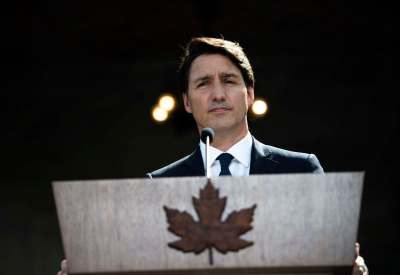
And, of course, O’Toole has to compete with the most photogenic prime minister of all time.
In his first term in office, the world news media fell in love with the youthful and dashing Trudeau and his equally youthful and dashing wife, Sophie Gregoire-Trudeau. In December 2015, he agreed to a provocative photo shoot that included several black and white portraits of the new prime minister copping a 1940s Hollywood icon posture and the infamous cover shot of Canada’s new first couple nose to nose in a sexy, loving embrace.
Trudeau would milk his model good looks and youthful presence for dozens of other photo shoots over the years. And by now, his sexy image has become — for better or worse — a core element in his brand as a political leader.
Can O’Toole compete with Trudeau on youthful and sexy? Surprisingly, the Tory leader is almost two years younger than Trudeau, who turns 50 this December. And that must drive Tories nuts; they have the younger leader but can’t capitalize on that because Trudeau is, well, half fashion model, half politician.
It should be noted that O’Toole’s magazine cover is a risky proposition. Calculated risks on image or publicity stunts can either make or break election campaigns. And all political leaders dabble in image-making at one time or another.
Former prime minister Stephen Harper was an excellent piano player and singer, and performed quite often in public, from a rendition of the Guns and Roses hit, Sweet Child O’Mine (I kid you not), to a rousing rendition of the Beatles’ standard, With a Little Help from My Friends.
These performances didn’t hurt Harper’s image, but didn’t help much either. Harper had chops, but his airport lounge-singer sensibility seemed somehow to just reinforce the country’s image of him as a very traditional, throw-back politician.
Other image-making attempts were much more successful. Top of my list was the infamous photo of Jean Chrétien water skiing at his cottage on Lac des Piles in 1993.
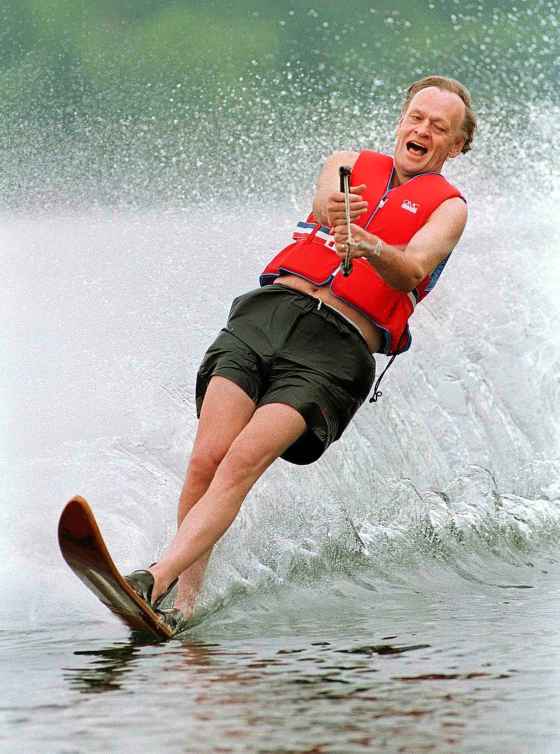
Jean Chrétien cuts through a wave while water-skiing near his cottage in Lac des Piles near Grand-Mere, Que. in 1993. (Ryan Remiorz / The Canadian Press files)
The newly minted Liberal leader was trying to dispel rumours he was too old to be an effective prime minister. So, he invited Canadian Press photographer Ryan Remiorz to shoot him carving the lake on a slalom ski. The photo worked; the image of a jubilant and athletic Chrétien put all concern about his age and health aside and paved the way for three successive majority election victories.
I’m not sure O’Toole’s “man-with-a-plan” photo is going to have the desired effect and may, in fact, turn off some of the older core supporters. But it’s clearly had some success. After all, it was intriguing enough convince me to put the cover hot in my newsletter.
Well played, Mr. O’Toole.
JOURNALIST, HEAL THYSELF
One of the most consistent forms of criticism I face is from readers concerned that I write both hard news stories and opinion columns. And it’s true; depending on the story, I may be asked to write it as a piece of hard news one day, and then I will provide analysis and commentary the next.
I will agree at times that can be confusing. But, is it really the ethical transgression that some of my readers think it is?
One reader put it this way:
“Most newspapers separate the opinion columnists from the newsroom. I have noticed that with increased frequencies the two WFP columnists, Tom Brodbeck and you, have had your bylines in straight news stories and some long form pieces.
“The question — is the reader justified in taking the straight news stories with a large grain of salt because the author has made his political views known through his columns?”
Excellent question. And here is how I will attempt to justify my hybrid approach to journalism.
First off, the reader is correct one the main point: that within the context of each type of story, the roles of reporter and columnist are different. Reporters report the daily news as fairly and factually as possible; columnist provide analysis and opinion.
Second, it should be noted that even though our jobs are different, columnists are journalists first and foremost. Even though we get to indulge in opinion writing, we must still be able to show that we are factual and fair.
Now, not every reader will agree that I am factual and fair; people who are invested in some of the people I criticize will offer their own robust criticism when I am seen to be attacking their preferred leader or party. I typically try to point out that the dispute has less to do with fairness, and more to do with the inherent biases on both sides.
The criticism I offer is based on what a politicians does and says, not who they are or what party they belong to.
That having been said, when my name suddenly appears on a news story — and it does from time to time — then what are readers to make of my journalistic ethics? Can they trust the story as fair and factual within the context of that one article?
Obviously, I think the story can be trusted. There is significant misunderstanding about how journalists go about their work. I am frequently told by readers that journalists present the news as “objectively” as possible, without any bias or opinion. That is not only not true; it’s more or less impossible.
To be truly objective, you must be able to strip all bias from your story. And quite obviously, every story we write has bias. From the editor who assigns it, to the reporter who does the interviews and writes it, to the people who edit it and write the headlines. Sometimes, our bias is really just our attempt to be compelling or provocative, and sometimes that gets the better of us.
Other times, we are driven by a more important motivator: speaking truth to power. A concept that originated with the Quakers, it has been ingrained in journalistic philosophy for as long as I can remember. Many journalists feel a compulsion to challenge people in power, and expose their failing. Sometimes, we call this adversarial journalism.
All of which is to say, although we go about this work in many different forms, our standards and goals are the same. Sometimes, we can speak truth to power in a long-form investigative project that exposes wrongdoing. Sometimes, it can be what we call a “heavy-head” hard news story. And, yes, in some instances it can mean a hard-hitting piece of opinion writing.
In the end, we should be judged the way we try to judge others: not about who we are, but by what we do. Or, to put it another way, whether we present the news — in many different forms — as fairly and factually as possible.
Do you have a subject you would like to see covered in Not For Attribution? Do you have specific questions about journalistic practices or the business of news? Do you have specific concerns about politics or political leaders? Email me your questions and I will respond. Promise.
|