|
The Toyota Production System is a remarkable feat of process engineering.
It’s a manufacturing philosophy more than a century in the making, dating back to founder Sakichi Toyoda’s first foray into business as a textiles manufacturer.
It’s what drives the company’s three Canadian manufacturing plants, two parts distribution centres and vehicle processing centre, as well as its plants around the world.
But did you know it also drives blood?
Toyota realized years ago that it has a marketable commodity in the way it plans, executes and continually improves all its processes, from parts picking to dashboard assembly, and in addition to selling its consulting services to other companies through the Toyota Production System Support Centre, it offers its consulting as a donation to such non-profits as Canadian Blood Services.
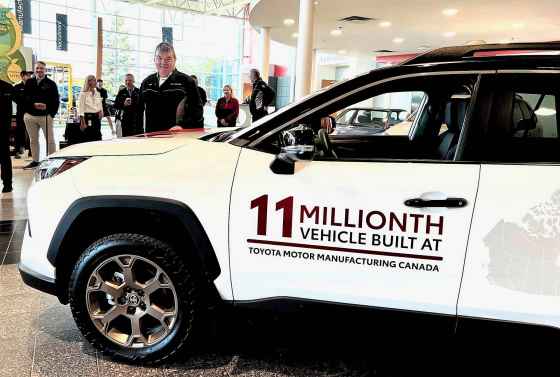
Frank Voss, president of Toyota Motor Manufacturing Canada, unveiled the 11 millionth vehicle, a 2024 Toyota RAV4, produced in Canada. It rolled off the line earlier in August. (Kelly Taylor / Free Press)
Paolo Oliveros, spokesman for Canadian Blood Services, said the support centre’s first Canadian project in 2015 helped CBS modernize its blood collection and distribution systems, resulting in a 40 per cent decrease in the time needed to package blood products, a 30 per cent increase in productivity and a 30 per cent reduction in the amount of steps required by employees.
“In addition to being a significant financial donor supporting CBS with more than $3 million in gifted advertising and cause marketing initiatives, Toyota Canada has supported Canada’s blood system by sharing best practices from the Toyota Production System,” Oliveros said in an email.
TPS works, largely, by planning processes down to granular detail, from the sequence for fastening nuts to identifying precise locations in warehouses for picking parts. It enforces best practices in ergonomics — wheels in Toyota’s processing centre aren’t removed without a wheel hoist, for instance — to help ensure a worker’s last task of the day is performed as well as the first. Parts are scanned as they’re installed, and the computer won’t release a vehicle or sub-assembly to the next stage until the task is complete.
Advertisement

But behind all the process engineering lies some pretty important social considerations, as well. Stephen Beatty, Toyota Canada’s corporate secretary, said for TPS to succeed, customers receiving TPS training must give themselves over to a philosophy that allows Toyota to accept mistakes as learning opportunities, to make decisions by consensus and put worker safety and mental health top of mind.
“When people feel they’ll be punished for mistakes, they tend to hide them,” Beatty said.
I experienced the Toyota Production System for a second time last week. I joined a segment of the company’s media drive across Canada in celebration of its 60th anniversary in Canada. Read my story on the trip here.
|