|
A few years ago, after realizing there was only one surviving prisoner of war from the Winnipeg Grenadiers’ Battle of Hong Kong during the Second World War, I researched and wrote a feature entitled The Final Witnesses.
The story featured the remembrances of some of the last eyewitnesses of four of the most horrific things done to people in the last decades.
It pointed out that when their eyes closed for the last time, the only way people would be able to find out about what they and others had experienced would be through history books, audio tapes, and film and video.
Advertisement

You can read the story here.
Besides George Peterson, who served with the Grenadiers, I spoke with Art Miki, whose family was uprooted from their property, which was sold, and sent to a Manitoba sugar beet farm when the Canadian government decided it didn’t want Japanese-Canadians to be near the West Coast during the Second World War.
I also spoke with Sonia Kushliak, who survived the Holodomor and still became teary eyed over a long-ago loaf of bread she ate without sharing with her family.
And I wrote about what Holocaust survivor Barbara Goszer saw.
The eyes of George and Sonia closed for a final time in recent years, and now Barbara’s eyes have, too.
Barbara, who was 94 when she died on Oct. 6, was only nine when what she called her idyllic life in Poland ended as Adolf Hitler’s Third Reich invaded her country.
Barbara, whose name at the time was Boronia Goldfischer, told me she witnessed “massacre after massacre, including the brutal murder of five people, a baby among them.”
Her older sister was the first to be taken away. She went to a concentration camp where the Nazis were testing poison gas. She never came back.
Her parents, fearing for Barbara’s safety, hid her whenever they went out, telling her to stay on a shelf above the toilet and be quiet.
Other times, Barbara did venture outside.
“I had to pass this place loaded with people and loaded with Germans with guns,” she said. “There was a pregnant mother with three children. I watched as all of them were murdered. I walked away. I went home. There was a piece of furniture and I crawled in and didn’t come out until my parents came home.
“Once you saw what they could do… what kind of people were they?”
Her parents were so fearful of their daughter’s safety that they put her into the hands of a Catholic family. She became Halina Stoklosa.
She didn’t see her parents again.
“I stayed with the Polish family for the duration (of the war),” said Barbara. “That’s how I survived.”
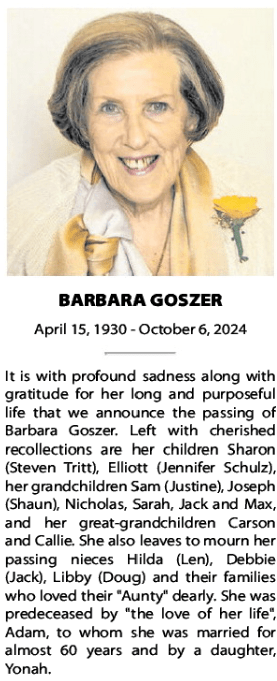
After the war, Barbara was connected to a Jewish community program in Germany for orphaned children. She went to Canada with about 150 other orphans in 1947, and was placed with a Winnipeg family in 1948.
Barbara later married Adam Goszer in 1952, helped operate his business Adam’s Camera at Portage and Main, and had three children, one who died when she was five.
Through the decades of her life here, Barbara worked to make sure nobody forgot about the Holocaust.
As Barbara’s family said in her obituary: “she spent decades dedicated to educating school-aged children and their teachers throughout Manitoba and other parts of Canada about the dangers of discrimination and intolerance of diversity. She advocated standing up for others and taking action despite fear. She also encouraged appreciation for freedom and having a roof over one’s head.
“She dreamed of a world free of hatred and of a bright future.”
Barbara also advocated for the creation of the Freeman Family Holocaust Education Centre at the Asper Jewish Community Campus and was its first chair.
She said she didn’t know just how profoundly the Holocaust affected her until her daughter told her many years later how protective she was of her and her brother.
“She said ‘Mom, you are always in the window’. It lives with you forever.”
The final thoughts Barbara shared with me were prescient.
“They were building the centre (it opened in 1997) and I moved heaven and earth to make sure they put a Holocaust Education Centre there,” she said.
“We knew we would age and someday no one would be around to speak for us.”
Barbara was predeceased by her husband of 59 years and daughter Yonah, and survived by her children Sharon and Elliott, as well as six grandchildren and two great-grandchildren.
Read more about Barbara.
How They Lived
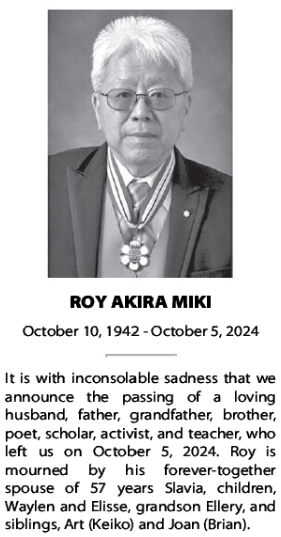
Roy Miki’s family had already been forcibly removed from B.C. to a Manitoba farm during the Second World War when he was born.
Roy, who was 81 when he died on Oct. 5, later went to the University of Manitoba, University of British Columbia, and Simon Fraser University, the last where he worked as an English professor until his retirement. He was a professor emeritus.
He was a leading spokesman for the National Association of Japanese Canadians, being instrumental in the signing of the historic Redress agreement with the federal government in 1988.
Roy wrote many books of poetry, but it was his book, Redress: Inside the Japanese Canadian Call for Justice, which detailed the process which resulted in the agreement.
Among other awards, he was honoured with the Order of Canada in 2006 and the Order of British Columbia in 2009.
Read more about Roy.
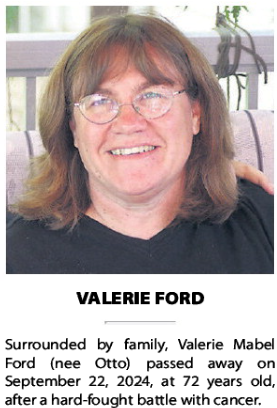
Many students in Glenboro got their chance to tread the boards thanks to Val Ford.
After getting her Bachelor of Teaching (music), Val, who died on Sept. 22 at 72 years of age, became a Grade 4 and music teacher at Glenboro School. She taught there from 1976 to 2007, staging both large musical productions and Christmas concerts.
After retiring, she began painting, joined the Hamiota Art Club, and saw her works displayed throughout the province.
Read more about Val.
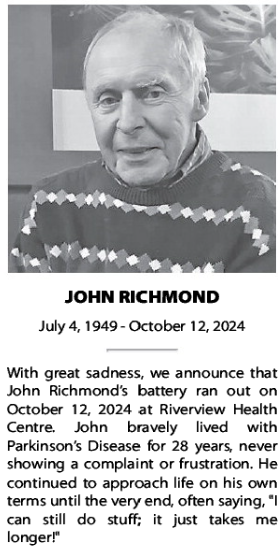
John Richmond knew how to get to Sesame Street.
John, who was 75 when he died on Oct. 12, worked with CBC for more than 30 years editing film.
Two of the shows he worked on were Sesame Street and Country Canada, as well as many other local productions.
John also had a great attitude towards Parkinson’s disease, which he lived with for 28 years: “I can still do stuff; it just takes me longer!”
Read more about John.
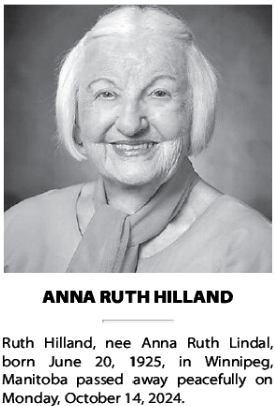
Armed with a social work diploma, and later a masters degree, Ruth Holland worked at the Family Bureau here before moving to Alberta.
Ruth, who died on Oct. 14 at 99, served there on the executive of the Canadian Mental Health Association, the City of Calgary’s charities committee, and the executive of the Calgary Women’s Literary Club for a decade.
She also preserved her heritage by being an honorary member of Calgary’s Leif Eiriksson Icelandic Club and baking vineterta every year.
Read more about Ruth.
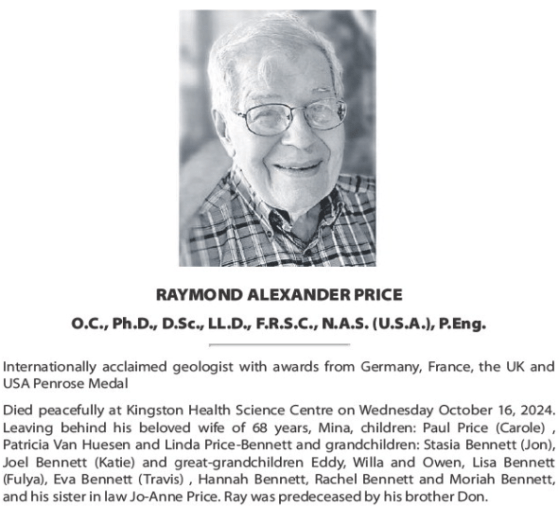
Ray Price was an internationally acclaimed geologist.
When Ray, who died on Oct. 16, began his career, he realized geologists didn’t know how mountains were formed — so he worked for decades to find the answers.
Along with many honours from around the world, Ray received the Order of Canada for his work.
Read more about Ray.
A Life’s Story
Hugh Donald Sutherland helped create space for people to become the best version of themselves.
That’s because Hugh, who died on July 30, and his wife were relationship mentor couples at the Archdiocese of Saint Boniface.
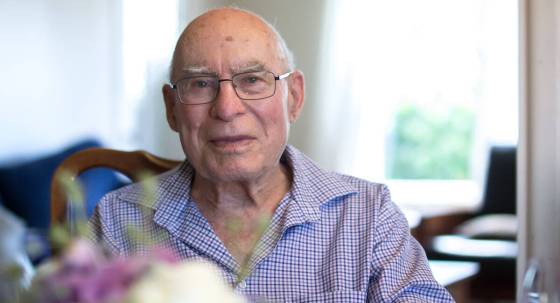
Hugh Donald Sutherland’s life was filled with love, laughter and learning. (Supplied)
“They were a couple which remain a huge inspiration to me, in the way they navigated through all stages of life together, with mutual respect and with such tenderness,” said Sophie Freyner-Agossa, who knew the couple when the worked at the Archdiocese’s Office of Marriage, Family and Life.
“I often recall something Donald had shared with me: ‘If you’re not laughing, you’re not learning.’”
Read more about Hugh’s life in our latest Passages feature.
Until next time, I hope you continue to write your own life’s story.
|