VOTE 2025: STAY INFORMED
We know you’ve got lots going on in your life and keeping an eye on everything that occurs during the election campaign is not always possible.
But no need to worry. Our newsroom team has your back. Subscribe to our free Election Extra newsletter for a weekly roundup of what you need to know to make your decision at the ballot box on April 28. Sign up here.
FIVE STORIES ON TURTLE ISLAND
On Saturday night in Vancouver, the Haisla rap duo Snotty Nose Rez Kids became the first Indigenous group to win the Juno award for rap album of the year.
Entitled Red Future, their sixth album “envisions a future where the resilience and innovation of Indigenous voices and perspectives are at the forefront” and the duo has been lauded for inspiring future generations of Indigenous hip hop artists.
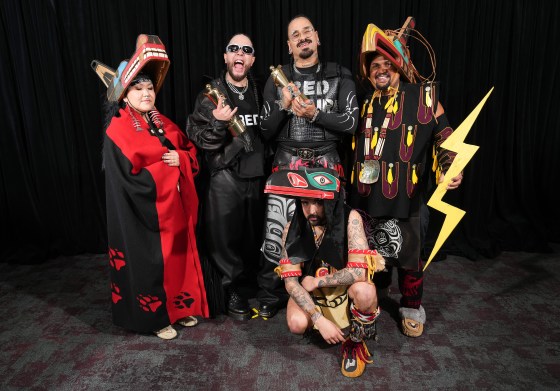
Snotty Nose Rez Kids pose for photos after winning the Rap Album/EP of the Year during the Juno Awards in Vancouver, B.C., on March 30. (Darryl Dyck / Canadian Press files)
In other notable news, two Inuit artists earned Junos, with singer-songwriter Elisapie winning in the adult alternative album of the year category (for her album Inuktitut) while opera singer Deantha Edmunds won classical composition of the year for her piece Angmalukisaa.
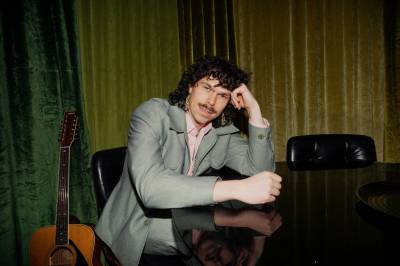
Locally, Sebastian Gaskin from Tataskweyak Cree Nation won his first Juno award in the Contemporary Indigenous Artist of the Year Category for their song Brown Man.

Sebastian Gaskin poses for photos after winning the Contemporary Indigenous Artist or Group of the Year award during the Juno Awards Gala in Vancouver. (Darryl Dyck / Canadian Press files)
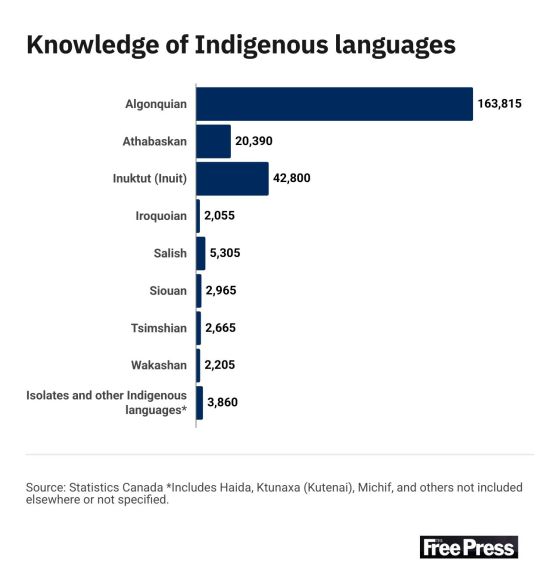
Indigenous language data has just been released from the 2021 census showing 243,155 individuals in Canada can speak one of 70 Indigenous languages and could perform “well enough to conduct a conversation.”
Classified into one of eight major language families, the largest was Algonquian languages with 163,815 speakers — with specific languages within the family like Cree languages (87,875 speakers), Ojibway (26,165) and Oji-Cree (15,305) the top three.
The second largest language family is Inuktitut, or Inuit, languages with the top branches being Inuktitut (41,675 speakers), Inuinnaqtun (790), and Inuvialuktun (355).
The language family with the third-highest number of speakers is Athabaskan (20,390), with the most commonly spoken language being Dene (11,560 speakers), Slavey-Hare languages (2,325) and Tlicho (Dogrib) (2,135).
The share of Indigenous language speakers who learned their language as a second language rose from 25.7 per cent in 2016 to 29.5 per cent in 2021, while the remaining share (70.5 per cent) learned an Indigenous language as their first language.
Meanwhile, a new pilot project will translate Manitoba’s political debates and proceedings into seven Indigenous languages, beginning with Anishinaabemowin.
Every year, and due to longstanding bungling by federal officials and weak laws, numerous conflicts emerge over Indigenous fishing and harvesting rights between fishing families, Indigenous fish and aquatic game harvesters, and fishing companies — and this year is no different.
On the weekend, harvesters from Sipekne’katik First Nation and employees from the Atlantic Elver Fishery clashed on a river in Nova Scotia over who can harvest lucrative baby eels. Last year — after decades of ignoring Indigenous rights claims over the fishery — federal officials gave half of the allowed catch of 9,950 kilograms of baby eels, previously held by commercial licence holders, would be transferred to local First Nations.

Elver fisher Suzy Edwards poses along the Sackville River in Halifax on Thursday, December 19, 2024. (Darren Calabrese / Canadian Press files)
First Nations leaders decried the decision, stating they have a right to establish their own regulatory system and “earn a moderate livelihood” — as guaranteed under treaty and other agreements with the federal Canadian government.
In a letter to federal officials, Chief Bob Gloade of Millbrook First Nation wrote: “We are not regulated by your colonial commercial licensing schemes, nor do we accept your proposed management plan.”
In a response letter, the federal government disagrees with this position, stating they are the regulatory body of commercial fishery on this issue.
Provincial education officials in Newfoundland and Labrador ordered the destruction of 8,600 textbooks purchased in 2023 because they contained “inaccurate information” about the territories, culture and history of local Indigenous nations.
The order to destroy the texts, which cost $202,140, came after the government’s Indigenous Education Advisory Committee determined that the books “did not accurately reflect the cultural reality in Newfoundland and Labrador,” according to department spokesperson Lynn Robinson.
The four books, used by Grade 7 and 8 French Immersion students, were from Scholastic Canada’s Passe à l’action pour la réconciliation series — a set of books created in consultation with Indigenous educators but none from Newfoundland or Labrador.
This likely explains why many of the claims found in the books pertained to Indigenous nations other than in the east. One example was that the books stated that “Turtle Island,” a name for the North American continent used in some Indigenous cultures, described a creation story that applies to all Indigenous people, when it is just some.
Activists have begun to mobilize as six Michigan Tribes withdrew their co-operation with the U.S. Army Corps of Engineers (Corps) after learning that the Trump administration intends to fast track Enbridge’s Line 5 pipeline from Superior, Wisconsin to Sarnia, Ontario.
Enbridge’s massive project involves transporting oil and natural gas across 645 miles of pipeline and a four-mile tunnel section beneath the Straits of Mackinac.
Under U.S. law, the Corps must conduct environmental assessments and work with tribal nations but, because of a Trump executive order declaring a “National Energy Emergency,” tribal leaders have been told both processes will be approved immediately.
In response, the Little Traverse Bay Bands of Odawa Indians, Bay Mills Indian Community, Little River Band of Ottawa Indians, Sault Ste. Marie Tribe of Chippewa Indians, Grand Traverse Band of Ottawa and Chippewa Indians, Match-E-Be-Nash-She-Wish Band of Pottawatomi, and Nottawaseppi Huron Band of the Potawatomi have all withdrawn their participation.
IN PICTURES
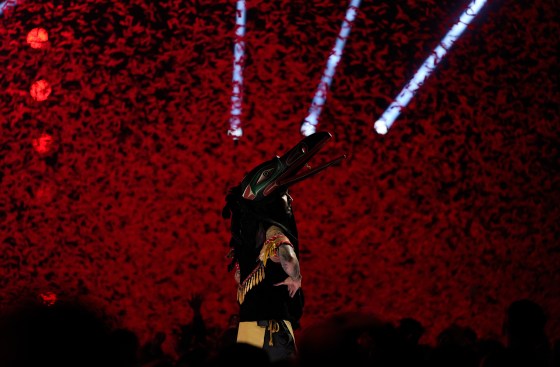
A First Nations artist performs with Snotty Nose Rez Kids during the Juno Awards, in Vancouver on Sunday. (Ethan Cairns / Canadian Press files)
RECONCILI-ACTION OF THE WEEK
Every week I highlight an action, moment, or milestone forwarding reconciliation, illustrating how far Canada has come – and how far the country has yet to go.
Over the past year, you probably have noticed the awarding of many King Charles III Coronation Medals, created to mark the coronation of the new King of the Commonwealth and the first Canadian commemorative medal to mark a coronation.
In 2023, the Office of the Secretary to the Governor General asked governments and politicians to distribute 30,000 medals to outstanding contributors and leaders in their local communities. The result: arguably the largest recognition of Indigenous leadership in Canadian history — many of them Manitoban.
Local recipients have included Arnold Asham, Brandy Lynn Bobier, David Chartrand, Sandra DeLaronde, Paulette Duguay, Cambria Harris, Della Herrera, Daniel Hidalgo, Wilford Mullin, Jordan Myran, Barbara Nepinak, Diane Redsky, Loretta Ross, Diane Roussin, Garrison Settee, Carl Stone, Angie Tuesday, and the late AMC grand chief Cathy Merrick – among many more.
On March 4, Winnipeg Centre MP Leah Gazan gave out 19 of the medals she was allocated, recognizing local Indigenous leaders like Gina Smoke, Hilda Anderson-Pyrz, and Matt Davidson.
|