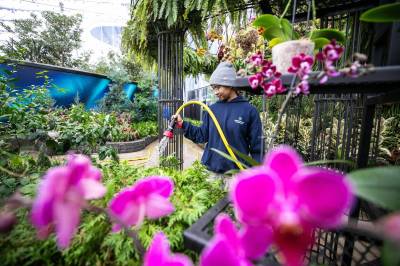
Let love bloom
Kelly Tellier shares tips on creating your most beautiful bouquet
Kelly Tellier is a Manitoba flower farmer and floral designer who owns and operates Lily Stone Gardens near Rosenort.
Tellier grows specialty cut flowers and provides U-pick flower experiences for visitors. She and her staff create dreamy bouquets and enjoy sharing their creativity in floral design with others.
Lily Stone, she says, designs with a garden aesthetic in mind. This can be readily seen in the two beautiful examples by Heather Page, one of Lily Stone’s florists.
“We are always trying to achieve a whimsical feel,” says Tellier.
Interested in creating a flower arrangement for Valentine’s Day that is uniquely your own? Below, Tellier shares her insights and key tips.
First, you will need to select your favourite cut flowers for arranging.
Start by finding a vessel that flows well with your space, says Tellier.
“Decide on whether your arrangement will be forward facing (against a wall) or will be seen from all angles.
“It is helpful to use different shapes of flowers to add interest.
“Arrangements should have an odd number of line flowers (tall, structured blooms to establish the height, width, and overall framework). Examples are snapdragons, stock.
“You will also need filler flowers (button chrysanthemums, limonium or feverfew); secondary focal flowers (ex. carnations or spray roses or ranunculus); and primary focal flowers (roses, lilies, etc.). And, of course, any greenery that will help accentuate the flowers.”
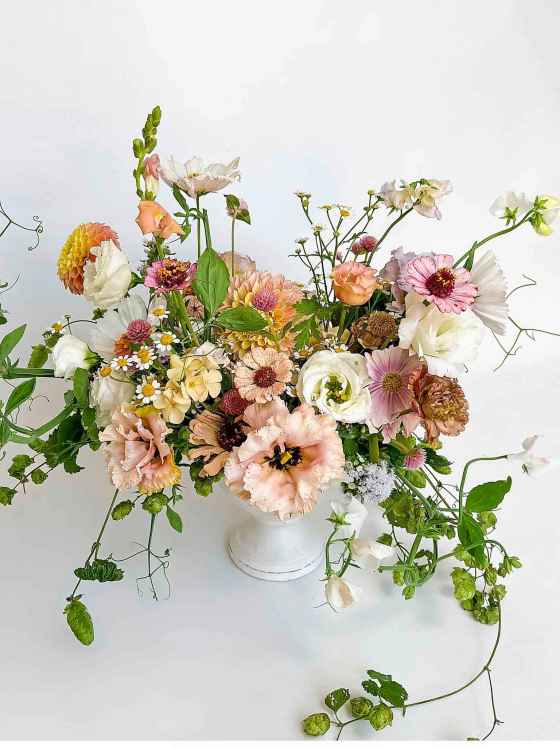
Create a flower arrangement for Valentine’s Day (Heather Page photo)
“When placing the flowers into your arrangement, ensure all foliage that sits below the water line is stripped,” she says.
“I like to design into a ‘cage’ or ‘ball’ of chicken wire, or you can even make a square grid of clear tape over the mouth of your vessel.
“When designing your arrangement, think once again about its placement. Should you balance the flowers throughout the entire arrangement if it is going to be seen from all angles? Or can you concentrate the flowers more in the front of the arrangement for a forward-facing arrangement with fewer flowers at the back.
“When placing your flowers, create dimension by allowing some flowers to pop a little higher than others. Some of the flowers should be a little lower to cover the mechanics of your vessel.
“My goal when creating each arrangement is to ensure every individual flower has its own space to shine versus being very tightly squished amongst other flowers.
“Now, go back into your arrangement and in between your focal and secondary focal flowers and line flowers, place stems of filler flowers to cover any gaps or open spaces between your blooms. This will allow your eye to move to each specific flower.
“Once you feel your arrangement is finished, step back and observe if your arrangement feels balanced visually and make the necessary adjustments.”
To keep your flower arrangement looking fresh, Tellier recommends changing the water every couple of days. Take care to avoid placing the flowers in direct sunlight.

Valentine’s Day gift idea: grow together with farm grown seeds from Lily Stone Gardens (Lily Stone Gardens)
This Valentine’s Day, would you like to give that special someone something other than chocolates or flowers?
How about flower seeds? “You can start the flowers together in the spring and watch them grow throughout the season,” says Tellier.
Lily Stone Gardens offers a wide selection of farm grown flower seeds.
Celery
Celery is an indispensable ingredient for so many recipes — soups, stews, and stir-fries. Eaten fresh, the stalks are a good source of fibre.
Homegrown celery has wonderful flavour. While some find celery tricky to grow, try starting the seeds indoors in late February to early March.
Douglas Green, author of Guide to Canadian Vegetable Gardening (Cool Springs Press, 2009), recommends planting seed very shallowly, only 0.5 cm deep. It’s critical to not bury the seeds as celery needs light to germinate. Green recommends laying the seed down on the flat and covering with just enough soil so that you do not lose sight of the seed.
Mist lightly with water and keep the soil consistently moist. The seed will germinate in about 15 days.

Celery: sow seed indoors end of February or early March. (Colleen Zacharias photo)
Maintain the daytime temperature around 22 degrees Celsius and lower the night temperature to 18 degrees Celsius.
Transplant the seedlings outdoors once there is no risk of frost.
One method is to use milk cartons with their tops and bottoms removed. Covering the stalks with tall and narrow milk cartons blanches the stalks so they are whiter, less bitter and have a sweeter taste.
Celery is a very shallow-rooted vegetable. Milk cartons hold moisture better than shallow containers. They’re also easy to label.
Start saving your milk cartons now!
The case of the missing plants
Winnipeg Gardener reader Jan Winnik asked an interesting question the other day when we were chatting.
“Why is it that I can’t find some of the plants at local garden centres that are featured in your column?”
That is a great question! Frankly, I’ve asked myself the same question over the years.
The answer comes down to supply and demand — that is, the interaction between the availability of plants (supply) and the desire by retailers to purchase them (demand). Let me explain.
The three big wholesale growers in Manitoba are Aubin Nurseries (Carman), Jeffries Nurseries (Portage la Prairie), and Vanstone Nurseries (Portage la Prairie). Each one of these grows a wide selection of plants ranging from trees, shrubs, perennials and annuals to herbs, grasses, small fruits and veggies.
Their customers are retail garden centres and big box stores located in a wide area that extends from northern Ontario, across the Prairie provinces, and in some cases, nurseries in the northern United States.
Retail customers from across this wide geographical area compete with one another to purchase plants from wholesale nurseries on a first come, first served basis.
I’ll share an example.
Last spring, Hemerocallis See You Tomorrow Daylily was one of the new introductions that was being offered by Jeffries Nurseries. I featured it in my column and couldn’t wait to get my hands on this new game-changing daylily with blooms that last four days or longer instead of the usual one day.

See You Tomorrow Daylily; each bloom lasts four to six days (ThinkPlants)
I looked high and low for this new daylily but couldn’t find it at any of the garden centres in Winnipeg.
So, I reached out to Jeffries Nurseries.
Shawna Bell, vice president, greenhouse perennials, explained that See You Tomorrow daylily was available at just three garden centres in Manitoba in 2025: Morden Nurseries in Morden, Sadlers Creekside Greenhouse in Souris, and Secord Crowe Greenhouse in Dauphin.
The remainder of Jeffries’ supply of See You Tomorrow daylily was snapped up by retailers outside of Manitoba.
Hopefully, it will be easier to find this new daylily at local garden centres this year.
In the coming weeks and months, my column as well as Winnipeg Gardener will be featuring many of the top new plants in this year’s lineup. Everyone will be vying for them — consumers and retailers.
Fibonacci sequence: the intersection between nature and mathematics
Plants offer so many attractive shapes and patterns. But there’s more to the geometric symmetry found in many plants than meets the eye.
In 2008, on a visit to Carmel, Calif., Marilyn Dudek, a Winnipeg gardener and succulent aficionado, was struck by the unusual pattern she happened to see in the purposeful and harmonious arrangement of echeverias in a front garden landscape.
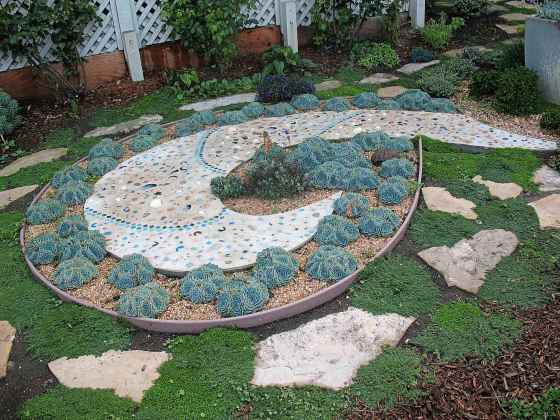
Garden design inspired by Fibonacci sequence (Marilyn Dudek photo)
It spurred Dudek to explore the concept of the Fibonacci sequence, a mathematical design found in nature. “The nautilus shell is touted to have the perfect pattern to show the sequence,” says Dudek.
Here, Dudek describes the mathematical rule behind nature’s patterns:
“Nature gives us unsurpassed beauty, but it also teaches us so much,” says Dudek. “Years ago, as I began my tender succulent collection, I admired the perfect symmetry and perfection of these plants.
“This led me to seeing the pattern in almost all plants, but especially flowers — for example, dahlias, sunflowers, zinnias, then pinecones, cauliflower etc. Being somewhat of a numbers person this led me to read more about nature’s patterns.”

Echeveria symmetrical rosettes, Fibonacci sequence (Marilyn Dudek photo)
“This pattern, known as the ‘Fibonacci sequence’ was discovered by Italian mathematician, Leonardo Fibonacci, in the 13th century. The terminology ‘Fibonacci sequence’ was not used until the 19th century,” she says.
“The mathematical pattern is that each number is the sum of the two preceding numbers: 0, 1, 1, 2, 3, 5, 8, 13, 21, and so on. It is noted that the human brain is attracted to such visual patterns laid out in sequence. Through this sequence the patterns of nature are described.
“The more one looks at patterns it is noticed that these patterns form much of nature’s beauty through flowers, vegetables and even trees.
“Also, it is noted that such number sequences are used in coding, and many other areas, but it returns to nature being the ultimate teacher,” says Dudek.
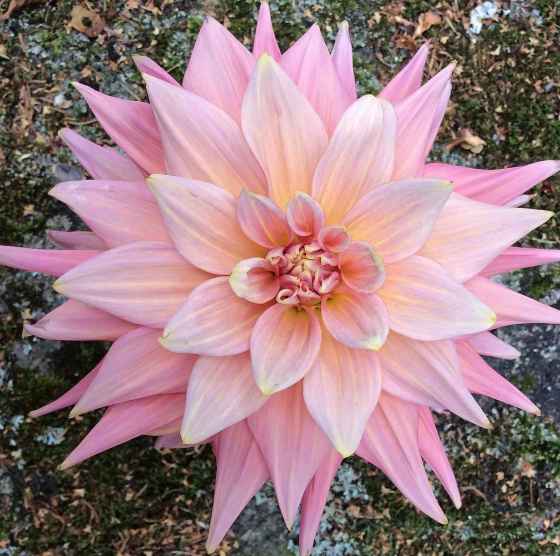
Dahlia Cafe au Lait, Fibonacci sequence (Marilyn Dudek photo)
Tired of smelling the coffee?
Smell these instead!
One of the things that makes the outdoor garden so enjoyable are all the fragrant varieties of flowers. Here are three fragrant annuals for your container arrangements:
Dianthus Capitan Magnifica
- A 2025 AAS Ornamental Winner from Selecta One
- Bicolour pink and white double blooms have a pleasing fragrance
- Frost and heat tolerance
- Attracts bees and butterflies
- Stems long enough to be used as a cut flower

Dianthus Capitan Magnifica, 2025 AAS Winner (Ball Horticultural)
Maestro Coral Hummingbird Mint
- New for 2026 from Proven Winners
- Award-winning Agastache hybrid
- Features aromatic foliage and blooms that release a spicy, minty scent when touched or brushed against
- Pollinator magnet and resists deer
- Height: 46 to 61 cm tall

Maestro Coral Hummingbird Mint Agastache hybrid (Proven Winners)
Safari Dusk South African Phlox
- This Jamesbrittenia hybrid has been named the 2026 Annual of the Year by Proven Winners
- A relative of Phlox, Safari Dusk has a delicate, sweet fragrance particularly noticeable during the evening
- Exceptional heat and humidity tolerance
- Purple blooms with a gold eye
- Compact (15 to 30 cm)
- Perfect for window boxes or containers
Nature’s Apothecary
A fragrant new show at The Leaf
On now until March 22, Nature’s Apothecary in the Babs Asper Display House explores the healing and transformative power of plants through dried botanicals, herbs, teas, and tinctures.
“We will be using rosemary, lavender and myrtle topiaries in the display,” says Wade Meisner, curator of horticulture at Assiniboine Park Conservancy.
Many of us are familiar with the lightly citrusy, pine-like notes of rosemary, a popular culinary herb that is also known for its antioxidant properties. Lavender, of course, is a classic culinary and medicinal plant. Beloved for its aromatic properties, lavender is a popular ingredient in body care products.
But what about myrtle? Myrtle has both aromatic and medicinal properties as well as culinary uses. Traditionally used in Mediterranean and Middle Eastern herbal medicine, the leaves and berries of myrtle (Myrtus communis) contain essential oils which are used in perfumes, incense, and aromatherapy.

Myrtle topiary, easy-to-shape (Pixabay)
Rosemary, lavender and myrtle are excellent choices for easy-to-shape topiary.
Nature’s Apothecary will also showcase the Conservancy’s citrus and olive collections.
Online plant pre-orders are going live
Can’t bear to wait any longer to start selecting your plants for the 2026 growing season? Be the first to add to your shopping cart all the plants you are dreaming of for your garden beds and containers.
Only a handful of retail garden centres in Manitoba offer online plant pre-orders at this time of year. Here are three for you to check out:
Glenlea Greenhouses
Online ordering for both fundraisers and retail pre-orders for the 2026 season is now open — as of January 30 — at Glenlea Greenhouses, located at 2715 Hwy 75, Ste. Agathe.
- Online orders must be pre-paid
- Online ordering ends in April
- Orders can be picked up starting May 8
- Curbside pick-up and home delivery available
“There are lots of fun goodies this year to choose from,” says Arielle Decraene, retail manager.
One of Decraene’s favourite annuals is Jamesbrittenia Safari Dawn. “I put it in my containers last year and thought it was incredible,” she says. “The flowers are pinky-red and are self-cleaning. You can use it as an alternative to calibrachoa.
Decraene is also excited about Artemisia SunFern, a versatile perennial (Zone 4a) with fern-like texture that thrives in full sun to part sun. Deer resistant and drought tolerant, SunFern grows to a height of 41 to 46 cm.
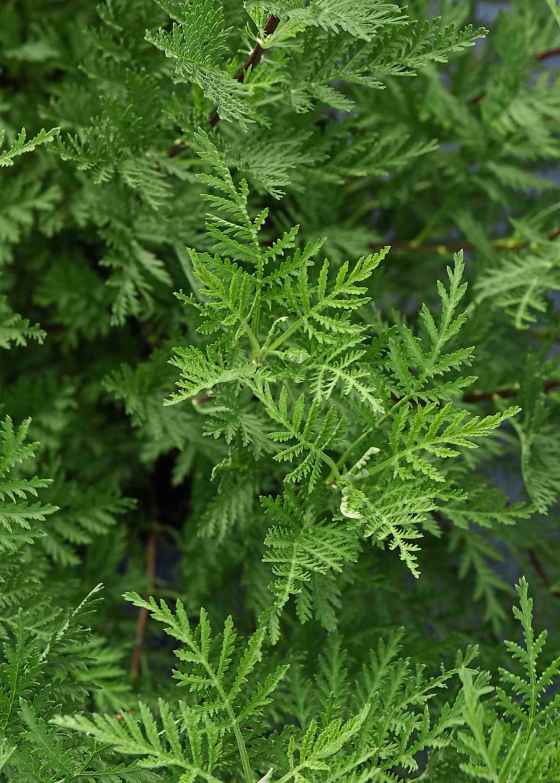
Artemisia SunFern (Darwin Perennials)
“We’ll also have SunParasol Bluephoria Mandevilla,” says Decraene. “This bush-type mandevilla has very unique colour — pink buds that open to blue-purple flowers.”
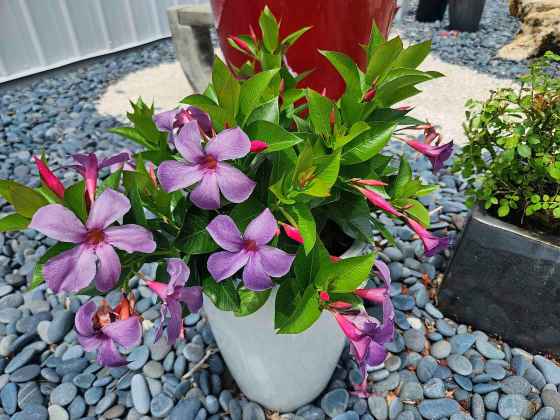
Sun Parasol Bluephoria Mandevilla (Suntory Flowers)
Van der Meer Garden Centre
Online pre-orders start Mar. 2 at Van der Meer Garden Centre, 1027 Old PTH 59, Île-des-Chênes.
Pre-order pick up and delivery for annuals begins the first week of May and runs through June.
“The deadline for bedding plant pre-orders is May 3 to ensure the best quality,” says Veronica van der Meer, retail store manager. Perennials, trees and shrubs will be available for order all season long.
“We’re excited to introduce a new cut-flower pack program, perfect for growing your own bouquets at home,” says van der Meer. Varieties will include lisianthus, tall snapdragon, asters, cosmos, statice, rudbeckia and more.
Van der Meer is also excited about two new varieties for 2026 from Proven Winners:
Sweet Caroline Sweetheart Shadow Storm sweet potato vine features variegated heart-shaped, near-black leaves that are speckled with green.

Sweet Caroline Sweetheart Shadowstorm sweet potato vine (Proven Winners)
Superbells Magic Double Grapefruit is a colour-shifting calibrachoa hybrid with flowers that open yellow and transition to soft, pastel pink tones.

Superbells Magic Double Grapefruit calibrachoa (Proven Winners)
“Last year, we trialed coco (fibre) hanging baskets, and we’re bringing them back—this time upgraded with a mess-free water reservoir by AquaSav,” says van der Meer.
“These baskets were a hit once customers learned they don’t drip through and keep plants hydrated!”

Coco fibre hanging baskets, water reservoir by AquaSav (Van der Meer Garden Centre)
Prairie Flora Greenhouse
Prairie Flora’s online catalogue opened for ordering on February 1. All seeds are open pollinated with a great selection of organic and heirloom varieties.
Aimee McDonald, co-owner, anticipates that seeds will be ready for shipping by Feb. 15.

Yellow Morden tomato, heirloom variety (Prairie Flora)
“I am particularly excited this year about having seed available for the Yellow Morden tomato,” says McDonald.
“Like many others, I can find it tough to balance life with tending my vegetable gardens, so I love this tomato since it is so reliable and easy to manage in short seasons. And I love how sweet it is!”
This is the first time that Prairie Flora is offering seeds for Yellow Morden tomato. Yellow Morden tomato was bred in 1950 at the Morden Experimental Station. It is a determinate (bush-type) tomato which matures 65 days from transplant.
Great for planting in containers!
For order details and pre-orders, click here.
Journey to Japan with Lego
New set makes a great Valentine’s Day gift
To mark International Lego Day on Jan. 28, Lego Group released a selection of new sets designed to spark shared storytelling and connection.
Lego Art Japanese Cherry Blossom Landscape for adults is a re-imagination of a Japanese landscape.
The set, which includes a black-lacquer shadow-box frame, features Mount Fuji, a traditional tea house, a red bridge, a waterfall, flying Japanese cranes as well as three species of trees native to Japan — Sango-Kaku maple and Japanese umbrella pine trees.

Lego Art Japanese Cherry Blossom Landscape (Lego)
Japan is a popular destination for gardeners including Winnipeggers France Barrette and Maurine Kiyoko Ulrich, both of whom visited Japan last fall.
“We had a fabulous time,” says Ulrich. Some of the places she visited included the famed Golden Pavilion (Kinkakuji) which features a path leading to a traditional tea house.

Japan, Golden Pavilion (Maurine Kiyoko Ulrich photo)
Barrette visited numerous Japanese gardens last fall. One of the growers at A grower at Schriemer’s Market Centre in East St. Paul, Barrette wishes she could have visited Japan in the springtime to see the cherry blossoms. “But spring is our busy time at the garden centre.”
A visit in the fall provided many opportunities to visit gardens in Japan, many of which featured red garden bridges, says Barrette.

Iconic garden bridge in Japan (France Barrette photo)
The North American Japanese Garden Association discusses the symbolic meaning and roots of this iconic element in the composition of Japanese gardens here.
The Lego Group’s Play Well Study found that 14 per cent of Canadian adults felt stressed almost daily over the past year. That’s where hands-on creativity comes in, says Lego.
The Lego Japanese Cherry Blossom Landscape framed wall art makes a nice mindfulness gift for adults who have a passion for Japan and landscape design. The set offers two display options — hang it on the wall or stand it on a shelf.
The set is 1,892 bricks and measures over 35 cm by 6 cm by 39 cm. It retails for $179.99 at The Lego Store in Polo Park.
An interesting suggestion from a reader: Winnipegger Dan Neufeld says he would like to see an exhibit of Lego set among the plants in the biomes at The Leaf at Assiniboine Park.
It’s an intriguing idea.
Lego exhibits have appeared in recent years at several botanical gardens and conservatories worldwide, including a major Lego exhibit at the Royal Botanical Gardens in Burlington, Ontario. At the time (according to the 2017 RBG Donor Report), the Lego exhibit titled “Nature Connects” used 378,436 Lego bricks.
Banana Bloom, peat and coco substitute
Several new products vie for attention each year at the Tropical Plant International Expo (TPIE). The event which is held in January in Fort Lauderdale, Fla., attracts garden centre retailers from across North America.
Banana Bloom Natural Soil Booster was one of 15 products which was named as a Retailer Choice Award winner.

Banana Bloom peat and coco substitute (Banana Bloom photo)
A soil amendment made from 100 per cent repurposed banana plant fibres sourced from the trunks of banana trees, Banana Bloom is said to provide superior water retention compared to traditional amendments like peat moss and coconut coir.
Naturally anti-microbial and sustainable, just 10 to 20 per cent of the product mixed into soil can reduce watering needs, unlike coconut coir which requires heavy water use and chemical processing.
Since many gardeners, including myself, would like to reduce or end reliance altogether on the use of peat moss in our container gardens, I reached out to Banana Bloom to inquire if the product is available in Canada or will be in the future.
A spokesperson replied that Banana Bloom is “actively working on establishing a physical presence in Canada with localized packaging and distribution, but we don’t have a specific timeline to share just yet.”
In the meantime, the company suggests that Canadian gardeners can access Banana Bloom through direct shipping.
If you would like to see the complete list of TPIE’s Retailer Choice Award winners, click here.
Which new product intrigues you?
Not every great gardening product is successful. Do you remember The Wedgie, a bright yellow tool which was invented by Chicago gardener Cookie Wherry to help people make planting holes more easily? Wherry developed the tool due to her own struggle with arthritis.
The Wedgie was featured in Garden Making magazine. When Beckie Fox was the keynote speaker at the 2013 Gardening Saturday, a trade show I organized for seven years on behalf of Gardens Manitoba, I reached out to Cookie Wherry, who provided a box of free samples for attendees.
But the bright yellow, triangular-pointed plastic hand tool similar to a dibble did not achieve mainstream success.
The Pressed Flower Handbook
Pressing flowers to preserve botanicals is an ancient practice. Herbariums preserved botanicals for scientific study. But it was in the 18th and 19th century that flower pressing became a hobby embraced by many people who wanted to preserve the beauty of blooms and foliage from their gardens.
The Pressed Flower Handbook – Simple Methods for Connecting with Nature and Preserving the Beauty of the Garden through the Seasons (Quarto Publishing, 2026) by Sarah Holland, is a marvellous step-by-step guide to traditional flower pressing. Beautiful photography illustrates every aspect of pressing flowers.
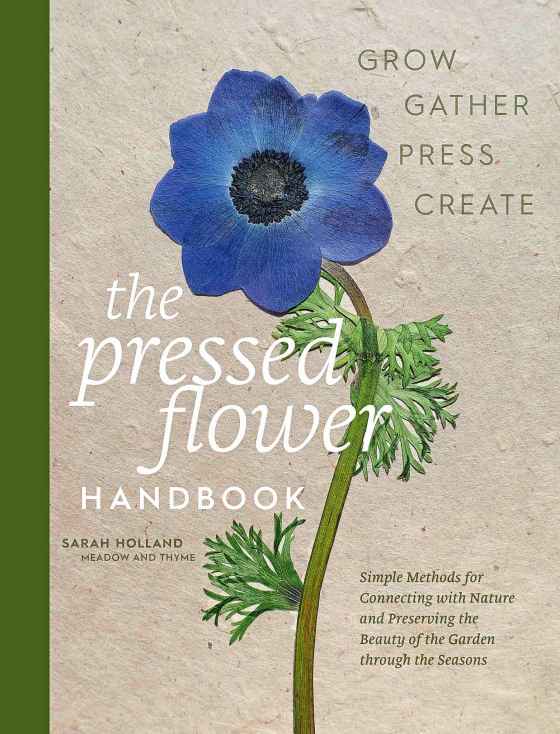
The Pressed Flower Handbook by Sarah Holland (Quarto Publishing)
There are tips on pressing flowers with multiple layers of petals or thick stems.
The author describes a variety of techniques using natural methods as well as troubleshooting tips for avoiding problems such as fading or breakage. Framing and mounting tips are also included as well as ideas for creative, doable projects.
The author, Sarah Holland, is based in Worcestershire, England. She grows all the flowers she presses and is committed to organic, wildlife-friendly and sustainable practices. Holland shares her thoughtful and knowledgeable perspective in an accessible way that is both informative and personal.
This is a beautiful book that will give readers endless hours of enjoyment.
Available May 12, 2026. Hardcover, 192 pages. Pre-order online. $35.99
Mark your calendars
- On Feb. 7, the Manitoba Master Gardener Association presents Agatha’s Almanac, winner of the Best Canadian Feature Documentary at the Hot Docs film festival in Toronto. This special film presentation will be screened in the Lecture Hall, South Campus, Canadian Mennonite University, 600 Shaftesbury Blvd., from 1 to 3 p.m. Tickets are $10 for MMGA members, $15 for guests. E-tickets can be purchased online.
- Winkler’s 2nd Annual Seedy Saturday takes place on Feb. 21, from 10 a.m. to 2 p.m. at Winkler Arts & Culture, 547 Park Street, Winkler. Free seed exchange and free admission. Bring labelled seeds to share with others and learn about seed saving. Visit the Facebook page for Winkler Seedy Saturday 2026 for a list of participating vendors.
- The annual Brandon Seedy Saturday event, hosted by Assiniboine Food Forest, will take place at the Ukrainian Reading Association Hall, 1005 Assiniboine Avenue, Brandon, on Feb. 21, from 11 a.m. to 4 p.m. Featuring gardening and nature-themed vendors and children’s activities. Refreshments available. Admission is free.
|