|
“Peaceful, lawful protest — if it is effective — IS innately disruptive of ‘business as usual.’ That is WHY it is effective.”
— author and journalist Naomi Wolf
A bylaw that sought to restrict the right to protest has been withdrawn by its author. In large part because enough Winnipeggers lined up to protest the bylaw.
The Macro
The real irony of Winnipeg City Coun. Evan Duncan’s poorly conceived proposal to ban “nuisance” protests is that it was ultimately undone by protest.
Hundreds of people registered to make presentations at council when it was scheduled this week to consider a proposal from the councillor for Charleswood-Tuxedo-Westwood for the “Safe Access to Vulnerable Infrastructure bylaw”. Hundreds more protested outside in the City Hall courtyard.
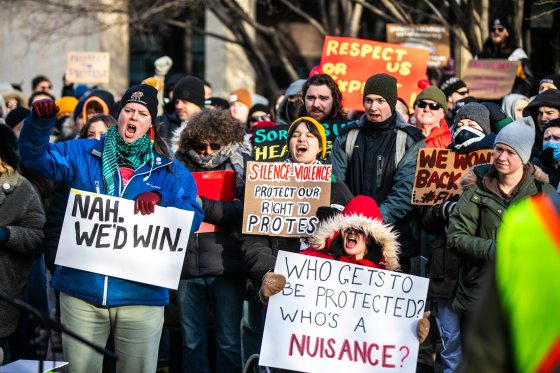
Hundreds of people rally at city hall opposing a proposed bylaw restricting “nuisance demonstrations” before the Executive Policy Committee on Tuesday. (Mikaela MacKenzie / Free Press files)
Duncan’s proposal would have banned “nuisance” demonstrations from a buffer zone of 100 metres around public buildings — including schools, libraries and health-care facilities — any place of worship and even cemeteries.
Duncan defined “nuisance” demonstrations as “any in-person protest or demonstration” that involves “the expression by any means… of objection or disapproval towards an idea, action, person or group based on or related to any specific characteristics.” Or any event that “obstructed pedestrians or motor vehicles” without obtaining the appropriate permits.
Not surprisingly, given the mounting protest against limitations on protest, Duncan announced this week he was withdrawing the proposed bylaw. Of course, he didn’t acknowledge that he had been wrong about the bylaw; instead, he claimed the opposition to his proposal was based on “misinformation.”
And then, Duncan delivered the punchline. “At no point in time was it ever my intention to ban peaceful protests.”
Memo to Coun. Duncan: Winnipeggers who objected to your proposed bylaw know that you were, in fact, trying to ban peaceful protests.
Why would Duncan willingly wade into an issue like this?
There is little doubt that pro-Palestine or anti-Israel protests were at the heart of Duncan’s proposal. Many of those who support Israel believe that any protest against its incursion into Gaza are expressing antisemitism, while pro-Palestine forces believe that those who support the war in Gaza are de facto supporting genocide.
There is genuine concern about the tone and substance of some of these protests.
Supporting Palestine and criticizing Israel for its relentless response to the horrific October 2023 Hamas attacks on Israel is not, in and of itself, objectionable. Allowing pro-Palestinian sentiments to evolve into advocacy of another Hamas-style attack, or the expression of unfiltered antisemitism — which has been a feature of some protests here and abroad — is not OK.
But the essential problem with Duncan’s proposed bylaw is that it lost sight of the important difference between disruptive, even discomforting, and utterly profane.
Advertisement

Second memo to Coun. Duncan: a protest can be highly critical or even demeaning of a person, company or country and still be legitimate and peaceful.
It did not help Duncan’s cause that just as he was trying to curb the right of Winnipeggers to express themselves through protest, citizens in Minneapolis were demonstrating, once again, the enormous power of organized citizen protest.
The protests that forced the Trump administration to withdraw most of its domestic army involved in immigration enforcement were highly organized, genuinely non-violent and, ultimately, devastatingly effective.
It’s an important lesson for lawmakers everywhere: protest is essential, even when we don’t like the message.
In the 1980s, as a high school and university student, I was heavily involved in protests against Canada’s contribution to nuclear missile proliferation. The protests I took part in were scrupulously non-violent and absent of even a hint of burning or breaking things just for the visceral pleasure of seeing smoke and broken glass.
Not every protest has followed the same model that I saw in the ’80s, or the one used in Minneapolis. And, as mentioned, there are times when the forces of hate hijack proceedings to express views they might be reluctant to express as individuals.
In the final analysis, Duncan did not consider that we have tools to ensure that protests stay inside the guardrails of the law. Permits are required for any protest that might disrupt traffic or occupy a public space. The Criminal Code has provisions to punish anyone guilty of violence or vandalism, or anyone making a direct threat against any individual or group. And finally, Canada has hate laws to prosecute anyone who advocates violence against any group for any reason.
None of these are perfect tools, and some protests will breach the aforementioned legal guardrails. But anyone who thinks banning protests on a broad scale is the solution to these problems just hasn’t thought enough about the underlying issues.
Like the councillor from Charleswood-Tuxedo-Westwood.
|