|
Toyota Canada came out last week and flatly denied reports it was moving an assembly plant from Alabama to Ontario.
Social media has been aflutter with news of this and news of that, particularly around trade, around actions by Prime Minister Mark Carney that “set off a bomb” in Washington or “left the White House scrambling” to repair the damage.
Little, if any, of it is true.
Advertisement

In Toyota’s case, it was a joint Mazda-Toyota plant in Huntsville, Ala., that was going to be the first casualty of U.S. President Donald Trump’s trade war. The $9-billion plant was closing and its 4,000 jobs were moving to southern Ontario, where Toyota operates two assembly plants and a host of related operations.
“There is no truth to this,” Toyota Canada spokesman Michael Bouliane told The Canadian Press.
The plant produces the Toyota Corolla Cross and the Mazda CX-50 hybrid. Interestingly, Toyota Canada can still import the Corolla Cross thanks to tariff relief granted by Canada for Toyota’s manufacturing here. Mazda, which doesn’t build anything in Canada, has had to cease imports of the CX-50 hybrid. (Non-hybrid models are built in Japan and thus not affected by Canada-U.S. trade friction.)
Much of what you might see about the trade dispute, both through legitimate news outlets and less-legitimate outlets operating on social media, will be “noise,” as Tim Reuss, president of the Canadian Automobile Dealers Association, told me during an interview for one of my freelance clients, Automotive News Canada.
The first test in determining which is true and which is clickbait is this: how reasonable does the claim appear to be? Is it accompanied by AI-generated photos of a visibly angry Trump about to blow his lid? Is it in character? Irrespective of whether you like the guy, one thing you can’t say about Carney is he’s given to rash actions.
Can it be verified through other sources? Choose whatever and however many media outlets you wish; if you can’t see anything even hinting at it being true, it’s almost certainly false.
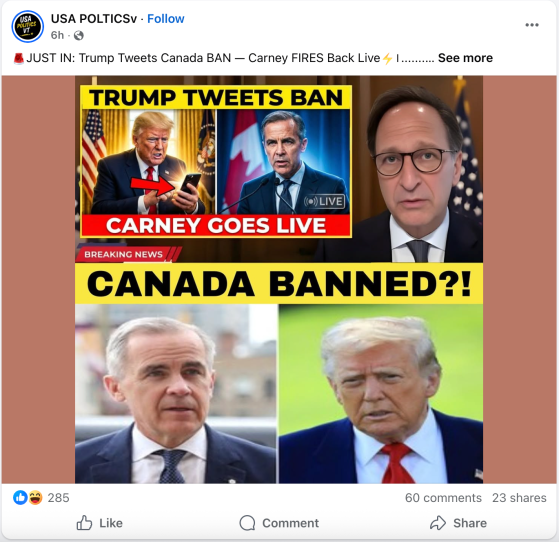
Online posts hint at all sorts of outrageous events. Very little is true. (Facebook)
The reasons for these false reports are many, but the single largest is most likely to simply be… clicks. More people clicking mean more revenue for the content creator. Other reasons could well be bad actors — often foreign — trying to stir up anger, resentment, sadness… anything to move public opinion.
If there’s one thing that suggests pragmatism will eventually win the day, it’s this: Carney, and prominent Trump critic Bill Maher, a guest of Trump’s at a private dinner at the White House, both say that when the cameras are off, Trump becomes almost gregarious. The bluster is parked and the ears are opened. Both say he listens and is pleasant. In direct contradiction of his public persona, of course.
Similarly, business organizations — the ones actually at the table for trade talks — say U.S. representatives are open to progress and interested in making a deal.
Wherever this trade dispute lands, one thing is clear: it will be what we can’t see that determines the outcome. So we should pay less attention to anything outrageous we can see.
|