FIVE STORIES ON TURTLE ISLAND
1. First Nations and Métis leaders expressed disappointment regarding the federal government’s 2026 spring economic update this week. Assembly of First Nations (AFN) National Chief Cindy Woodhouse Nepinak highlighted a lack of distinctions-based funding and critical infrastructure investment, calling for better “Canada Strong” planning.
Perhaps aware that Indigenous leaders may have concerns, the federal government made one of their spokepeople of their statement an Indigenous face: Minister of Arctic and Northern Affairs and Minister Responsible for CanNor Rebecca Chartrand.
2. Speaking of economic outlooks, the First Nations Major Projects Coalition (FNMPC) held its 9th Annual Conference in Toronto this past week, highlighting the growing role of 198 First Nations in equity participation for major resource and infrastructure projects across Canada.
A remarkable part of the conference was the first international speech of the newly installed Maori Queen Te Arikinui Kuini Nga wai hono i te po, who told the 1,800 delegates “to lead with intergenerational vision, grounded in Indigenous values. Protect Indigenous rights, grow economies that uplift our people, and uphold the right of Indigenous nations to lead economically and globally.”
The FNMPC conference was interrupted however by the announcement by First Nations leaders that they are not considered or included in the federal government’s new national Sovereign Wealth Fund.
3. In a fascinating court decision with Métis people on both sides, the Manitoba Metis Federation (MMF) is celebrating an $11.8-million award against the Métis National Council (MNC) following a legal dispute and allegations of defamation and impropriety between the organizations.
This follows a November 2025 decision in which MMF President David Chartrand and others were found not to have their “breached fiduciary duties” when MNC officials alleged the group attempted to “destroy the MNC” and replace it with the MMF as the “national body for Métis people in Canada.”
In 2021, the MMF left the MNC followed by the Métis-Nation Saskatchewan and the Métis Nation British Columbia in 2024.
Speaking of becoming a national voice for Métis, the MMF has been busy also disputing what they claim to be misrepresentation by First Nations chiefs of the treaty they agreed to with the federal government.
4. There is rising concern in Native American tribal nations in the United States after the U.S. Supreme Court struck down Louisiana’s congressional map, ruling that it relied too heavily on race in redrawing district lines — and dealt a major blow to the Voting Rights Act.
The concern is that this decision opens the door for states to more easily dilute the voting power of Native Americans in this fall’s mid-term elections alongside the participation of Indigenous peoples in American democracy.
5. Finally, a huge congrats and miigwech to Governor General Mary Simon, who is ending her term as Canada 30th Governor General and first Indigenous person to ever hold the post.
Simon completed her five year term this week and was replaced with former Supreme Court judge Louise Arbour.
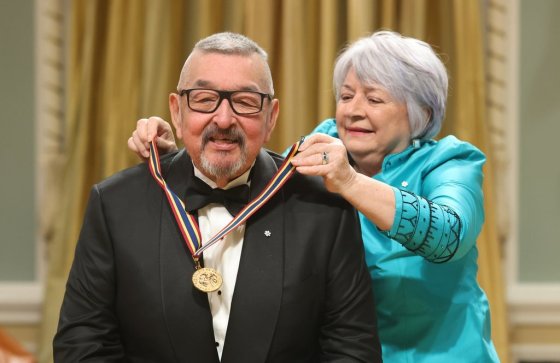
Governor General Mary Simon presents actor Graham Greene with the Lifetime Artistic Achievement Award in 2025. (Patrick Doyle / The Canadian Press files)
Called “the right Governor General for our times,” Simon was the first Inuk leader and Inuktitut speaker in the Governor General role and focused her mandate on representing Canadian interests nationally and internationally and working on initiatives in mental health, reconciliation, education, and environmental protections.
Miigwech to you, Gov. Gen. Simon — anyone who knows you knows you will continue to do this work no matter what role you hold.
IN PICTURES

Traditional dancer Lynne Ballantyne during the grand entry at the RRC Polytech annual graduation pow wow on May 1. (Mikaela Mackenzie / Free Press files)
RECONCILI-ACTION OF THE WEEK
Every week I highlight an action, moment, or milestone forwarding reconciliation, illustrating how far Canada has come — and how far the country has yet to go.
The reconciliaction of the week is the partnership forged locally in Winnipeg between Sisler High School’s CREATE animation program and media companies Eagle Vision and Sinking Ship Entertainment to train Indigenous students interested in entertaining animation, cartooning and television production.
Funded through the Indigenous Screen Office, this initiative will take place this summer and will see Indigenous young story creators working with professional animators to learn skills such as character rigging, background creation, scene assembly and have an opportunity to work on already existing animation shows such as Stevie and the Sacred Animals.
Indigenous animated films and television programs such as the 2025 APTN show Chums have experienced a resurgence in recent years — check out this great set of recent films by the National Film Board, for instance — and the media industry is clearly ready for more.
|