|
“Good temper and moderation are the characteristics of parliamentary language.”
— Betty Boothroyd, the first female speaker of the U.K. House of Commons
Another instance of bad language and behaviour in the Manitoba legislature. And a unique ruling on words that shall never be spoken again in the chamber.
Advertisement

The Macro
Tom Lindsey, the MLA for Flin Flon and the speaker of the Manitoba Legislature, barely had time to brush the lint from his black robe after a week’s break in proceedings before he was pressed into action.
On Monday, Lindsey ruled Tory MP Wayne Ewasko (Lac du Bonnet) used unparliamentary language in the chamber when, during a prickly exchange with Premier Wab Kinew, he told the first minister to “quit drinking.”
NDP House Leader Nahanni Fontaine said Ewasko’s comments were an attempt to slur the premier with a toxic Indigenous stereotype. (Kinew, for the record, does not drink alcohol.) Lindsey said he confirmed what Ewasko had said by reviewing audio recordings and asked him to apologize.
Unqualified apologies are considered table stakes — the minimum requirement — for elected members of a legislature who have been caught doing or saying something unparliamentary. Unfortunately, like an obstinate preschooler caught in front of a defaced living room wall with a mitt full of crayons, Ewasko refused to acknowledge the obvious.
Ewasko said he accepted the speaker’s ruling, but did not apologize. When urged by Lindsey to give it another go, Ewasko engaged in one of those “if you took offence at what I said, then I apologize” non-apologies.
Lindsey asked him to try again.
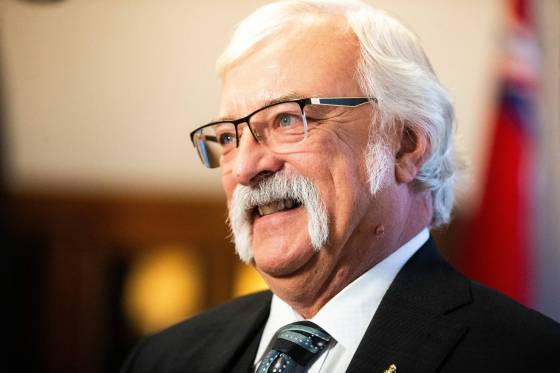
Speaker Tom Lindsey said Monday that MLAs on both sides of the chamber are a problem, with excessive heckling and unparliamentary language and behaviour. (Mikaela MacKenzie / Free Press files)
When Ewasko refused again, he was ejected from the chamber.
“I would like to congratulate us on meeting a new low,” Lindsey said in frustration.
But that’s not all Lindsey had to say to the legislature. He also deemed that words like “bigot,” “homophobe,” “racist,” “misogynist” and “transphobe” were also now officially considered unparliamentary language and should not be used in the chamber.
Fontaine objected to Lindsey’s decision to blacklist certain words, given that the NDP regularly call out the Opposition Progressive Conservatives for saying racist and homophobic things. And to be fair, the Tories have given the governing NDP quite a lot of raw material to work with.
It should be noted that Lindsey was not setting a precedent. In Ottawa, the House of Commons considers these terms unparliamentary and punishes members who hurl them at each other. It’s really just a natural evolution of the ancient art of parliamentary language.
For those of us who have spent far too much time listening to debates in various parliaments, the concept of parliamentary language is a constant source of amusement. One of the best, and funniest examples is the prohibition on the word “liar.”
Elected members of a parliament are forever accusing each other of dishonesty without using the word liar. The best replacement phrase is that the honourable member is “a stranger to the truth.” It’s totally acceptable language that communicates the allegation of dishonesty in elegant fashion.
Was Lindsey correct in banning words like racist and homophobe from debate within the chamber? It would be nice to think that elected officials could call out racism or homophobia when they see it.
Fortunately, if parliamentary language has taught us anything, it is that dehumanizing assertions can still be called out, even if we don’t call them out by name. Lindsey made that point when he told the legislature that regardless of what words are used, he will not allow “offensive or disorderly” comments to be used in debate. “I will also be listening for members using creative variations of the words I’ve listed and those comments may also warrant a caution or be ruled out of order,” he said.
It would be nice to think that banning disrespectful or dehumanizing language would somehow make proceedings more genuinely respectful. For now, we’ll have to be satisfied with having debate sound more respectful.
|