|
Unpopular opinion, maybe, but I don’t mind falling back in November nor springing forward in March — although the former is certainly preferable to the latter. It’s annoying for a day or two and then it’s fine. Like jet lag, minus the vacation.
I understand why people don’t like doing this, I do. I know the stats about car accidents and heart attacks.
But have you really looked at our choices in the proposed adoption of a permanent year-round time system? Have you crunched the numbers? Have you really sat with the reality of what this means for our particular place in this particular hemisphere?
Because I’ll tell you: I am positively aghast.
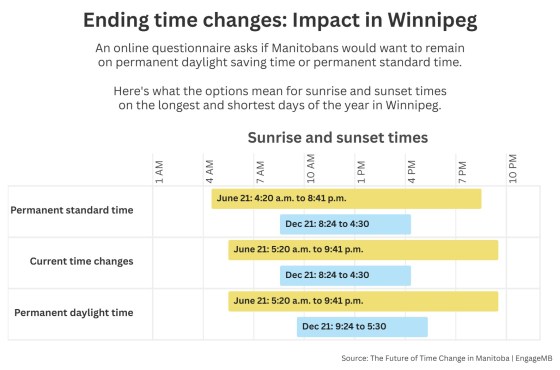
If we move to permanent standard time, we can have the sun rise at 4:20 a.m. (!) in the summer. That is a nighttime hour that shouldn’t be daytime.
If we move to permanent daylight time, we can have the sun rise at 9:24 a.m. (!!) in the winter. That is a daytime hour that shouldn’t be nighttime.
Those are… both bad. I don’t want either of those things. The current system is annoying, yes, but do you really want it to be sunny out in the hour of four in June? Or have the morning commute be in full darkness in December?
Apparently, 34 per cent of you want the 9:24 a.m. sunrise option (!!!).
Manitobans are pulling out in favour of permanent daylight time according to a recent poll. That’s expected; we’d preserve our late, nearly 10 p.m. sunsets in the summer while ditching the soul-crushing 4:30 p.m. sunset in winter.
But not everyone thinks permanent daylight time is the best option.
“Scientists over the world have been warning about the negative health and safety implications of permanent daylight saving time and have been advocating for permanent standard time instead,” Myriam Juda, an adjunct professor and sleep researcher at Simon Fraser University, told the Weather Network in March for an article about B.C.’s move to permanent daylight time.
Advertisement

This is for a few reasons: standard time more closely follows our circadian rhythms with a more even split between morning light and afternoon light.
Morning light sets the stage for better sleep, because it helps your body time out the release of melatonin later in the day. The dark commute on permanent daylight time in the winter is also a safety concern; spare a thought for our school patrols.
I guess we should be happy we’re being given a say: B.C. wasn’t. It was either stick with the twice-yearly time change or move to permanent daylight time. The province did the latter.
But there’s always tradeoffs. We’d lose those super-late prairie sunsets in the summer if we move to permanent standard and would have the sun come up in what I consider to be the middle of the night.
We’d also lose the ability to complain about the twice-yearly clock resets if we stop doing them at all — and the complaining \unites us!
I guess if the majority of people want the sun to come up at — and I cannot stress this enough — 9:24 a.m. in the deep dark of winter, I can’t do anything about it except accept it.
And perspective: there are places in the world in which it’s actually permanent midnight in the winter and permanent daylight in the summer. I would never live there, mind you. But they exist.
Nexties, are you team standard, team daylight or team leaving things the way they are?
|