|
“Solar power is the energy of the future. It’s free, it’s clean, and it’s abundant.”
— Thomas Edison
Countries around the world are embracing micro-generation of electricity — largely solar panels installed on a house-by-house basis — to build a more sustainable, carbon-neutral energy future. In Canada, not so much.
Advertisement

The Macro
Island nations do tend to be creative about problems that other countries part of larger land masses don’t have to worry about. So, it’s hardly surprising Australia has become a global leader in micro-generated electricity.
A recent feature story in The Guardian newspaper details how Australia is escaping the worst of the current war-in-Iran energy crisis through creative use of smaller solar arrays.
How successful has the Australian program been? The Australian government was able to announce electricity bills in New South Wales and the southeast portion of Queensland provinces were to be cut by 10 per cent owing to “record levels of renewables and batteries in the power grid.”
This has been done through a combination of larger, utility-sized developments but also through smaller micro-arrays installed on individual homes.
Currently, it is estimated slightly more than 40 per cent of Australian homes — nearly 11 million individual residences — have some sort of solar array and a battery to store the energy.
How is Canada faring in the race to establish micro-generation from solar and wind? Not so good.
Canada currently produces 25 gigawatt hours (GWh) of electricity though solar and wind, which is about nine per cent of our total electricity generation. By comparison, the average capacity of renewable energy generation in G7 countries is 20 per cent.
And even though Prime Minister Mark Carney has promised to double the capacity of our energy grid by 2050, and double the amount of renewable energy by 2035, we’re actually falling well behind leading countries such as Australia.
While Canada currently generates 25 GWh of electricity from wind and solar, Australia’s total renewable capacity has already reached 110 Terawatt hours — that is 110,000 GWh.
And Australia is aggressively expanding that capacity. I wrote about this approach to energy generation nearly two years ago, when the newly minted NDP government was preparing for the release of its broader energy strategy.
I asked at that time whether micro-generation would be part of that strategy; it was not mentioned.
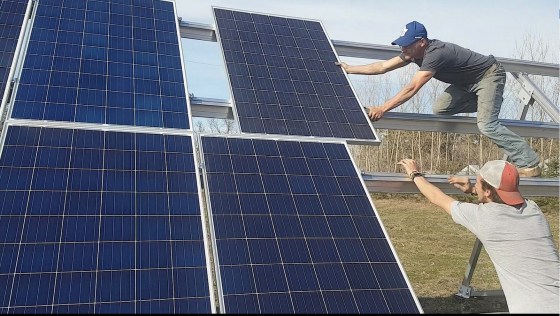
Solar Manitoba employees work at installing solar panels. (Submitted)
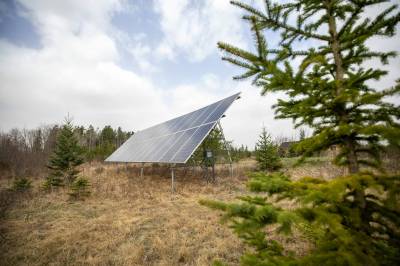
That’s not to say we don’t have some micro-generation. In 2024, Manitoba Hydro acknowledged more than 1,600 privately owned solar arrays in the province, ranging from a few solar panels on the roof of a single-family home to a seven-acre, 3,000-panel solar farm on the Fisher River Cree Nation, 200 kilometres north of Winnipeg. These arrays generated about 40 megawatts of electricity, which Hydro estimated was enough to power Oakbank for an entire year.
Moreover, even with the relatively small number of private solar arrays, there is a net benefit to the entire province: nearly two-thirds of the electricity generated by these arrays is sold back to the provincial grid.
With the experience in other countries, and our own small but meaningful contributions, you would think the provinces would be rushing to build micro-generation. There are grants and interest-free loans available from various provincial governments and from Ottawa, but for reasons that are not entirely clear, the uptake has not been significant.
One reason for the cool reception from homeowners may be that Canada regularly boasts about how most of its electricity — which comes from massive hydroelectric generation systems — is already renewable and “green.” And while that may be technically true, it’s a bit of a fallacious premise.
Hydro does not rely on burning coal or gas to generate electricity, but it does have a profound and permanent environmental cost on the lands that are flooded to create the reservoirs to store water for hydro turbines.
On top of that, the reality is Canada’s existing hydroelectric generation system is tapped out. That is definitely the case in Manitoba, where demand for power is increasing so fast, in the very near future we won’t be able to sell electricity to neighbouring jurisdictions to subsidize rates.
The Carney government, and many provincial leaders, still seem to have a “go big or go home” mentality to meeting our future energy needs.
Ontario is spending billions on new nuclear generating stations. Other provinces are considering new hydro projects. There are ongoing negotiations on establishing a national grid so provinces can sell electricity to one another.
What if the solution to our energy crunch could be found simply by looking up to the roof lines of our homes?
|