|
“How will the world speak my name in years to come? Will I be known as the philosopher? The warrior? The tyrant?”
— Richard Harris as Emperor Marcus Aurelius in Gladiator
The Macro
Various stories are leaking out of the Liberal government about how Prime Minister Mark Carney is governing. Are they telling different versions of the same truth?
Advertisement

Most political leaders go through a natural cycle of popularity.
It starts with a honeymoon period, often driven by curiosity. Then, comes the galvanization of the leader’s personal brand.
Then, further on down the road of their careers, come stories that attempt to poke holes through that brand.
And finally, you are left with the lasting image that voters have of the leader.
As journalists, we have to be wary of the evolution of this cycle of popularity, particularly if the hole-poking phase involves anonymous sources from the backbenches of a caucus, complaining about how they are being treated.
I won’t condone boorish or bullying behavior. However, I’ve also come to understand that the inner workings of any government tend to, at times, involve measures of tough love and bad behaviour.
Demeaning someone for the sake of demeaning them is not on. But politics in general, and governing in particular, is emotional, the stakes are high and it’s not always necessary for people to use their indoor voices.
The longer leaders serve, the more likely you’ll read stories involving anonymous sources offering anecdotes about leaders allegedly gone wild.
The first of these stories about Prime Minister Mark Carney appeared in early June, written by Toronto Star national columnist Althia Raj, a well-respected and long-serving member of the National Press Gallery.
Raj wrote a story with the headline “He Yells” which recounted how Carney had become an ogre in Liberal caucus meetings. “Grit MPs report Carney lashing out at certain members when he doesn’t like the message they deliver,” Raj wrote. She went on to detail how “Carney does not want to hear concerns, he wants to hear solutions.”
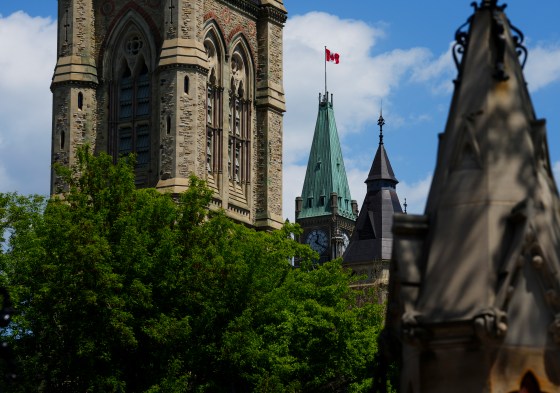
The Canadian flag blows on the Peace Tower on Parliament Hill in Ottawa. (Sean Kilpatrick / The Canadian Press files)
It was a powerful story, but it didn’t get much traction. CTV News did a matching story, but only reported with attribution what the Star had written the day before.
CTV was not able to identify any new sources, or indicate that its parliamentary bureau had actually confirmed any of the information.
CTV did, however, quote Liberal caucus chair and MP James Mulroney asserting that the story “was not true.”
This is a horrible position for any journalist, and one that I have faced a couple of times in my career: after reporting a story from deep inside the political machinery of government, nobody follows your story except to publish or broadcast official denials.
(For reference, please see my “Bison of Shame” column about the inner workings of the government of former premier Brian Pallister. The PC caucus did issue a statement denying the story, but more than a dozen sources confirmed my account.)
I’m not saying Raj was wrong. Only that it’s lonely being the lone journalist in the gallery reporting an explosive story like this.
And you can bet that the longer your story goes uncorroborated by other news organizations, voices offering contradictory narratives will start to appear.
That was certainly the case this week when The Hill Times reported that Carney had forged the first authentic “cabinet government in about 40 to 50 years.”
The Hill Times, a publication dedicated to the “inside baseball” account of politics on Parliament Hill, argued the prime minister was demanding his cabinet ministers be more accountable and involved in major decisions. That’s as opposed to former prime minister Justin Trudeau, who tuned out cabinet ministers and reportedly made all major decisions on his own with the advice of trusted but non-elected staff.
Could both stories be slightly different versions of the other? To reach that conclusion, we should consider some fundamental truths about power and politics.
The first is that regardless of how much backbenchers and ministers are listened to, the power in a parliamentary system is concentrated in and around the prime minister.
It’s worth debating whether this is good for the country, but it’s certainly a fact of political life that the PM runs the show, picks the cabinet, and decides who within caucus is worthy of involvement in the actual running of the country.
Another fundamental truth worth mentioning is that there just isn’t enough prime minister to go around. In other words, the prime minister does not have enough hours in the day to meet separately with every MP to discuss those issues.
That means the concerns from caucus are filtered through political staff who — if we’re being honest — are often drunk on their own access to the prime minister.
That brings us to the last truth: one person’s “yelling” is another person’s “forcefully applied expectations of accountability.”
This is the one that all responsible journalists need to keep in mind when reporting “inside baseball” accounts of the tone and temperature of conversations around a cabinet or caucus table.
One final note: good journalists who make their living by being able to reveal the inner workings of government must always guard against being seduced by axe-grinders or backbench MPs who haven’t really earned the right to be involved directly with major decisions.
Just saying.
|