|
“Setting people to spy on one another is not the way to protect freedom.”
— Tommy Douglas
How often do politicians spy on other politicians with private investigators? Quite often, it seems.
Advertisement

The Macro
I personally think that politics these days is a very dangerous and desperate pastime.
It’s hyper-partisan, hyper-toxic and the guardrails of civility and mutual respect have been completely eroded. Politicians can say whatever they want, whenever they want, with little in the way of repercussions from voters.
So perhaps it’s not surprising that this week, there were two separate stories about politicians spying on other politicians.
In Ontario, The Trillium and POLICORNER – two online news outlets that focus on Ontario politics – reported that the Ontario Progressive Conservative party paid $3,000 to send a private investigator to Jamaica to spy on then-Ontario Liberal Leader Bonnie Crombie, who had travelled to the Caribbean paradise in December 2023 for a family vacation.
When confronted, a spokesperson for the Ontario PC party dismissed the entire matter as nothing more than “opposition research.” When Ontario Premier Doug Ford was asked about his party’s surveillance activities, he dismissed the matter as well.
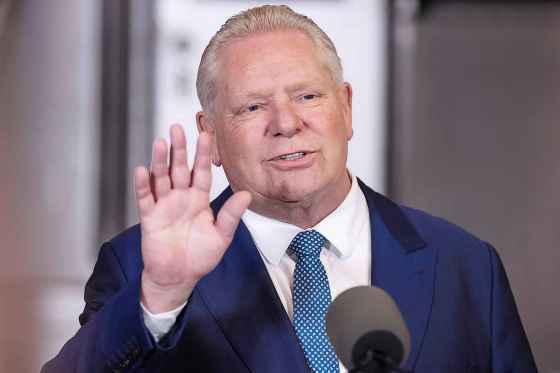
Ontario Premier Doug Ford dismissed the reports of his party paying for a private investigator to spy on then-Ontario Liberal Leader Bonnie Crombie in December 2023 by saying “things happen.” (Chris Young / The Canadian Press files)
Ford said he didn’t “approve” of what his party did, and “wouldn’t do it again.” However, he also said he wasn’t all that concerned about it because in politics, “things happen.”
In an odd and pleasurable twist in the current news cycle, a very similar story erupted in the United Kingdom.
News reports in multiple news organizations detail how political parties and operatives had hired private investigators to dig up dirt on their rivals. The reports focus on Aaron Banks, a wealthy member of the Reform UK party and a key figure in the Brexit campaign.
The reports detail how Banks hired private investigators to dig up dirt on a reporter from the Sunday Times who broke a series of stories about questionable financial dealings by Reform leader Nigel Farage, who has earned significant sums of money from donors and benefactors even as he served in the House of Commons. The questionable income included a £5 million undeclared payment from a Thai crypto billionaire.
After that first story, The Guardian reported that Banks also hired investigators to surveil Kevin Hollinrake, the chair of the UK’s Conservative Party, which is in a desperate fight with Reform for right-of-centre voter support.
Hollinrake had been instrumental in unearthing some of the details of Farange’s morally and ethically questionable income and thus became a prime enemy of Reform.
These two stories, which overlapped over the last week or so, beg a question: how common is it for political parties, operatives or supporters to hire investigators to undermine an opposition politician?
Again, even though there are only anecdotes to rely on – nobody seems to track the number of incidents reported publicly – the consensus seems to be that private investigators are a common reality of modern-day politics.
Parties and other political organizations don’t just hire investigators to unearth information to undermine opponents; increasingly, investigators are called in to vet potential candidates and scan the public domain for anything that could undermine their own campaigns.
Still, looking for something to attack a political opponent seems to be the most common use of outside investigators. That’s what happened in Manitoba when the Progressive Conservative Party hired an investigator to look into now-Premier Wab Kinew’s background when he was still in opposition.
First reported in the Free Press, the PC Party hired an investigator in 2018, a year before an election, to review claims that Kinew had made in his autobiography, The Reason You Walk.
Kinew had some legal problems when he was younger, some of which were detailed in the book and others that were mentioned but were later found to be somewhat incomplete accounts.

Former Manitoba premier Brian Pallister was obsessed with looking into now-Premier Wab Kinew’s background. He was searching for anything that could be used against the NDP leader. (Mikaela MacKenzie / Free Press files)
Party insiders said then-premier Brian Pallister was obsessed with finding inconsistencies in the book. So much so that he used his personal copy of the book as a prop in a pandemic-era committee meeting where he levelled a number of incoherent allegations against Kinew.
Kinew could only smile as Pallister raged on about claims in the book, ultimately offering to sign Pallister’s copy. The former premier was caught on microphone calling Kinew “an asshole.”
Eventually, his senior staff worked through the party to hire an investigator who ultimately did not find anything that could be used against the NDP leader.
This isn’t proof that hiring investigators is pro forma in modern politics, and there isn’t much in the way of social science on this subject. But there are some first-person accounts that make for fascinating reading, including a tell-all account in Politico Magazine by investigator American Michael Corwin, who was hired to dig dirt on hundreds of political campaigns. It’s well worth the read.
Politics has always been a dirty business. Investigators, it seems, ensure that as much of that dirt gets reported as possible.
|