|
There’s an interesting dichotomy developing at the top of Winnipeg’s mayoral campaign.
On one hand, you have challenger Kevin Klein — who has nothing to lose — making campaign promises about what Winnipeggers see as the leading issues facing the city.
On the other, you have the incumbent, Scott Gillingham — who risks losing the Mayoral Chain of Office — who, so far, has campaigned on softer issues.
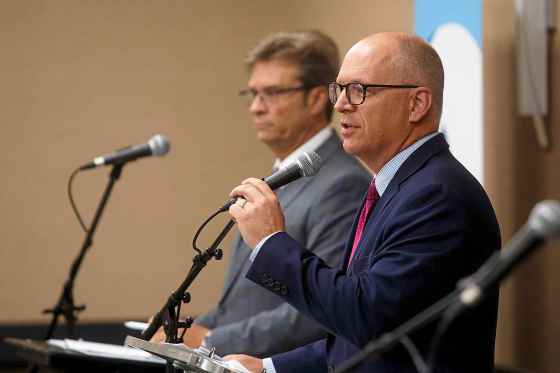
Scott Gillingham (right) and Kevin Klein at a mayoral candidates forum in 2022. (Mike Deal / Free Press files)
One wants to clean up the streets, the other wants to clean up the Seine River.
Klein has proposed addressing the encampment issue by creating what he called a “bridge” to a better life. He proposes a managed system where homeless can have showers, bathroom facilities, garbage management and counselling to help them get off the street. He’s proposed this be run by Marion Willis, head of St. Boniface Street Links, an organization with a decent track record of success.
He’s proposed a joint committee, chaired by former police chief Devon Clunis, to address significant policing issues in the city, including downtown crime, arson and a perception the downtown is an unsafe place to be.
Oddly, Klein appears not to have obtained either Willis’s or Clunis’s permission to attach their names to his promises. What’s next, a downtown rejuvenation committee chaired by Mark Chipman that Chipman doesn’t know is coming?
Klein has proposed a freeze on water and sewer rates. We could debate the wisdom of handcuffing revenues in the midst of the city’s largest-ever water and sewer project, but we can’t deny it is a promise that will resonate with cash-strapped Winnipeggers.
Gillingham has proposed creating a park along the Seine River. He’s promised to speed up approvals for economic development projects, increase staffing at the Winnipeg Police and Winnipeg Fire and Paramedic services, level the playing field for local businesses on city contracts and open the door to more housing and business development in the city.
He has promised a summit on rejuvenating north Main Street. Bizarrely, he’s only promising to do so in the second half of another term as mayor.
These are all worthy goals, and if everything else were good in the city — and without a delay on Main Street — a fine campaign platform.
Problem is, little else is right in the city. Encampments are an embarrassing scourge and an indictment of so many social issues the city and province have allowed to fester.
Graham Avenue is at risk of becoming a ghost town just more than a year after it had been booming. Despite steady growth in downtown residency, rejuvenation seems to remain a distant goal. Winnipeg Transit’s overhaul continues to be a constant source of complaints.
Advertisement

Gillingham’s political strategy behind dodging the serious issues facing the city is a head-scratcher. Is it an attempt to avoid litigating the past four years? Is it an attempt to gild the lily so much people can’t see the rot?
For the mayor, confronting the issues risks shining a spotlight on his track record. On the other hand, it risks letting the challenger be the only one speaking to issues of importance.
None of this should be seen as an endorsement either way, but it all brings to mind a line from The American President about voters’ perception of leadership: people don’t drink the sand because they’re thirsty, they drink the sand because they don’t know the difference.
It is axiomatic in urban development that as the downtown goes, so goes the rest of the city. In that vein, what the city needs is a new ward. Downtown currently comprises small parts of four wards: Point Douglas, Daniel McIntyre, Fort Rouge-East Fort Garry and Mynarski.
An area of this importance can’t possibly have sufficient representation from councillors whose wards stretch as far northwest as Jefferson Avenue and King Edward Street, as far south as Crescent Drive and Pembina Highway and as far north as Kildonan Park. Even Daniel McIntyre stretches from Fort Street to Omand’s Creek.
The city’s charter, governed by the province, mandates 15 wards. Perhaps while Gillingham is asking Premier Wab Kinew to change the city’s charter to allow paid leaves for councillors facing criminal charges, he could ask for a 16th ward, as well.
|