Name this houseplant
Hint: this pouch-shaped flower grows in two-lipped clusters and is good value for your pocketbook. Scroll down for the answer.

Can you guess this houseplant? Keep reading this newsletter for the answer. (Ball Horticultural)
Pumpkin patch prospects

This summer was not kind to pumpkin harvesters. (Arthur Cameron)
Arthur Cameron is a giant-pumpkin grower and a longtime organizer of the annual Roland Pumpkin Fair, which took place Oct. 3.
“I think most giant growers, including myself, would consider this as one of the worst summers in a long time,” he says.
“It was so cold and windy in May and June that it delayed getting the plants into the garden. Even then, you needed to keep them warm at night. The plants did not develop very well until the weather warmed up around midnight.
“Normally, you would like to have pollinated pumpkins by the end of June. My first (pumpkin) was pollinated July 15. There are a few growers who grow in a greenhouse who were able to get pumpkins started earlier. It would have been a difficult start for some of the new growers who haven’t had the experience that some of us have,” says Cameron.
But there is always next year.
Magwyer Herring, owner of River’s Garden Company, grows seasonal cut flowers and specialty pumpkins at her flower farm in Howden. This year, her flower crop flourished but not her pumpkin patch.
She and her husband Gerry hoped to harvest thousands of pumpkins this fall from the seeds they planted in spring. Herring estimates that the wet spring resulted in a loss of about 75 per cent of their pumpkin crop.
“I’d be lucky if we have 100 pumpkins,” she says.

The flower truck will be at the Hollow Market at Pineridge Hollow. (River’s Garden Company’s Magwyer Herring)
But the silver lining is her 1958 turquoise blue Chevrolet Apache pickup truck. Repurposed as a flower truck with an aluminum frame and canopy, Herring and her truck visited farmers’ markets, popped up at parties and other venues, and spread flower joy wherever it travelled this past summer.
“We decided that we are going to fill the flower truck with pumpkins,” says Herring. Its destination will be the Hollow Market at Pineridge Hollow, which runs three Saturdays in October (Oct. 3, 10, and 17).
There’s always the possibility the pumpkins will be sold out on the first Saturday but “depending on how much I sell, I might return to Pineridge Hollow on Oct. 10,” says Herring.
Why not crochet your own pumpkin?

You can crochet your own pumpkin in this beginner-friendly workshop. (Prairie Knitwear Co.)
Join Ally Timlick from Prairie Knitwear Co. for a beginner-friendly crochet class to create your own custom pumpkin. Don’t stop at just one! Just think of the pumpkin possibilities.
The workshop is on Oct. 16 at the Pineridge Hollow Village Studio, 67082 Heatherdale Rd. It starts at 5 p.m.; duration is two and a half hours and the cost is $60. All materials are provided, including a light snack and beverages. Register here.
Decorate with dried hydrangea
Maryanne Bergmann owns The Garden Path Flowers, a flower farm and florist specializing in cut flower bouquets and dried arrangements.
Celebrating its 30th season, The Garden Path Flowers is located at 1859 Lord Selkirk Hwy. in Glenlea.
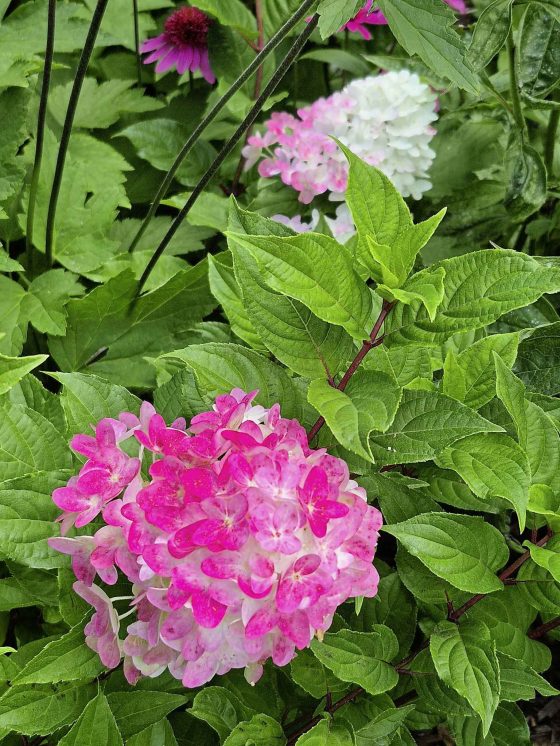
There’s still time to dry your hydrangeas for fall bouquets. (Colleen Zacharias)
I asked Bergmann whether September’s abundant rainfall ruled out the possibility of cutting and drying hydrangea flowers for indoor arrangements — once the blooms are no longer sopping wet, of course!
“Hydrangeas can be picked for drying any time after the petals become papery,” says Bergmann.
“It’s not too late to pick them to dry. I’ve been meaning to do so myself. If they look nice, they can be picked. Typically, people pick them too early rather than too late.
“To dry hydrangeas, I usually just arrange them in a vase right away. It’s easier to arrange them without damaging them when they aren’t quite dry. They can of course be hung upside down, but it’s not as necessary (with hydrangeas) as other flowers. They dry just as well in a vase or basket.”
That sounds so easy! Be sure to strip the leaves first before placing the stems in a vase. Use only a shallow level of water (2.5 to 5 cm is adequate). Allow the water to evaporate naturally over a period of about two to three weeks. Avoid placing the vase in direct sunlight. A cool space that is not close to a heat source is recommended.
Bergmann will have all kinds of fall flowers, wreaths, and dried bouquets at the St. Norbert Farmers’ market on Saturday, Oct. 10 or available for farm pickup anytime by appointment.
A popular item is Pumpkin on a Stick. A unique variety of ornamental eggplant, Pumpkin on a Stick has an uncanny resemblance to miniature, scarlet-orange pumpkins that grow in small clusters on dark, woody stems that have thorns. The small fruits start off green then transition first to orange and then reddish-orange.
A bouquet of Pumpkin on a Stick is long-lasting. Bergmann recommends recutting the stems after purchase. Place the stems in only a small amount of water (2.5 to 5 cm) with 1.8 (0.6 ml) of bleach.
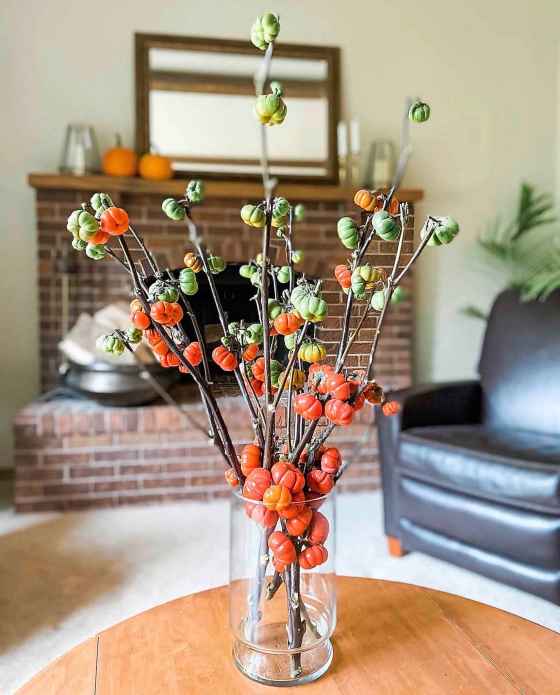
A bouquet of Pumpkin on a Stick. (The Garden Path Flowers)
The stems can be kept in water for a few weeks for a long-lasting display. Even after the tiny, heavily ribbed “pumpkins” start to shrivel, they keep their bright colour throughout fall.
Price of popular plant plummets
In January 2020, Costa Farms took the Tropical Plant International Exposition (TPIE) by storm when it showcased Monstera deliciosa Thai constellation.
It was selected as the favourite new foliage plant at the annual event.
At the time, the variegated houseplant, with its heart-shaped foliage and creamy white marbling, was already known to the houseplant world. With a price tag that ran into the hundreds of dollars, few could afford it.
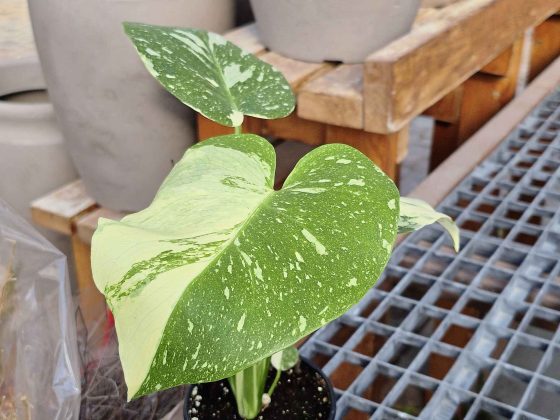
Monstera deliciosa Thai constellation (Colleen Zacharias)
But Costa Farms announced at the 2020 TPIE, a green industry event hosted each January in Florida, that it planned to make the pricey collector plant readily available to the mass market at an affordable price.
In 2022, though, Costa Farms acknowledged difficulties in propagating Thai constellation by tissue culture — particularly in the volumes needed for the houseplant market.
Interestingly, the problem was eventually solved by the broader tissue-culture industry.
Today, Monstera deliciosa Thai constellation, which sold for $300 or more for a single potted specimen as recently as five years ago, can be yours for less than $25.
Spotted last week at Jensen’s Nursery and Garden Centre was a perky slip of Monstera Thai constellation in a four-inch pot for just $19.99! It can tolerate low light but grows best in a bright, indoor location.
The precipitous plunge in price speaks to the marvels of tissue culture production.
Typically, gardeners propagate plants by softwood or hardwood cuttings, dividing, tip or trench layering, root cuttings, and seeds.
What are the basics of tissue culture propagation? Here is an excellent explanation from the University of Manitoba’s plant biotechnology course.
Erosion in the garden
Heavy rainfall has the potential to be so forceful it can dislodge bark chips and soil from garden beds onto pathways and lawns.
Did you observe this happening in your garden this year?
When driving rain fell on Sept. 6, it marked the third time this year that bark chips and soil were pushed out of beds in two locations of my sloped property. In each case, the two areas are at the bottom of a steep slope.
This occurred on my property only one other time — July 17, 2005. I can recall the exact date because south Winnipeg was struck by a severe thunderstorm that dropped up to 90 mm of rain in one hour along with intense wind gusts during the early morning hours. My garden was one of the gardens featured on a garden tour that day.
When the rain finally stopped and I discovered the mess, my family and I madly shovelled sopping wet soil off the lawn back into a large flower bed before visitors arrived.
It changed the way I gardened. By installing terraces, raised stone garden beds, and growing plants more densely, soil is held in place.
But repeated intense rainfall — the type experienced this year by many communities in southern Manitoba in 2026 — can cause garden soil erosion. Bare soil is especially at risk.
Whether a landscape is sloped or flat, driving rain, combined with strong winds and excess water saturated soil cannot absorb, can strip away essential nutrients and damage soil structure.
In addition to planting densely, generously applying organic mulch — straw, shredded leaves, natural bark chips — to the soil surface can also protect soil when heavy rain occurs. Another option is to install a rain garden.

In the example of my garden where I observed surface runoff this year, the two areas in question are on opposite sides of my property at the bottom of the slope where drainage pipes are installed directly underground. Both areas are outside my raised stone walls. The two surfaces are typically covered with a layer of bark mulch.
Since the bark mulch did not do its job when conditions were extreme this year, I plan to experiment with a small berm of rocks in the problem area to slow down the flow of water.
Top petunia picks
Recently I chatted about plants with Shea Doherty, manager of Our Farm Greenhouse, located in Portage la Prairie.
Doherty gave a shout out to two petunia varieties he plans to carry again next spring at Our Farm.
Petunia Inferno the Orange! (the exclamation mark is part of the name) is a 2026 introduction by Westhoff, a flower breeding company based in Germany.
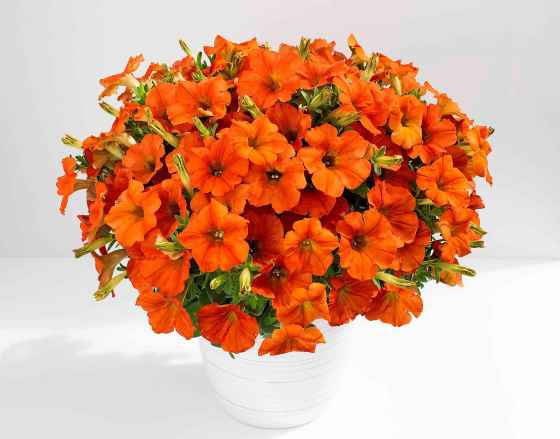
Petunia Inferno the Orange! (PAC Elsner Westhoff)
“The colour is metallic orange. I kid you not, there is nothing like it,” said Doherty.
On a visit this summer to Delta Beach, Doherty was impressed by the impact of a display of Inferno the Orange! Petunias in front of a cabin he saw from a distance.
“We’re talking 800 feet back,” said Doherty.
Late August is not always peak time for petunias, however, excellent drainage promotes longevity.
Another petunia variety that Doherty said has been an excellent season-long performer this year is the Petunia-shake series.
“Shake was a brand-new series for 2025 but availability increased this year so we were able to offer it. My customers have come back with 100 per cent good reports. It has been bred to perform well in garden beds but many of my customers also shared photos of it planted in containers.”
Petunia shake raspberry is especially appealing with raspberry and lemon-lime bloom colour. It is a 2025 All-America Selections Ornamental Winner.
Fall foliage tours
Sheldon Falk, owner of Falk Nurseries in New Bothwell, is hosting fall foliage tours in October.
Tour Falk’s spacious 15-acre home property is located just a short distance from Falk Nurseries. It’s an opportunity to appreciate the fall beauty of an incredible array of unique tree specimens ranging from Kentucky Coffee trees to sugar maples, conifers, fruit trees and much more.

Registration is free for Falk Nurseries’ fall foliage tours. (Sheldon Falk)
To inquire about tour dates, please call 204-388-4927. Registration is free.
A local orchid source
Canadian orchid growers who rely on U.S. customers are facing a prohibitive 50 per cent U.S. tariff on exports of live orchids and fresh-cut orchids.
Orchid growers in Ontario are being hit particularly hard. There is a very real concern that smaller orchid growers, which depend on U.S. customers, could go out of business.
Ever Spring Orchids, 2868 Pipeline Rd., is a Winnipeg-based specialty greenhouse and orchid supplier. Owned and operated by Ariel Lin, Ever Spring Orchids grows a wide range of orchid species.
The greenhouse is open to the public each day except Tuesdays from 9 a.m. to 5 p.m.
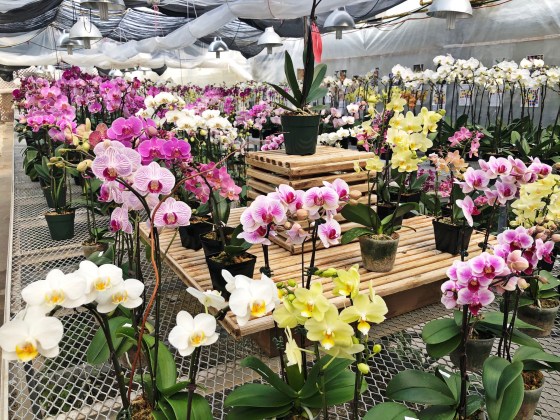
Ever Spring Greenhouse specializes in orchids. (Ariel Lin)
Ever Spring Orchids also supplies some local florists, but it does not ship to the U.S.
“As we move into the fall season, many of our non-Phalaenopsis varieties are entering their blooming period,” says Lin. “This makes it an excellent time to explore different types of orchids and select varieties that can be enjoyed as they begin flowering over the coming months.
“Whether you are interested in Cattleyas, Oncidiums, Dendrobiums, Maxillaria tenuifolia, Rhynchostylis gigantea, or other orchid varieties, this is a great opportunity to add something distinctive to your collection while taking advantage of seasonal savings,” says Lin.
An additional 10 per cent discount is available on all non-Phalaenopsis orchid, including items that have already been reduced in price. This offer is valid until Oct. 31.
Did you know you can freeze honey?
John Russell is a beekeeper who owns The John Russell Honey Company. He is also the vice-president of Red River Apiarists Association.
“The honey crop in Manitoba this year was below average,” say Russell.
This fall, several of his customers have approached him to purchase large quantities of farm-fresh honey in 10 or 15 kg pails.
“Traditionally, a lot of beekeepers that sell to the public will run out of honey before Christmas,” says Russell.
A jar of locally made honey makes a great gift for the holiday season. But many are also eager to support local beekeepers because of the tariffs on Canadian honey.
Russell’s customers who purchase large pails of honey decant it into smaller containers to use as they need it. “The best way to store honey for the long term is to freeze it,” says Russell.
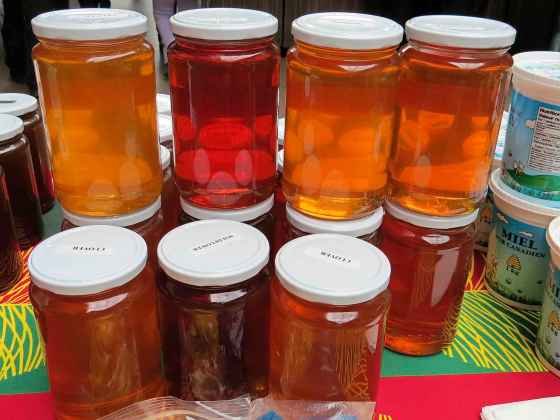
A jar of locally made honey makes a great gift. (C. Polcyn)
“Honey is less than 18 per cent moisture, so it doesn’t expand like water. It won’t blow up your jars! As honey becomes warmer, it becomes less viscous. But as it becomes colder, it becomes more viscous. When you store it at a temperature below zero, it remains slightly malleable. Freezing honey pauses the crystallization process.”
Frozen honey thaws very quickly, says Russell.
Name this plant
Calynopsis red+yellow eye is a brightly coloured plant which is equally at home indoors during the winter or outdoors in the summer where it is suitable for small pots or mixed containers.

Did you correctly identify this plant? The answer is: Calynopsis Red+Yellow Eye (Ball Horticultural)
Commonly known as the pocketbook plant or slipper flower, Calynopsis red+yellow eye boasts brilliant red-orange, pouch-shaped flowers with a yellow eye and freckle-like markings. The flowers bloom profusely in two-lipped clusters in spring.
At first glance, the blossoms bear a slight resemblance to lady’s slipper orchids. Calynopsis, however, does not belong to the orchid family but instead, the Calceolariaceae family.
In fact, Calynopsis is practically an only child. The relatives are so few, that the family tree includes only one other genera — a species known as Jovellana (violet teacup flower).
I bought my Calynopsis plant at Our Farm Greenhouse in Portage la Prairie. Unfortunately, it drowned in a heavy rainfall. But had I taken better care, I could have moved it indoors to a sunny window to spend the winter.
Calynopsis red+yellow eye grows to a height of 25 to 30 cm. Its water needs are small.
Mark your calendars
On Saturday, Oct. 10 at the St. Vital Shopping Centre, 1225 St. Mary’s Rd., the Manitoba Regional Lily Society will host its annual Fall Bulb Sale. Featuring a wide selection of lily varieties including hard-to-find heritage lilies, the sale runs from 10 a.m. to 4 p.m.
|