|
My Mazda3 is in the shop, thanks to the crash I wrote about earlier. Because the crash was the other guy’s fault, I’m entitled to replacement coverage, which in this case is a 2026 Kia Sorento.
It’s an interesting coincidence, since my wife and I are starting to make noise about replacing the other Mazda in the household, a 2018 Mazda CX-5. While the Sorento, a three-row SUV, and the CX-5 aren’t direct competitors, my time in the Sorento will be instructive to the current state of Kia. The Sportage is Kia’s answer to the CX-5.
The current state of Kia is vastly superior to my first taste of the Korean brand, way back in 2003 during a media launch event of the first Sorento to come to Canada. Then, the brand struggled to make interior plastic bits look good, and the transfer case on the Sorento I was driving failed during the ride-and-drive.
Advertisement

Fast-forward to today and this Sorento is light-years ahead. Interior trim is executed to a very high level and the design is striking, though it might be a little derivative of Cadillac’s Art&Science design language. Today’s Kia models rank highly in JD Power’s vehicle dependability studies.
The Sorento is comfortable, competitive with the CX-5 in power and close, if not a direct threat, in handling.
To be honest, however, I don’t think a Kia SUV is my cup of tea. The Sorento’s auto-stop/start system is very aggressive: with my foot on the brake, the vehicle lunged noticeably forward when the engine restarted.
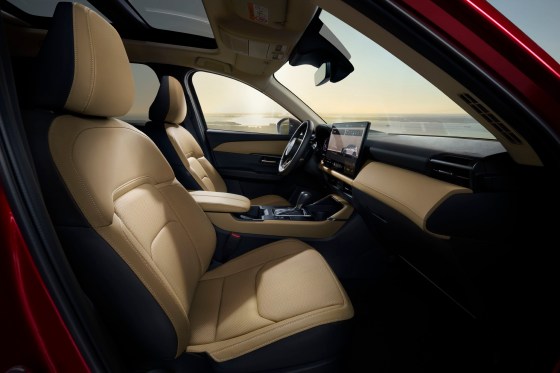
The 2026 Mazda CX-5 is the latest generation of the venerable compact SUV. I’d show you the Sorento, but this one is filthy and Kia Canada’s media site is offline. (Mazda Canada)
Moreover, the sound system’s only volume control is on the steering wheel. Wait, strike that — it’s actually a positive, since the passenger can’t mess with the sound level. (Insert evil chuckle here.) Most of the controls are touch controls, either on the infotainment screen — hello, fingerprints — or on the heating and ventilation control cluster.
The newest CX-5, the 2026 model, may be edging its way off our radar screen, too, for similar reasons. Mazda has abandoned its console-based interface knob and buttons for a touchscreen. It has also adopted something Mazda has fiercely resisted until now: auto-stop/start. I haven’t had a chance to drive it, so I’ll reserve complete judgment for now.
Touch controls, unless accompanied by haptic feedback — such as in Porsche models, where you push on the panel to confirm — can be distracting, since you have to devote more attention from the road than for buttons. If you’re sensing I’m not a fan…
|