Biidaajimowin
Winnipeg Free Press Logo
 

You have a role in stopping this crisis

May 5 was Red Dress Day, also known the National Day of Awareness for Murdered and Missing Indigenous Women, Girls and Two-Spirited Peoples (MMIWG2S) — a moment when all Canadians are invited to help stop the violence, abuse, and genocide experienced by these communities.

For 15 years now, Indigenous communities and Canada have been marching and talking about Canada’s most egregious and unaddressed issue: the high rate of Indigenous women and girls and two-spirit peoples who experience of violence, disappearance, and murder.

It’s significant that Red Dress Day started in — you guessed it — Manitoba.

An exhibit of the REDress Project by Jaime Black in the Canadian Museum of Human Rights. (Submitted)

An exhibit of the REDress Project by Jaime Black in the Canadian Museum of Human Rights. (Submitted)

Inspired by Manitoba Métis artist Jaime Black, the REDress project was an art installation of red dresses hanging in public spaces to serve as a visual reminder of MMIWG2S.

Since 2010, Indigenous advocates, families of survivors, and other Canadians have stood in solidarity with the movement by hanging red dresses, creating artwork, and marching together to honor and remember the missing and murdered.

The movement has since grown, aligning with national efforts such as the Truth and Reconciliation Commission. Notably, Call to Action 41 urges Canadian institutions to address the disproportionate violence faced by Indigenous women and girls, and specifically calls on the federal government to establish a public inquiry into the crisis. This inquiry, conducted between 2016 and 2019, resulted in a final report containing 231 Calls for Justice.

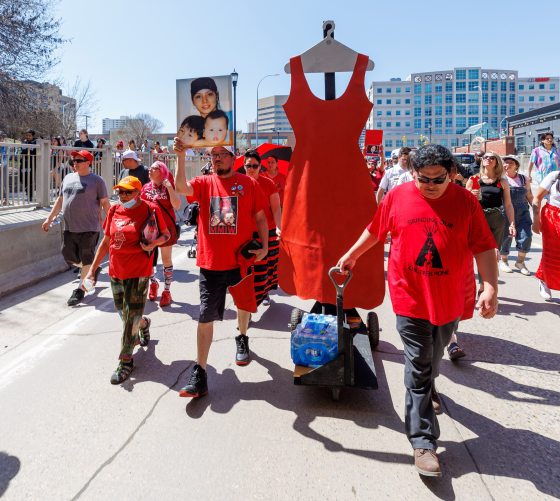
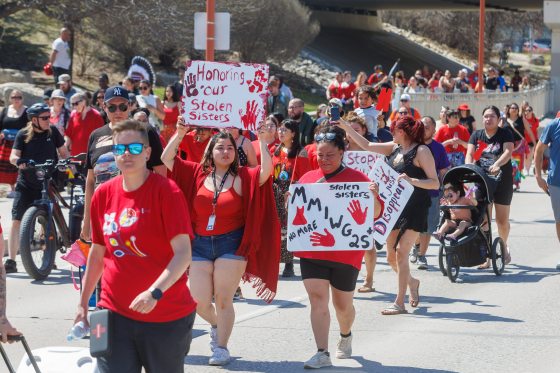
Hundreds of people walked from Memorial Park to The Forks during the annual Red Dress Day memorial walk, Monday morning. (Mike Deal / Free Press files)

Hundreds of people walked from Memorial Park to The Forks during the annual Red Dress Day memorial walk, Monday morning. (Mike Deal / Free Press files)

On Monday, hundreds marched from Memorial Park to The Forks Oodena Circle, and this was the first year the government of Manitoba made funds available through a MMIWG2S+ Healing and Empowerment Endowment Fund to support events and programs.

This year also marked the first Red Dress Day on St. Theresa Point First Nation since Ashlee Shingoose was identified as Mashkode Bizhiki’ikwe, the previously unknown victim of a serial killer in Winnipeg. Plans to search for Shingoose’s remains at the Brady Road Landfill are ongoing.

Meanwhile, other projects are in development in Manitoba and across Canada to address the issue of MMIWG2S, including a “Red Dress Alert” system.

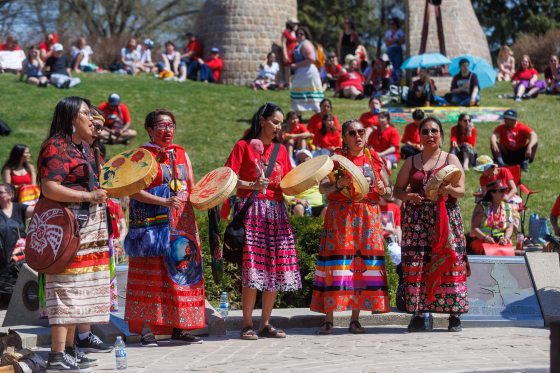
Drumming and singing, dressed in red and carrying signs and banners, people walked to The Forks and made their way to the Oodena Circle in commemoration of Red Dress Day. (Mike Deal / Free Press files)

Drumming and singing, dressed in red and carrying signs and banners, people walked to The Forks and made their way to the Oodena Circle in commemoration of Red Dress Day. (Mike Deal / Free Press files)

To mark this year’s Red Dress Day, the Pauktuutit Inuit Women of Canada, Les Femmes Michif Otipemisiwak (LFMO), the Ontario Native Women’s Association (ONWA) and 2 Spirits in Motion Society (2SiMS) announced a collaborative, Indigenous-led data project focused on researching and making recommendations for institutions.

I’ve written before about the actions people can take on Red Dress Day, including listening, learning and saying the names of relations.

In other words: we all are affected, so we all need to be a part of the solution.

The violence toward missing and murdered Indigenous women, girls and two-spirit people is an epidemic. It’s a human-rights crisis in Canada tied to the systemic racism, colonization, misogyny and homophobia that infiltrates all too many places and institutions in the country.

Everyone has a role in helping stop this crisis. One step is to listen, learn and understand the issue.

Put on a red shirt. Then, join with others to do something about the problem.


Niigaan Sinclair, Columnist


Advertisement


FIVE STORIES ON TURTLE ISLAND

The changing of the seasons means the rise of the impacts of climate change — with the beginning of floods, wildfires and drought impacting particularly northern and remote First Nations, Métis and Inuit communities.

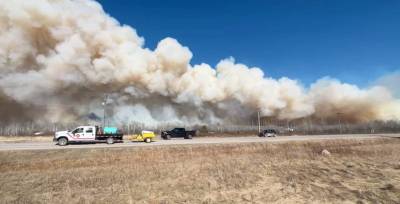
Two communities close to my heart, Peguis First Nation and Opaskwayak Cree Nation, were among the communities that faced wildfires created from the sudden drying and lack of rain.

The Government of Canada released a report last year calling for the “necessity of Indigenous-led climate change adaptation.” Winnipeggers will also be affected, as hundreds of refugees hit by climate-created crises become neighbours, having evacuated to Winnipeg hotels.

International media are taking notice. The Guardian published a piece about extreme weather changes in northern Ontario.


Federal judges are hearing a case this week from more than 100 First Nations in a class-action lawsuit against Canada for failing to fulfil legal treaty obligations and provide adequate housing.

The statement of claim for $5.1 billion in compensation alleges Canada has failed to uphold the honour of the Crown and Canada’s Constitution by using “deliberately underfunded housing on reserves,” while simultaneously isolating First Nations by imposing restrictions on their ability to provide housing for themselves.

The class action was launched in 2023 by St. Theresa Point First Nation in Manitoba and Sandy Lake First Nation in northwestern Ontario, and more than 1oo other First Nations have joined the lawsuit.

“The Crown forced us to move onto reserve land that it deemed economically invaluable, and packed us in like a can of sardines. We were set up to suffer. The housing crisis on reserve is a national shame,” Raymond Flett, chief of St. Theresa Point Ansininew, told APTN.


In the face of wide-scale calls from First Nations to dial back her rhetoric, Alberta Premier Danielle Smith continues to double down on her commitment to reduce the requirements for instigating a referendum on separation from Canadian confederation.

There is sadness and dissatisfaction in Alberta after the election of the federal Liberals to a minority government during last month’s federal election, resulting in rallies promoting Alberta separatism.

I wrote about Smith’s new Bill 54 last week, arguing that sowing the seeds of Alberta discontent is predominantly a political distraction from the many scandals in which the province’s government is currently mired.

Smith has now announced any referendum on Alberta separation will “100 per cent” respect Indigenous treaty rights.


My colleagues over at APTN Investigates exposed a trend happening in Manitoba where government officials are using non-disclosure agreements (NDA) for former employees to mask acts of racism and discrimination.

Former City of Winnipeg employee Dennis Smith, who is Métis, alleged he was harassed numerous times at work — including colleagues sabotaging his work, bullying him, and accusing him of reporting on others — resulting in a conflict with his union, the signing of (what he claims is a coerced) NDA, and a controversial $20,000 compensation deal. APTN has documented other cases as well.

Advocates have long accused forces in the public and private sector of using NDAs to shield violence in workplaces in Canada.


On May 2, U.S. President Donald Trump released his administration’s 2026 budget proposal, which intends to cut $163 billion throughout the federal government, including severe cuts to essential education, business, policing, infrastructure and child-welfare programs in Native American communities.

Specifically, the budget plan calls for a 24 per cent reduction — nearly $911 million — to core tribal programs overseen by the Bureau of Indian Affairs, Bureau of Indian Education, and Department of Housing and Urban Development. The White House claims it is trying to “weed out radical woke grants and programs and streamline other programs for tribal communities that were ineffective.”

Critics and tribal leaders argue the cuts “threaten to undermine the federal government’s treaty and trust obligations to Tribal Nations.

IN PICTURES

Hundreds of Manitobans gathered for Red Dress Day ceremonies this week, including at The Forks in Winnipeg. (Mike Deal / Free Press files)

Hundreds of Manitobans gathered for Red Dress Day ceremonies this week, including at The Forks in Winnipeg. (Mike Deal / Free Press files)

Raven Lacerte and her daughter Cedar, 6, look on as hundreds of people take part in the third Our Women Are Sacred walk of reflection on Songhees-Esquimalt Nation land in Esquimalt, B.C., on Monday, May 5. (Chad Hipolito / The Canadian Press files)

Raven Lacerte and her daughter Cedar, 6, look on as hundreds of people take part in the third Our Women Are Sacred walk of reflection on Songhees-Esquimalt Nation land in Esquimalt, B.C., on Monday, May 5. (Chad Hipolito / The Canadian Press files)

The healing event Our Women Are Sacred took place in Esquimalt, B.C. to raise awareness and honour sacred life givers, members of the 2SLGBTQIIA community and a remembrance for the (MMIW) Missing Murdered Indigenous Women and Girls. (Chad Hipolito / The Canadian Press files)

The healing event Our Women Are Sacred took place in Esquimalt, B.C. to raise awareness and honour sacred life givers, members of the 2SLGBTQIIA community and a remembrance for the (MMIW) Missing Murdered Indigenous Women and Girls. (Chad Hipolito / The Canadian Press files)

RECONCILI-ACTION OF THE WEEK

Every week I highlight an action, moment, or milestone forwarding reconciliation, illustrating how far Canada has come – and how far the country has yet to go.

Hundreds of new Indigenous doctors, lawyers, teachers, nurses, business leaders and other professionals graduated from Manitoba’s universities and colleges this month.

A 36th annual traditional powwow ceremony was held at the University of Manitoba last Saturday afternoon, where nearly 500 First Nations, Métis and Inuit students graduated during the 2024-2025 academic year — one of the largest cohorts in history.

Graduates of the university receive a purple stole for their graduation ceremony, while Métis students receive a traditional sash from the Manitoba Métis Federation.

Meanwhile, the University of Winnipeg and RRC Polytechnic graduated their own cohorts on the same weekend, with the U of W wrapping their graduates in a blanket.


Advertisement


WHAT I'VE BEEN WORKING ON

Niigaan Sinclair:

Alberta premier’s talk of separation a political ploy and a dangerous distraction

Western alienation is real, but extreme views for separatism are a minority. Provincial separation from Canada without First Nations involvement is also unconstitutional, illegal and unprecedented. Read More


Niigaan Sinclair:

Tough choices for Indigenous voters in key Prairie ridings

In order to understand the Indigenous vote in next week’s federal election, two ridings will tell the story. The first is Desnethé—Missinippi—Churchill River in northern Saskatchewan, where First Nati... Read More


LOCAL NEWS

Maggie Macintosh:

Changing school’s name carries risk of erasing colonist’s racist history, MMF warns trustees

The Manitoba Métis Federation made a case Monday against trustees renaming a city school honouring a military leader who has gained infamy in recent years. Read More


Nicole Buffie:

‘Changing that system’: daughter of murder victim sees progress on Red Dress Day

A year ago on Red Dress Day, Cambria Harris pleaded with the Manitoba government to search the landfill for the remains of her murdered mother. “One year later, I can officially say that we were right... Read More


Nicole Buffie:

‘Trying to engage as wide as we can’

Red Dress Alert pilot project underway in province, could be online as early as this fall Read More


Carol Sanders:

‘We are setting a new tone’

New PC Leader Khan apologizes for not searching landfill, vows better decorum in legislature Read More


Brett Nicholls:

Healing northern nursing stations

Residents deal with gloom of staffing shortages, burnout, inadequate facilities but signs of progress glimmer in distance Read More


Kevin Rollason:

Hundreds of Peguis First Nation residents bused to Winnipeg after wildfire evacuation

Hundreds of Peguis First Nation residents were forced to flee in the dead of night due to wildfires breaking out in and around the community on the weekend. Read More


Scott Billeck:

Winnipeggers overcome with playoff frenzy

Jets fans soar with ‘rally’ barf bags aboard flight; First Nations-run business printing Whiteout towels 14 hours a day Read More


Brittany Hobson, The Canadian Press:

Hudson’s Bay Company records give public chance to ‘reconnect’ with ancestors

WINNIPEG – Dyana Lavallee stares at a copy of a photograph on display to the public at the Hudson’s Bay Company Archives in Winnipeg.  The Metis woman quickly recognizes it as the same one... Read More


OPINION

Rebecca Chambers:

Face to face in our often contentious historical space

I am Métis, and I am also a Winnipegger. I feel at home claiming membership in both communities, and maybe it doesn’t matter, in the moment, who “we” is when I write it on the page. “We” is just whoever’s in the elevator at that moment. Read More


Olivia Finlayson:

Harm reduction, not handcuffs

Every day in Winnipeg, Black and Indigenous people are disproportionately arrested for drug-related offences, not because they use drugs more often, but because they are more often policed. Read More


ARTS & LIFE

Conrad Sweatman:

Victorious milestone

Artist Kent Monkman‘s Prairie influences featured in first major American exhibit Read More


Alex Nino Gheciu, The Canadian Press:

CBC, APTN quietly cancel planned comedy about Indigenous rap duo Snotty Nose Rez Kids

Indigenous hip-hop duo the Snotty Nose Rez Kids say they don't know why CBC and APTN have quietly cancelled plans for a comedy series about their rise to fame. Read More


Martin Zeilig:

Documentary The Spoils paints gripping picture of stolen history

Director turns investigative lens on resistance to restitution of Nazi-looted art Read More


FROM FURTHER AFIELD

Susan Montoya Bryan And Michael Warren, The Associated Press: Indigenous people raise awareness about their missing and murdered
 

Share:


Download our News Break app